
Last letters from the living dead man
David Patterson (Spirit) Hatch
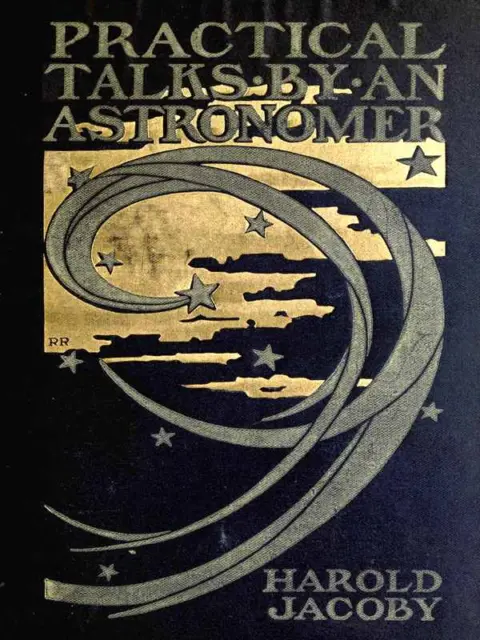
THE CLASSIC COLLECTION · 1902
"Practical Talks by an Astronomer" by Harold Jacoby is a collection of engaging essays on astronomy written in the late 19th century. The work does not aim to serve as a comprehensive text on the subject; rather, it selectively explores intriguing topics within astronomy, using accessible language designed for a general audience. The book potentially appeals to readers who possess a casual interest in celestial phenomena without delving into overly technical detail. The opening of the work introduces the concept of using astronomy for navigation at sea, recounting historical methods and instruments used by maritime captains in times prior to modern navigation tools. Jacoby shares anecdotes from an old sea captain regarding how ships relied solely on a compass and observational techniques, like utilizing a sextant to measure the sun's position at noon, to determine their latitude, demonstrating the blend of history and science that characterizes the book. This approach highlights the practical significance of astronomical knowledge while piquing curiosity about the interconnections between science and navigation.
Introduction adapted from the source catalogue; source summaries may be automatically generated.
Free to read · English · 42,260 words · No account needed
MAKE TIME FOR A GOOD BOOK
On by default. Untick to stop anonymous reading totals. Each page counts after 10 seconds in view. How this works.
Anonymous counting is on unless you have switched it off.
Herschel fixed the position of the apex at a point in the constellation Hercules. The most recent investigations of Newcomb and others have, on the whole, verified Herschel's conclusions. With the intuitive power of rare genius, Herschel had been able to sift truth out of error. The observational data at his disposal would now be called rude, but they disclosed to the scrutiny of his acute understanding the germ of truth that was in them. Later investigators have increased the precision of our knowledge, until we can now say that the present direction of the solar motion is known within very narrow limits. A tiny circle might be drawn on the sky, to which an astronomer might point his hand and say: "Yonder little circle contains the goal toward which the sun and planets are hastening to-day." Even the speed of this motion has been subjected to measurement, and found to be about ten miles per second.
The objective point and the rate of motion thus stated, exact science holds her peace. Here genuine knowledge stops; and we can proceed further only by the aid of that imagination which men of science need to curb at every moment. But let no one think that the sun will ever reach the so-called apex. To do so would mean cosmic motion upon a straight line, while every consideration of celestial mechanics points to motion upon a curve. When shall we turn sufficiently upon that curve to detect its bending? 'Tis a problem we must leave as a rich heritage to later generations that are to follow us. The visionary theorist's notion of a great central sun, controlling our own sun's way in space, must be dismissed as far too daring. But for such a central sun we may substitute a central centre of gravity belonging to a great system of which our sun is but an insignificant member. Then we reach a conception that has lost nothing in the grandeur of its simplicity, and is yet in accord with the probabilities of sober mechanical science. We cease to be a lonely world, and stretch out the bonds of a common relationship to yonder stars within the firmament.
Airy, Astronomer Royal, 1
Allis, photographs comet, 101
Andromeda nebula, 28
temporary star, 28, 29, 45
Apex, of solar motion, explained, 221
Aquila, constellation, temporary star in, 40
Arctic regions, position of pole in, 194
Argo, constellation, variable star in, 205
Association, international geodetic, 139
Asteroids, first discovery by Piazzi, 59, 106
discovery by photography, 64
group of, 63
photography of, invented by Wolf, 104
Astronomer, royal, 1
working, description of, 152
Astronomy, journalistic, 176
practical uses of, 112
Atmospheric refraction, explained, 193
Axis, of figure of the earth, 136
of rotation of the earth, 136
polar, of telescope, 173
Your reading position is saved on this browser. Take it to another device with a library code. Reading pages adapt to text, rather than matching a printed edition.
BEHIND THE BOOK
This eBook is for the use of anyone anywhere in the United States and most other parts of the world at no cost and with almost no restrictions whatsoever. You may copy it, give it away or re-use it under the terms of the Project Gutenberg License included with this eBook or online at www.gutenberg.org. If you are not located in the United States, you will have to check the laws of the country where you are located before using this eBook. Read the source licence.
The original source file, including credits and licence, is retained by this library. Request an original-format copy at no charge. Please include the book title and Project Gutenberg identifier #53396.
KEEP YOUR CURIOSITY GOING
David Patterson (Spirit) Hatch

David Patterson (Spirit) Hatch

David Patterson (Spirit) Hatch

Ralph Waldo Emerson

Maurice Baring

Oscar Wilde & James McNeill Whistler