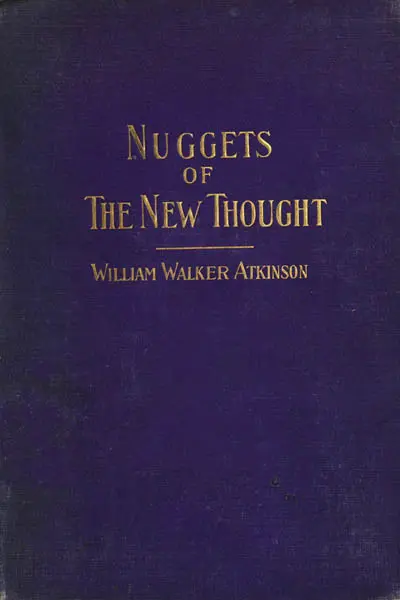
Nuggets of the New Thought: Several Things That Have Helped People
William Walker Atkinson
THE CLASSIC COLLECTION · 1907
"Practical Mind-Reading" by William Walker Atkinson is a guidebook on mental phenomena, particularly focusing on the concepts of thought transference, telepathy, and mind reading, written in the early 20th century. The work aims to educate readers about the principles of these phenomena, providing practical exercises and lessons to develop the skills necessary for self-demonstration. The overarching theme is the exploration of the mind's capabilities to connect and communicate, suggesting that such skills can be mastered by anyone through proper training and practice. The opening of this instructional text sets the stage for exploring the concept of mind reading, beginning with a historical perspective on public understanding and skepticism regarding the subject. Atkinson cites prominent scientists who have validated the existence of thought transference, describing its relevance in contemporary scientific discourse. The text emphasizes moving away from theoretical discussions toward practical lessons, indicating that readers will soon engage in exercises designed to facilitate their understanding and experience of mind reading. It establishes a tone of authority and encouragement, promising that with determination and guided practice, anyone can learn to harness the latent capabilities of their mind.
Introduction adapted from the source catalogue; source summaries may be automatically generated.
Free to read · English · 20,255 words · No account needed
MAKE TIME FOR A GOOD BOOK
On by default. Untick to stop anonymous reading totals. Each page counts after 10 seconds in view. How this works.
Anonymous counting is on unless you have switched it off.
DEMONSTRATION III. Similar to the above is the feat known as the "Game of cards." Two players sit opposite each other at a table, having dealt themselves two hands of euchre. Have the Transmitter lead you behind the first player, and standing there have the player silently point out the card he wishes to lead, to the Transmitter. The Transmitter then should concentrate his mind on the card, and you will find it in the usual manner, and having found it will play it on the table. Then leading you around to the other player, the Transmitter repeats the process, and you find and play the card. Then back to the first play, and repeat. Then alternate between the players, in the same manner, until you have played out the game. This may be improved upon by the Transmitter thinking of which player has won the trick, when you will push the cards over to the winner, having discovered the direction in the usual manner. This feat is very effective indeed when properly performed.
DEMONSTRATION IV. Have a map laid open on the table, and have the audience decide upon a trip between two points, either by rail or by water. Then returning to the room, stand as above described, and with your forefinger find the place from which the trip starts. Then move slowly along the selected course in the same manner in which the checker-game was played, passing along the chosen route until the end is reached. These feats are all really variations of the one principle.
DEMONSTRATION V. This is a very effective feat, and requires some little skill and practice, but there is no reason why any careful, patient, and persistent student should not be able to master it. It consists in the audience selecting any given card from the pack, and then replacing it with the others, being sure that the Transmitter is familiar with the card chosen, and knows enough about cards to recognize it when he sees it again. Then the pack of cards should be placed on the table, face up. Returning to the room, you take the Transmitter's hand as usual, and with your right hand pick off the cards from the pack, slowly and one by one. As you pick up each card, slowly weigh it in your hand, so to speak, and then place it aside if you receive no "stop" orders from the mind of the Transmitter. Having previously practiced this feat in private you will have learned that peculiar "heavier" sensation that comes to you when you lift the right card from the pack, so that when you finally reach it you will know it. We cannot describe just what this sensation will feel like--you must learn it by actually experiencing it in private practice. We advise you to diligently practice this feat in private, for it is wonderfully effective. You will find that after a bit of practice you will be able to get the "heavy" feeling when you lift up and "weigh" the right card. You should perform this feat slowly, and carefully, shaking your head, "No," just before you discard a card. If by the lack of concentration of the Transmitter, you fail to feel the "heavy" feeling when you pick up the right card, the shake of the head will be apt to arouse him to exert his Will more actively, and you will receive the "hold on" impulse immediately. Do not be in too much of a hurry to discard, but make several feints at it before finally letting go. This feat may be improved by having the audience select a "poker-hand," such as a "flush," a "straight," "three-of-a-kind"; a "full-house," etc., etc., and having you find the hand one card at a time. This latter is a fine effect, and always brings down the house. But be sure that your Transmitter really knows and remembers the cards, else the feat will fail, of course. He must remember each card, and recognize it when it appears face up on the pack before you, as you proceed with the discarding. Never attempt this feat in public without previous careful, private, practice, for it requires the most delicate perception and skill. If you find that you cannot master it to your satisfaction, after sufficient practice, you may try it by the "Simpler Method" given at the conclusion of this Lesson.
Your reading position is saved on this browser. Take it to another device with a library code. Reading pages adapt to text, rather than matching a printed edition.
William Walker Atkinson
William Walker Atkinson
William Walker Atkinson
William Walker Atkinson
BEHIND THE BOOK
This eBook is for the use of anyone anywhere in the United States and most other parts of the world at no cost and with almost no restrictions whatsoever. You may copy it, give it away or re-use it under the terms of the Project Gutenberg License included with this eBook or online at www.gutenberg.org. If you are not located in the United States, you will have to check the laws of the country where you are located before using this eBook. Read the source licence.
The original source file, including credits and licence, is retained by this library. Request an original-format copy at no charge. Please include the book title and Project Gutenberg identifier #41358.
KEEP YOUR CURIOSITY GOING

Charles G. (Charles Griffith) Ross
Hannah Webster Foster

Emily Lawless
Edwin Hamlin Carr

Charles De Lano Hine
Andrew Ure