Climate, considered especially in relation to man
Robert DeCourcy Ward
THE CLASSIC COLLECTION · 1899
"Practical Exercises in Elementary Meteorology" by Robert DeCourcy Ward is a scientific publication written in the late 19th century. The work serves as a laboratory manual aimed at guiding students through observational and practical studies in meteorology, intending to bridge the gap between theoretical knowledge and real-world application. At the start of the manual, the author emphasizes the significance of meteorology in understanding daily weather changes and its impact on human activities, such as farming and transportation. The opening portion also outlines the structure and purpose of the exercises to be conducted, focusing on non-instrumental observations like temperature, wind direction, sky conditions, and precipitation, leading into a systematic approach for recording meteorological data. The objective is to prepare students for more advanced studies by establishing a foundational comprehension of atmospheric phenomena and their correlations with daily life.
Introduction adapted from the source catalogue; source summaries may be automatically generated.
Free to read · English · 52,516 words · No account needed
MAKE TIME FOR A GOOD BOOK
On by default. Untick to stop anonymous reading totals. Each page counts after 10 seconds in view. How this works.
Anonymous counting is on unless you have switched it off.
Sling Psychrometer, consisting of two cylindrical bulb thermometers, mounted one a little above the other upon a light brass frame, with a perforated guard to protect the bulbs while swinging, but which can be raised (by sliding upon the frame) for the purpose of moistening the linen covering of the wet bulb. Much less liable to be broken than the Weather Bureau pattern, $5.00.
Rain Gauge (United States Weather Bureau standard), 8 inches in diameter, complete, with measuring stick, $5.25.
Rain Gauge, 3 inches in diameter, with overflow and measuring stick,
$1.25.
Wind Vane (United States Weather Bureau pattern), $10.00.
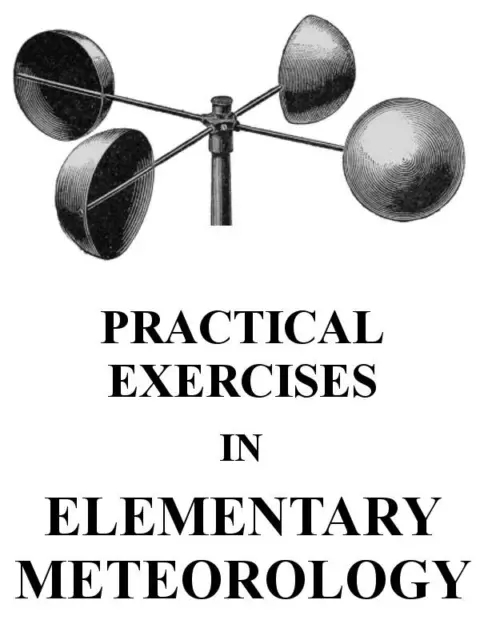
Anemometer (United States Weather Bureau pattern), with indicator, aluminum cups, and electrical attachment, $25.00.
The same, with painted brass cups, $23.00.
Anemometer Register (United States Weather Bureau pattern), with pen and ink attachment, $35.00.
The same, with pencil attachment (old style), $24.00.
Aneroid Barometer (for meteorological work), $14.00-$16.00.
NOTE.——Much cheaper aneroids can be purchased, and may be used to some advantage in the simpler observations in schools.
Mercurial Barometer (Standard United States Weather Bureau pattern), complete with attached thermometer, vernier, etc., $30.00-$33.00.
NOTE.——The above instruments, as used by the United States Weather Bureau, are made by H. J. Green, 1191 Bedford Avenue, Brooklyn, N. Y. The prices are those given in Green’s latest catalogue.
Mercurial Barometer. New improved form, especially designed for school use. Mounted on mahogany back. Scale engraved on aluminum. Divisions of scale on metric and English systems. No vernier, $5.75.
(L. E. Knott Apparatus Co., 14 Ashburton Place, Boston, Mass.)
Thermograph (designed by Dr. Daniel Draper, of New York). Consists of a bimetallic thermometer in a case which carries a disk, with a chart upon its axle instead of hands like the ordinary clock. A pen (resting on the face of the disk) registers the fluctuations of temperature as the chart is carried around. Sizes, 14 × 20 inches, $30.00; 10 × 14 inches, $15.00. This instrument may be purchased of H. J. Green.
Thermograph. Self-recording thermometer (as adopted by the United States Weather Bureau), made by Richard Frères, of Paris. Records continuously on a sheet of paper wound around a revolving drum, which is driven by clock-work inside. Standard size (without duty), $30.00.
Barograph. Self-recording barometer (as adopted by the United States Weather Bureau), made by Richard Frères, of Paris. Similar in general arrangement to the thermograph. Standard size (without duty), $27.60.
These last two instruments can be procured through Glaenzer Frères & Rheinboldt, 26 & 28 Washington Place, New York City.
Instrument Shelter (standard United States Weather Bureau pattern) will hold a set of maximum and minimum thermometers, psychrometer, and a thermograph. May be set up on top of posts driven into the ground, or may be attached to a wall, $18.00.
Your reading position is saved on this browser. Take it to another device with a library code. Reading pages adapt to text, rather than matching a printed edition.
Robert DeCourcy Ward
BEHIND THE BOOK
This eBook is for the use of anyone anywhere in the United States and most other parts of the world at no cost and with almost no restrictions whatsoever. You may copy it, give it away or re-use it under the terms of the Project Gutenberg License included with this eBook or online at www.gutenberg.org. If you are not located in the United States, you will have to check the laws of the country where you are located before using this eBook. Read the source licence.
The original source file, including credits and licence, is retained by this library. Request an original-format copy at no charge. Please include the book title and Project Gutenberg identifier #41351.
KEEP YOUR CURIOSITY GOING

John Muir

Asa Gray
Asa Gray

Florence Nightingale
Elizabeth Robins Pennell
Denison Olmsted