Object: matrimony
Montague Glass
THE CLASSIC COLLECTION · 1909
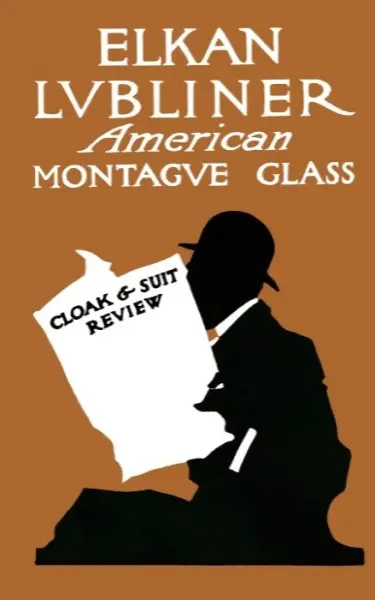
"Potash & Perlmutter: Their Copartnership Ventures and Adventures" by Montague Glass is a comedic novel written in the early 20th century. The story centers around the titular characters, Abe Potash and Morris Perlmutter, who embark on various business ventures in the cloak and suit trade. Through their humorous discussions and interactions with clients and competitors, the novel explores themes of partnership, business ethics, and the trials of immigrant life in America. The opening of the book introduces Abe Potash, who is in a distressed mood after dissolving his partnership with Pincus Vesell. As he converses with his business broker, Philip Noblestone, he ruminates on the challenges of partnership and his aversion to the cloak and suit business. Through a series of conversations with Noblestone, they discuss potential new partnership opportunities, leading to the eventual meeting with Morris Perlmutter, who has struggled in his own business ventures. The humorous banter and character dynamics set the stage for their future copartnership, highlighting the quirks and struggles faced in their industry amidst the backdrop of the bustling New York City.
Introduction adapted from the source catalogue; source summaries may be automatically generated.
Free to read · English · 94,447 words · No account needed
MAKE TIME FOR A GOOD BOOK
On by default. Untick to stop anonymous reading totals. Each page counts after 10 seconds in view. How this works.
Anonymous counting is on unless you have switched it off.
"With a feller like that, Mawruss," Abe said, "you shouldn't bother yourself at all. If you make a lowlife bum a couple blue eyes, he will make you also a couple blue eyes, maybe, and that's all there is to it, Mawruss. But when you make it a crook like Ferdy Rothschild a couple blue eyes, then that's something else again. Such a schwindler like him, Mawruss, would turn right around and sue you in the courts yet for damages, and the first thing you know you are stuck for a couple thousand dollars."
"Well, I am through with him, anyhow," Morris replied, "so we wouldn't talk no more about him. A dirty dawg like him, Abe, ain't worth a--a----" He was searching his mind for a sufficiently trivial standard of comparison when Abe interrupted him.
"I thought you wasn't going to talk about him, Mawruss," he said; "and, anyhow, Mawruss, what's the use talking about things what is past already? What we got to do now, Mawruss, is to sell that house."
"I know it, Abe," Morris replied ruefully, "but how are we going to sell that house with B. Rashkin going around offering to sell the identical same house for forty-four five? If I would be lucky enough to get forty-five seven-fifty for mine, Abe, I would still be out several hundred dollars."
"You talk foolish, Mawruss; you would get forty-seven thousand, sure,
for that house."
"Would I?" Morris cried. "How would I do that?"
"Leave that to me," Abe replied.
He put on his hat and coat.
"Where are you going, Abe?" Morris asked.
Abe waggled his head solemnly.
"You shouldn't ask me, Mawruss," he said. "I got an idee."
It was a quarter to twelve when Abe left the loft building on Nineteenth Street, and he repaired immediately to the real-estate salesroom on Vesey Street, where auction sales of real estate are held at noon daily. To this center of real-estate activity comes every real-estate broker of the East Side, together with his brothers from Harlem and the Bronx, and Abe felt reasonably sure that B. Rashkin would be on hand.
Indeed, he had hardly entered the salesroom when he descried B. Rashkin standing on the outskirts of a little throng that surrounded the rostrum of a popular auctioneer.
"Now, gentlemen," said the auctioneer, "what am I offered for this six-story, four-family house. Remember, gentlemen, it is practically new and stands on a lot forty by a hundred."
"Forty thousand," said a voice at Abe's elbow.
"Come, gentlemen," the auctioneer cried, "we ain't making you a present of this house, exactly. Do I hear forty-one? Thank you, sir. At forty-one--at forty-one--at----"
Your reading position is saved on this browser. Take it to another device with a library code. Reading pages adapt to text, rather than matching a printed edition.
Montague Glass
Montague Glass
Montague Glass
Montague Glass
BEHIND THE BOOK
This eBook is for the use of anyone anywhere in the United States and most other parts of the world at no cost and with almost no restrictions whatsoever. You may copy it, give it away or re-use it under the terms of the Project Gutenberg License included with this eBook or online at www.gutenberg.org. If you are not located in the United States, you will have to check the laws of the country where you are located before using this eBook. Read the source licence.
The original source file, including credits and licence, is retained by this library. Request an original-format copy at no charge. Please include the book title and Project Gutenberg identifier #18164.
KEEP YOUR CURIOSITY GOING
Coulson Kernahan

Maurice Baring
Frances Wright
Cécile Tormay

Frederic Jesup Stimson

W. H. P. (William Henry Pope) Jarvis