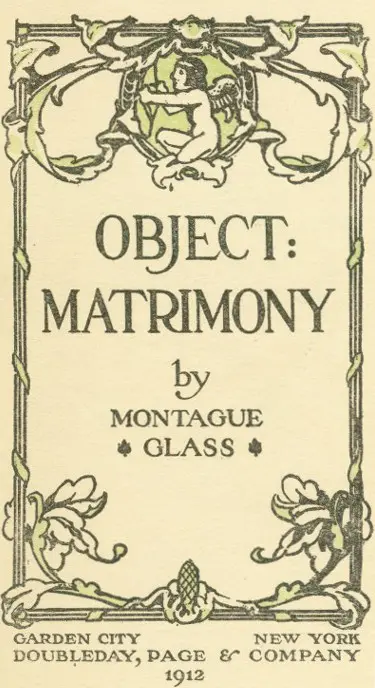
Object: matrimony
Montague Glass
THE CLASSIC COLLECTION · 1919
"Potash and Perlmutter Settle Things" by Montague Glass is a comedic novel written in the late 19th century. The story follows two Jewish garment merchants, Morris Perlmutter and Abe Potash, as they navigate the complexities of business and life in the aftermath of World War I, especially during the Paris Peace Conference. Through their witty banter and misunderstandings, the characters engage in humorous discussions on politics, society, and their ambitions, showcasing a mix of comedy and cultural commentary. The opening portion introduces us to Morris and Abe, who express their frustration over a business strike and their desire to travel to Paris for fashion designs, which leads to hilarious debates about worries, politics, and their competitive nature against rival Leon Sammet. As their plan to obtain passports unfolds, readers get a glimpse into their character dynamics and their humorous take on contemporary events like the arrival of President Wilson in Paris. The dialogue captures the some cultural nuances and provides relatable humor through their exchanges, effectively setting the tone for the rest of the novel.
Introduction adapted from the source catalogue; source summaries may be automatically generated.
Free to read · English · 62,215 words · No account needed
MAKE TIME FOR A GOOD BOOK
On by default. Untick to stop anonymous reading totals. Each page counts after 10 seconds in view. How this works.
Anonymous counting is on unless you have switched it off.
"You're sure he didn't say the Knights of Pythias or the I. O. O. F., because, while I don't belong to the Masons myself, Abe, Rosie's sister's husband's brother by the name Harris November has been a thirty-sixth degree Mason for years already," Morris declared, "and I'll swear that if a gabby feller like him would have known that the Masons had anything to do with bringing on the war, Abe, he would of spilled it already long since ago."
"Well, of course, I don't know nothing about what Harris November said or what he didn't say, Mawruss, but that's what the Kaiser said," Abe continued, "and he also had a good deal to say about Queen Victorine of England what a wonderful woman she was, olav hasholom, and how she told him many times he should look out for that low-life of a son of hers by the name Edwin."
"But I always thought this here Edwin was such a decent, respectable feller," Morris interrupted.
"That's what everybody else thought," Abe went on, "but the Kaiser says that many times the old lady says to him he shouldn't have nothing to do with Edwin. 'Believe me,' she said, according to the Kaiser, 'he wouldn't do you no good intellectually, morally, or socially,' and so for that reason the Kaiser wouldn't join the Entente with England, France, and Russia."
"Because this here Edwin was at the bottom of it?" Morris inquired.
"That's what the Kaiser said," Abe replied.
"Maybe he also caught the poor Czar selig eating with his knife or something," Morris suggested.
"That he didn't say, neither," Abe answered, "but he might just so well have said it, for all it would go down with me, Mawruss, because we all know how kings sow their rolled oats, Mawruss, and any king which wouldn't associate with any other king on the grounds of running around the streets till all hours of the night or gambling, y'understand, if that ain't a case of a pot calling a kettle, I don't know what is."
"And I suppose he topped off them lies by getting religious, ain't it?"
Morris remarked.
"Naturally," Abe said. "And in particular he got very sore at the Freemasons on account of them being atheists."
"That's the first time I hear that about the Freemasons," Morris
observed. "I think, myself, that he was getting them mixed up with the
Elks."
"The Elks ain't atheists," Abe said.
"I know they ain't, but at the same time they ain't religious fanatics exactly," Morris said, "which to a particular feller like the Kaiser would be quite enough, Abe."
Your reading position is saved on this browser. Take it to another device with a library code. Reading pages adapt to text, rather than matching a printed edition.
Montague Glass
Montague Glass
Montague Glass

Montague Glass
BEHIND THE BOOK
This eBook is for the use of anyone anywhere in the United States and most other parts of the world at no cost and with almost no restrictions whatsoever. You may copy it, give it away or re-use it under the terms of the Project Gutenberg License included with this eBook or online at www.gutenberg.org. If you are not located in the United States, you will have to check the laws of the country where you are located before using this eBook. Read the source licence.
The original source file, including credits and licence, is retained by this library. Request an original-format copy at no charge. Please include the book title and Project Gutenberg identifier #19948.
KEEP YOUR CURIOSITY GOING
Coulson Kernahan

Maurice Baring
Frances Wright
Cécile Tormay

Frederic Jesup Stimson

W. H. P. (William Henry Pope) Jarvis