THE CLASSIC COLLECTION✦An outlaw’s diary: the CommuneCLASSIC FREE BOOKS
An outlaw’s diary: the Commune
Cécile Tormay
THE CLASSIC COLLECTION · 1921
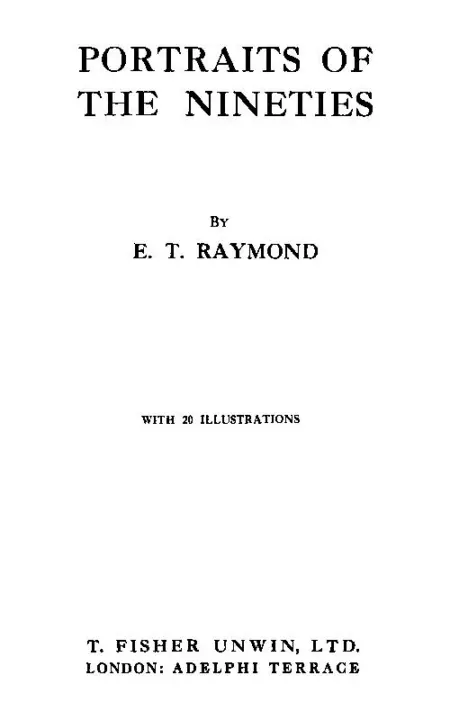
"Portraits of the Nineties" by E. T. Raymond is a biographical account written in the early 20th century that examines key figures and events from the 1890s towards the close of the Victorian era. The author sets out to explore the societal changes and prominent personalities of the decade, providing insight into their impacts on contemporary culture and politics. At the start of the narrative, the author reflects on the significance of the 1890s, contemplating the mixture of stability and transition characterizing the era. Raymond introduces the idea that the decade, often considered a "golden age," was marked by cultural vibrancy, political intrigue, and a naive optimism about the future. He alludes to the decay of the established social order and hints at the rising influence of new wealth and ideas. Thus, the opening chapters build a framework for analyzing notable figures of the time, such as Lord Rosebery and Cecil Rhodes, setting the stage for a deeper exploration of how these individuals shaped the public discourse of the 1890s.
Introduction adapted from the source catalogue; source summaries may be automatically generated.
Free to read · English · 96,367 words · No account needed
MAKE TIME FOR A GOOD BOOK
On by default. Untick to stop anonymous reading totals. Each page counts after 10 seconds in view. How this works.
Anonymous counting is on unless you have switched it off.
“You have a Chancellor in your family, and a Lord Lieutenant of Ireland,” said John Morley to him, in the year 1894, “and you’d like to have a Prime Minister in your family, and no earthly blame to you.” True, it was no great thing to be Liberal Prime Minister just then. The estate was terribly encumbered, and the brokers’ men were already at the door. That Sir William knew as well as any. But still, if one must be a “transient and embarrassed phantom,” it was just a little better to be a phantom in a shooting jacket than a phantom in livery. To don the Primrose livery, especially, was gall to the proud Plantagenet. He was of very ancient English and French family, while Lord Rosebery sprang (many years ago, it is true) from a mere Presbyterian minister; he had been in Liberal politics when Lord Rosebery was in the nursery; he had loyally supported Mr. Gladstone through thick and thin; he had never spared himself in the House of Commons or on the platform; he was conscious of qualifications with which the Scottish nobleman, with all his graces, could not vie; and he had every reason to calculate on the support of the Radical wing of the party, which he had served faithfully, if not always with conviction. Small wonder that Sir William Harcourt was bitter when with one accord the men in the inner councils of Liberalism, the new men as well as the old, the Asquiths and Aclands, as well as the Morleys and Spencers, turned against him, and towards Lord Rosebery.
We know now that the choice, if the best possible, was still unfortunate. But in politics the things which seem most obviously unreasonable are precisely the things which are done for the most serious reasons, and there were grave reasons indeed against a Harcourt Premiership. Sir William was endowed with a temperament which sometimes made it hard for men to work with him, and might well have made it impossible for men to work under him. He was at once too difficult and too easy. He had a fatal knack of rousing antagonism, and lacked the force or inclination to crush antagonism when it arose. He sometimes used language of the kind that stirs up rebellion in men of the most temperate blood, and, while sensitive himself, took little thought of the feeling of others. But, though he thoughtlessly made enemies, he was far too kindly and warmhearted a man to convert them into victims. Thus he had to meet a most perilous combination—strong hostility and no serious fear. It would have been well with him if he could have invoked the argument of terror; it would have been better if he could have led men in silken bonds. But he could not dominate, and he could not manage. The lack of tact and the lack of resolution were both well illustrated over the matter of the Rosebery Premiership. Sir William Harcourt stood out just enough to make the position for Lord Rosebery difficult, and gave way just enough to make his own position impossible. Then he fumed in private over the arrangements in which he had publicly concurred, and, apart from his manful work in his own department, played the part of a sulking Achilles. There were, of course, many excuses. He was getting old. He had no great enthusiasm for Home Rule, or, indeed, for anything. He was, like the rest of the Liberal leaders, bitterly disappointed by the size of the majority of 1892, and incensed by the futility of the task it had in hand; “he missed,” says Lord Morley, “old stable companions, and did not take to all the new”; and altogether he might well be oppressed by a sense of anachronism. For he was a politician of the old school, and the Nineties were perpetually reminding him that the old school was going, and almost gone. More an eighteenth-century man than even a nineteenth, with a taste for elegant scholarship and rotund phrase, he could not feel entirely at home in a House of Commons which included Mr. Keir Hardie, and jibbed at Horace. Indeed, whether quite consciously or not, John Morley had, in the sentence quoted above, put his finger on the trouble. The whole secret of Sir William Harcourt’s political life was that he was a belated Whiggish aristocrat trying to realise himself in unfavourable circumstances. The whole tragedy of Sir William Harcourt’s political death was that the circumstances were too strong for the ambition. A whist-player of the gentlemanly old school, he could have borne with philosophy a rubber lost to a conspicuously better player, or one with a conspicuously better hand. But it was bitterness indeed to have the card-room turned into a Bedlam at the exact moment when the last trick looked like being his.
Your reading position is saved on this browser. Take it to another device with a library code. Reading pages adapt to text, rather than matching a printed edition.
BEHIND THE BOOK
This eBook is for the use of anyone anywhere in the United States and most other parts of the world at no cost and with almost no restrictions whatsoever. You may copy it, give it away or re-use it under the terms of the Project Gutenberg License included with this eBook or online at www.gutenberg.org. If you are not located in the United States, you will have to check the laws of the country where you are located before using this eBook. Read the source licence.
The original source file, including credits and licence, is retained by this library. Request an original-format copy at no charge. Please include the book title and Project Gutenberg identifier #59538.
KEEP YOUR CURIOSITY GOING
Cécile Tormay

Moritz Busch
John L. Ransom
Frances Wright
Cécile Tormay

Mabel Potter Daggett