THE CLASSIC COLLECTION✦An outlaw’s diary: the CommuneCLASSIC FREE BOOKS
An outlaw’s diary: the Commune
Cécile Tormay
THE CLASSIC COLLECTION · 1921
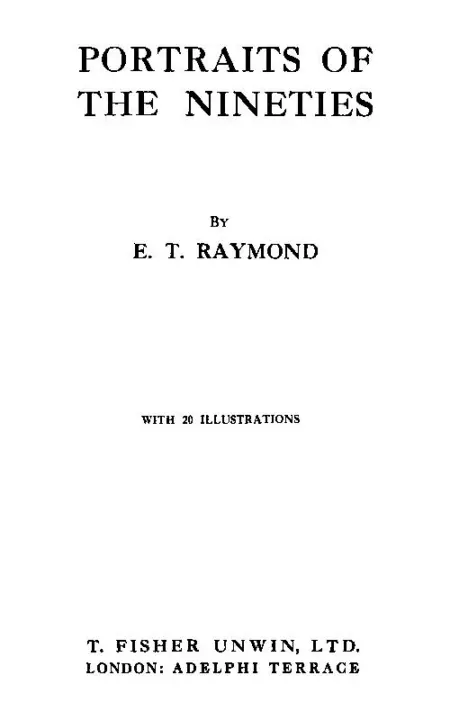
"Portraits of the Nineties" by E. T. Raymond is a biographical account written in the early 20th century that examines key figures and events from the 1890s towards the close of the Victorian era. The author sets out to explore the societal changes and prominent personalities of the decade, providing insight into their impacts on contemporary culture and politics. At the start of the narrative, the author reflects on the significance of the 1890s, contemplating the mixture of stability and transition characterizing the era. Raymond introduces the idea that the decade, often considered a "golden age," was marked by cultural vibrancy, political intrigue, and a naive optimism about the future. He alludes to the decay of the established social order and hints at the rising influence of new wealth and ideas. Thus, the opening chapters build a framework for analyzing notable figures of the time, such as Lord Rosebery and Cecil Rhodes, setting the stage for a deeper exploration of how these individuals shaped the public discourse of the 1890s.
Introduction adapted from the source catalogue; source summaries may be automatically generated.
Free to read · English · 96,367 words · No account needed
MAKE TIME FOR A GOOD BOOK
On by default. Untick to stop anonymous reading totals. Each page counts after 10 seconds in view. How this works.
Anonymous counting is on unless you have switched it off.
Now the editor of the Nineties had none of this excessive respect for the momentary and this strange disregard for continuity. Nor was he in the smallest degree concerned about the symmetry of his news page. His main idea was to make an impression, and an impression he certainly made. The truth is that he felt himself less an artist in newspaper technique than a prophet; often a Nonconformist by extraction, sometimes a secularist of that Victorian type which was really more religious than the orthodox, he was consumed with the idea that it was his business to put the world right, and if he thought the world could be put a little more right by letting an article run to five good columns, he could not bring himself to hack it into two poor columns. He would rather leave out something about a dog swallowing a will.
Curiously enough, the only newspapers which have not lost the knack of propaganda are those which, in their origin, represented the revulsion against propagandist journalism, and set out to supply simply “what the public wants.” What I have called the newest journalism of the Nineties (that is, the most solidly established journalism of to-day) has none of the moral fervour of the Parkes and Steads. But it understands as well as they did the importance of “rubbing it in”; and modern history might well have run a far different course had such mastery of method been associated with a more stable political philosophy.
This newest journalism is the child of two men—Alfred, Viscount Northcliffe, and Mr. Kennedy Jones, M.P. The soul of it belongs to the one, the body of it was moulded by the other. There were immediate imitators, careful but uninspired, like Sir Arthur Pearson, and in the long run all sorts of old papers abjectly copied the methods which had brought them discomfiture. Other magnates, endowed with more character, adopted the spirit while imparting to their productions a rather more masculine note. But on the whole the great revolution in the Press since the Nineties took its form from the personality of these two men. The journalism represented by The Star was half a joke and half a crusade, with a commercial side to it. It was meant to pay, and no doubt did pay up to a point; but its main motive was hardly a purely commercial motive. The newest journalism, on the other hand, was frankly businesslike: it set out to industrialise Bohemia, and succeeded. It was as businesslike as a tea-shop: indeed, its progress was very like that of the great tea-shop concerns. The tea-shops started with the lightest of refreshments; the newest journalism started with the lightest of reading. The tea-shop concerns went on extending and experimentalising until they embraced every branch of the trade; they bought up old concerns and started new ones; but to every acquisition and departure they imparted something of their own original character. It was the same with the newest journalism. Starting on crackers and sherbert, it worked its way to fifteen-course dinners and vintage wines. But it has retained throughout a certain singularity; and that singularity is the complete standardisation of things of the spirit. The newer journalism carelessly made a joke, sniggered over it, and then forgot all about it. The very new journalism, on the contrary, treated a joke as a very serious thing, in which it was right—a joke is a very serious thing. It decided against certain classes of jokes. There must not be jokes about Nonconformists: many advertising agents are Nonconformists. There must not be jokes about Jews: many Jews are wealthy and prone to advertising; was not the first advertisement on record that of a Frankfort Jew? Jokes against “aliens” are, of course, permissible. On the whole, there must not be jokes about the Church of England, though that is a less serious matter. There must not be “unpleasant” jokes; otherwise the babies’ foods and the condensed milks will not come into the advertising columns. Finally, by a process of exhaustion, the right kinds of jokes are reached, and by due experiment (prize competitions and the like) conducted with all the seriousness of a Home Office analysis, it is found which particular kind of joke brings the greatest happiness to the greatest number. This discovery made, the joke is made the subject of mass production, and vast stocks are poured out until the bookstall agents recommend a change. It is much the same with news; the experts can tell within five hundred the circulation effect of an ordinary murder, a “mystery,” a “poison mystery,” a “poison mystery” with a “money motive,” a “poison mystery” with a “love motive,” a divorce case with two eminent co-respondents and no particular point, and a divorce case with one quite undistinguished co-respondent and a strong “heart interest.” The business mind only begins to haver when it reaches the rarefied atmosphere of high politics. It inclines to the view that, war apart, foreign news is only useful to give a certain distinction to a paper, but that home politics may occasionally furnish the raw material for a really effective “stunt.”
Your reading position is saved on this browser. Take it to another device with a library code. Reading pages adapt to text, rather than matching a printed edition.
BEHIND THE BOOK
This eBook is for the use of anyone anywhere in the United States and most other parts of the world at no cost and with almost no restrictions whatsoever. You may copy it, give it away or re-use it under the terms of the Project Gutenberg License included with this eBook or online at www.gutenberg.org. If you are not located in the United States, you will have to check the laws of the country where you are located before using this eBook. Read the source licence.
The original source file, including credits and licence, is retained by this library. Request an original-format copy at no charge. Please include the book title and Project Gutenberg identifier #59538.
KEEP YOUR CURIOSITY GOING
Cécile Tormay

Moritz Busch
John L. Ransom
Frances Wright
Cécile Tormay

Mabel Potter Daggett