THE CLASSIC COLLECTION✦An outlaw’s diary: the CommuneCLASSIC FREE BOOKS
An outlaw’s diary: the Commune
Cécile Tormay
THE CLASSIC COLLECTION · 1921
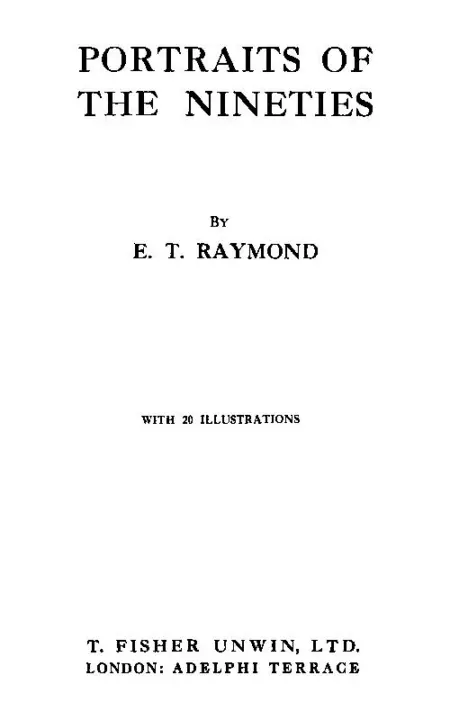
"Portraits of the Nineties" by E. T. Raymond is a biographical account written in the early 20th century that examines key figures and events from the 1890s towards the close of the Victorian era. The author sets out to explore the societal changes and prominent personalities of the decade, providing insight into their impacts on contemporary culture and politics. At the start of the narrative, the author reflects on the significance of the 1890s, contemplating the mixture of stability and transition characterizing the era. Raymond introduces the idea that the decade, often considered a "golden age," was marked by cultural vibrancy, political intrigue, and a naive optimism about the future. He alludes to the decay of the established social order and hints at the rising influence of new wealth and ideas. Thus, the opening chapters build a framework for analyzing notable figures of the time, such as Lord Rosebery and Cecil Rhodes, setting the stage for a deeper exploration of how these individuals shaped the public discourse of the 1890s.
Introduction adapted from the source catalogue; source summaries may be automatically generated.
Free to read · English · 96,367 words · No account needed
MAKE TIME FOR A GOOD BOOK
On by default. Untick to stop anonymous reading totals. Each page counts after 10 seconds in view. How this works.
Anonymous counting is on unless you have switched it off.
We have here the architect. In the finish of the details we have the poet. Those who think of the Muse as a dishevelled harridan may dispute. But those who regard the poet as bound, like any other kind of artist, to observe the conventions attaching to his medium will agree that the discipline gained in versification is observable in all Hardy’s prose. It is not that he makes ostentatious chase of the “right word.” Any word which will serve his purpose well enough he uses, just as the bricklayer does not discard a brick which happens to be a millimetre or so out of the true; such finicky fastidiousness he rightly feels is for the amateur, and not for the craftsman. But the word, like the brick, must be right enough, and there must be no question as to the way it is built into the sentence, or the way the sentence is built into the page, or the page into the chapter, or the chapter into the book. That great critic, Mr. Curdle, spoke of a “universal dove-tailedness” as the mark of the artist. I can think of no more fitting description of the perfection of Mr. Hardy’s literary joinery.
A word may be said of the material. Mr. Hardy was born near Dorchester, where he still lives, and has lived ever since he forsook London in yet early life. Anyone who called on him would find a man of very ordinary appearance in a very ordinary house. I remember one young London journalist who, greatly daring, did so call on him round about his seventieth birthday in order to discuss (with a view to subsequent publication) how it feels to be seventy and a classic. Hardy—whom Mr. H. G. Wells described as a “grey little man”—received this adventurer with a mechanical courtesy, veiling inflexible disapproval. No man can be more amiable, in conversation or correspondence, to those who have some sort of right, as Wessex compatriots or fellows of the craft, to claim his attention. But none can be more drily discouraging to impertinence. On this occasion the dry mood naturally prevailed. The visitor explained that he wanted a “story.” The author pointed to the landscape from the window, intimated that it had already afforded plenty of material for one writer, and that its capacities were still unexhausted and perhaps inexhaustible. But, when the visitor explained that he had not come down from London to write about scenery, Mr. Hardy not merely declined to be “interviewed,” he even showed (or simulated) an incapacity to understand what “interviewing” was, or how any human being could be possibly interested in the private affairs of a mere writer of books. There are, indeed, few lions so determinedly unleonine. But, in his capacity of a citizen, Mr. Hardy is by no means unsocial. Party-going has never appealed to him. But he has a quiet gift of friendship, and some sense of public obligation. He used to occupy a fairly regular seat on the county Bench, and has written pleasantly of his experiences as a Justice Silence. He has taken much interest in local performances of his own novels in dramatised form. He is a great lover of the local museum. Most, indeed, that concerns his fellow-townsmen is not altogether alien to him. He could not have written so well about Wessex if he had not been a great artist in words. But neither could he have written so well had he not been, most intensely, a Wessex man. Dorset is still, in the main, one of the least changed of English counties, and the glittering modernities of some of its seaside places only give ironic emphasis to that sense one gets of the Roman pavement on which all the later civilisations rest. It is this sense that pervades all the Wessex novels. Mr. Kipling stands for the idea of horizontal extension; we learn from him how wide a place is the world, and how tiny a place our own particular spot in the world. Mr. Hardy stands for the idea of vertical extension; he shows us that on a half-acre plot we can reach the centre of everything, provided we go deep enough. Tess is only a village girl, but the forces that made her, and will presently rend her, are older than those bones which are still dug up, in company with coins of Claudius or Hadrian, just beneath the turf of a Wessex field. The Dundee marmalade pot which she dedicates to the poor little heathen child which the curate would not bury in consecrated ground is one with the tear jugs in the Dorchester Museum. The coarse seducer is related to the Norman ancestors of Tess, who, rollicking home from a fray, dealt hard measure to some rural damsel of their day; the shame-bought parasol is brought into congruity not only with the Bournemouth esplanade but with the relics of human sacrifice which for unknown ages have caught the first beams of the sun on Salisbury Plain. There is nothing of archæological priggishness in Mr. Hardy; but there is a deep sense of the unity of past and present, and if his novels are not crowded with living beings they hold a teeming population of ghosts. It is the speciality of a man living in a cemetery. Durdles, with his intimacy with the “old ’uns,” might have written thus if he had enjoyed a literary gift.
Your reading position is saved on this browser. Take it to another device with a library code. Reading pages adapt to text, rather than matching a printed edition.
BEHIND THE BOOK
This eBook is for the use of anyone anywhere in the United States and most other parts of the world at no cost and with almost no restrictions whatsoever. You may copy it, give it away or re-use it under the terms of the Project Gutenberg License included with this eBook or online at www.gutenberg.org. If you are not located in the United States, you will have to check the laws of the country where you are located before using this eBook. Read the source licence.
The original source file, including credits and licence, is retained by this library. Request an original-format copy at no charge. Please include the book title and Project Gutenberg identifier #59538.
KEEP YOUR CURIOSITY GOING
Cécile Tormay

Moritz Busch
John L. Ransom
Frances Wright
Cécile Tormay

Mabel Potter Daggett