THE CLASSIC COLLECTION✦An outlaw’s diary: the CommuneCLASSIC FREE BOOKS
An outlaw’s diary: the Commune
Cécile Tormay
THE CLASSIC COLLECTION · 1921
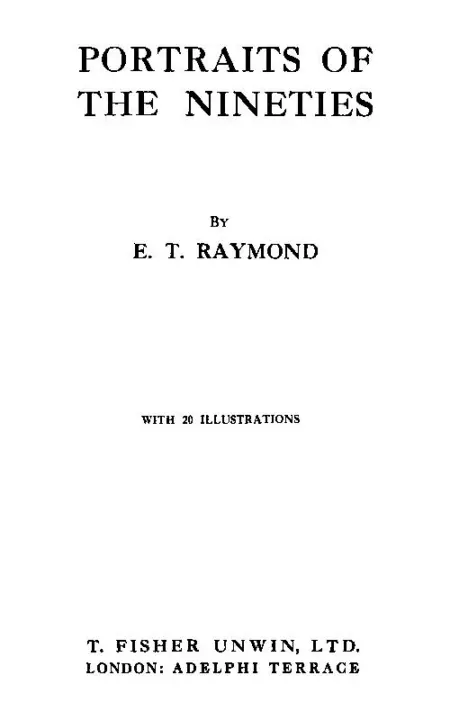
"Portraits of the Nineties" by E. T. Raymond is a biographical account written in the early 20th century that examines key figures and events from the 1890s towards the close of the Victorian era. The author sets out to explore the societal changes and prominent personalities of the decade, providing insight into their impacts on contemporary culture and politics. At the start of the narrative, the author reflects on the significance of the 1890s, contemplating the mixture of stability and transition characterizing the era. Raymond introduces the idea that the decade, often considered a "golden age," was marked by cultural vibrancy, political intrigue, and a naive optimism about the future. He alludes to the decay of the established social order and hints at the rising influence of new wealth and ideas. Thus, the opening chapters build a framework for analyzing notable figures of the time, such as Lord Rosebery and Cecil Rhodes, setting the stage for a deeper exploration of how these individuals shaped the public discourse of the 1890s.
Introduction adapted from the source catalogue; source summaries may be automatically generated.
Free to read · English · 96,367 words · No account needed
MAKE TIME FOR A GOOD BOOK
On by default. Untick to stop anonymous reading totals. Each page counts after 10 seconds in view. How this works.
Anonymous counting is on unless you have switched it off.
Morley was not killed by journalism, was rather made by it. Of his talent for the craft everything requisite has been said; great as it was, it was perhaps exceeded by his talent for making valuable friendships. It was journalism, for example, that gave him personal touch with the greatest formative influence of his life—John Stuart Mill. The intense admiration of the younger for the older man was natural enough: Mill had a singularly lovable nature. But there was danger in the completeness of Morley’s surrender. For Mill was in one sense a highly amiable Satan; he knew all about the past and present, but had no sense whatever of the future. The whole philosophy of individualism is founded on the presumption that the world would always remain much as it was in the middle of the nineteenth century; Mill does not seem to have had a suspicion of the way in which capital, taking always the line of least resistance in the search for profit, would cease in all its greater manifestations to preserve more than a vestige of its “private” character. All his theories depend on a balance which was destroyed within a very few years, historically speaking, of their promulgation; the balance, namely, of a mob of unrelated capitalists dealing with a mob of unrelated workers. Morley was a little unfortunate in coming, like a late investor, into the Mill philosophy at the top of the market; almost immediately the stock began to decline, and it was to some extent the inflexibility of economic opinions formed under these auspices that handicapped him when he arrived at a position of great authority in the Liberal party.
Nevertheless, in the Nineties all things seemed still possible to John Morley. He was, as a real and fervent Home Ruler, Mr. Gladstone’s chief dependence; it was he who bore the main burden of the great Committee fight on the Home Rule Bill. Mr. Gladstone’s “rapid splendours” implied an enormous amount of detail work. “It must be rather heart-breaking for you,” said Mr. Asquith to Morley; “it is brutal to put into words, but, really, if Mr. Gladstone stood more aside we might get on better.” “Though putting away this impious thought,” comments Morley, “I could not deny that a little dullness and a steady flow of straightforward mediocrity often mean a wonderful saving of Parliamentary time.” With Sir William Harcourt, again, he was on excellent terms, while keeping up the most cordial relations with the Rosebery camp. His own work at the Irish Office—his second experience of that bed of torment—was creditable. He had lost a seat, but confirmed a reputation, by his refusal to accept the principle of the eight-hours’ day. With the vulgar he was accepted, if without enthusiasm, still with respect, and the Liberal party generally regarded him as one of two possible successors to the leadership. At this time his name was always associated with that of Sir William Harcourt; they played the two Cæsars to the Augustus of Mr. Gladstone. It is just possible that, if the election of 1892 had yielded a solid Liberal majority of a hundred instead of a strangely composite and insecure majority of nominally forty, the name of John Morley might have graced the august list of British Prime Ministers. An inspiring prospect might have conquered finally the vacillation between politics and literature which endured through almost all Lord Morley’s active life. “I wonder whether you are like me,” he quotes Mr. Balfour as once saying to him; “when I’m at work in politics I long to be in literature, and vice versa.” “I should think so, indeed,” was Morley’s reply. No doubt literature was his real business, and he did wrong to desert it at all. Certainly no man of letters will regret the circumstances which led him to withdraw awhile to his study to produce that great human document, glowing with colour and pregnant with shrewd generalisation, the Life of Gladstone. But Morley’s attitude in the Nineties need only be compared with that of Disraeli during his long period of waiting, for the difference to be at once manifest between the man of letters who is incidentally and casually a man of action and the man of action who is incidentally and casually a man of letters. Both were engaged in an apparently hopeless struggle. But Disraeli never lost interest in the fight; he was as resolute and tenacious in the extremes of adversity as he was dashing and resourceful on the verge of victory. Morley’s interest, on the other hand, only lasted while he was in office; when the Rosebery break-up came he ceased to count, and his return to the Cabinet in 1905 was in a character that would have seemed quaint indeed ten years before—that of subordinate to Sir Henry Campbell-Bannerman. There was assuredly nothing discreditable to Lord Morley in his failure or disinclination to control an unfortunately developing situation. But his sudden renewal of interest in politics when the once despaired-of Liberal victory and reunion at length arrived, did suggest once again what has already been hinted—that he had perhaps too sure an instinct for the sunny side of the peach.
Your reading position is saved on this browser. Take it to another device with a library code. Reading pages adapt to text, rather than matching a printed edition.
BEHIND THE BOOK
This eBook is for the use of anyone anywhere in the United States and most other parts of the world at no cost and with almost no restrictions whatsoever. You may copy it, give it away or re-use it under the terms of the Project Gutenberg License included with this eBook or online at www.gutenberg.org. If you are not located in the United States, you will have to check the laws of the country where you are located before using this eBook. Read the source licence.
The original source file, including credits and licence, is retained by this library. Request an original-format copy at no charge. Please include the book title and Project Gutenberg identifier #59538.
KEEP YOUR CURIOSITY GOING
Cécile Tormay

Moritz Busch
John L. Ransom
Frances Wright
Cécile Tormay

Mabel Potter Daggett