The Mentor: Game Animals of America, Vol. 4, Num. 13, Serial No. 113, August 15, 1916
William T. (William Temple) Hornaday
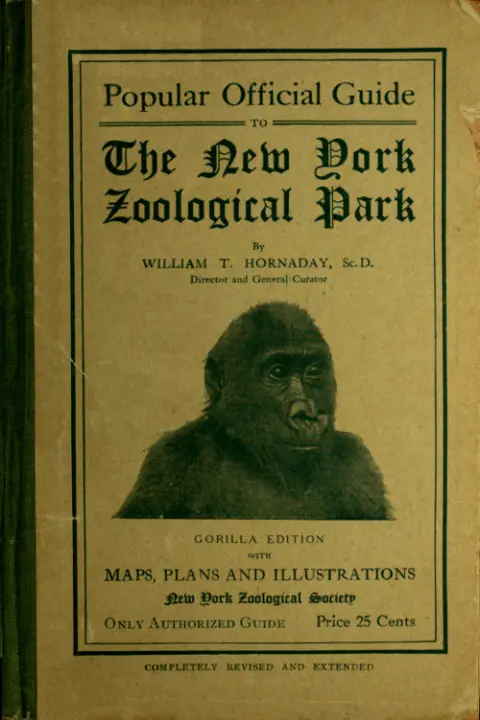
THE CLASSIC COLLECTION · 1899
"Popular Official Guide to the New York Zoological Park" by William T. Hornaday is a scientific publication written in the early 20th century. The guide serves as an informative resource for visitors to the New York Zoological Park, outlining the various animal exhibits and facilities available in the park, which includes extensive collections of mammals, birds, reptiles, and more. It highlights not only the species on display but also the history and operational aspects of the facility itself. The opening of the guide provides a richly detailed introduction to the New York Zoological Park, emphasizing its purpose and significance as a public educational institution aimed at animal preservation and the promotion of zoology. Hornaday outlines the park's development, the ongoing need for animal acquisitions, and the various support received from community members and entities. The text includes administrative details and statistics about the park, such as animal collections and facilities, along with a detailed table of contents that hints at the comprehensive examination of the park’s diverse wildlife which follows.
Introduction adapted from the source catalogue; source summaries may be automatically generated.
Free to read · English · 52,542 words · No account needed
MAKE TIME FOR A GOOD BOOK
On by default. Untick to stop anonymous reading totals. Each page counts after 10 seconds in view. How this works.
Anonymous counting is on unless you have switched it off.
The Hamadryas Baboon, with long side whiskers and cape of long hair, is one of the handsomest animals of this group. Its explosive, ear-racking cry is almost as startling to visitors as a cannon-shot.
The Golden Baboon has the liveliest disposition and the best temper possessed by any baboon. Young specimens are full of good-natured mischief, and are much given to hectoring their cage-mates. The Long-Armed Yellow Baboon is quite at home in the Primate House, and has bred here. It is a good species to keep in captivity.
The Group of Old World Monkeys, in addition to the baboons, contains several species worthy of special remark. There are some which have tails so very short and insignificant that they seem to be tailless, and several of them are called “apes.” They are not true anthropoids (manlike apes), however, and it is a confusing error to designate any of them as “apes.” The species referred to are the following:
The Black “Ape,” of Celebes, exceedingly like a true baboon.
The Magot, or Barbary “Ape,” of North Africa and Gibraltar, which is a
true macaque.
The Japanese Red-Faced Monkey, another macaque, with a brilliant red face, and long, thick coat of hair, which enables it to live out of doors all winter, even in this Zoological Park.
The Pig-Tailed Monkey, several species of which are found in Burma and other portions of southeastern Asia.
All the above are on exhibition in the Primate House, and the outdoor
cages.
The Rhesus Monkey, of India, is one of the sacred species, and ages of immunity from molestation, or even wholesome discipline, have made this animal aggressive and domineering in temper.
The Bonneted Macaque is the best-tempered monkey of all the monkey
species found in the East Indies, and it is by far the best to keep as a
pet.
The Entellus Monkey, of India, is also a sacred species, and its natural seriousness of manner, and dignified bearing, quite befit the direct descendants of the original Hunuman, or monkey deity of the Hindoos, who helped to build Adam’s Bridge.
Of the many African monkeys, some of the most showy (such as the Guerzas and Colobos) are so difficult to procure they can not be set forth as permanent residents in the Primate House. The following species, however, may be classed with the reliables:
The White-Collared Mangabey and Sooty Mangabey are both so lively, so good-natured, and so free from the fighting habit, they are prime favorites with everybody.
The Mona Monkey is handsome and easily kept, and an excellent representative of the great African genus Cercopithecus.
Your reading position is saved on this browser. Take it to another device with a library code. Reading pages adapt to text, rather than matching a printed edition.
William T. (William Temple) Hornaday
William T. (William Temple) Hornaday & W. J. (William Jacob) Holland
William T. (William Temple) Hornaday
William T. (William Temple) Hornaday
BEHIND THE BOOK
This eBook is for the use of anyone anywhere in the United States and most other parts of the world at no cost and with almost no restrictions whatsoever. You may copy it, give it away or re-use it under the terms of the Project Gutenberg License included with this eBook or online at www.gutenberg.org. If you are not located in the United States, you will have to check the laws of the country where you are located before using this eBook. Read the source licence.
The original source file, including credits and licence, is retained by this library. Request an original-format copy at no charge. Please include the book title and Project Gutenberg identifier #53141.
KEEP YOUR CURIOSITY GOING
Cécile Tormay

Moritz Busch
John L. Ransom
Frances Wright
Cécile Tormay

Mabel Potter Daggett