THE CLASSIC COLLECTION✦Jerry Todd and the rose-colored catCLASSIC FREE BOOKS
Jerry Todd and the rose-colored cat
Leo Edwards
THE CLASSIC COLLECTION · 1927
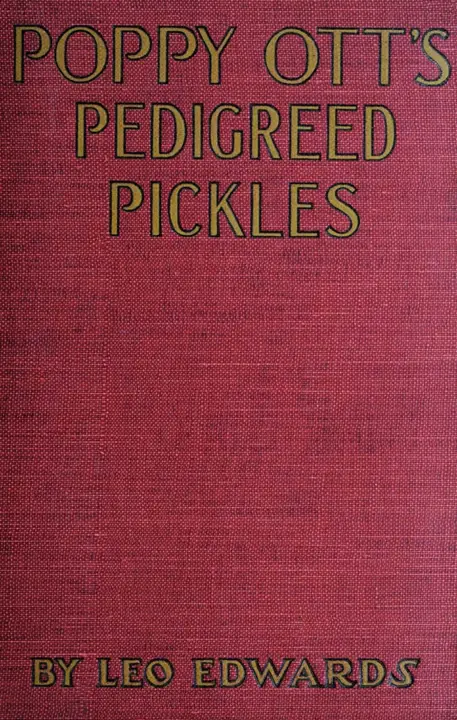
"Poppy Ott's Pedigreed Pickles" by Leo Edwards is a children's novel written in the late 1920s. It follows the adventurous and entrepreneurial spirit of a boy named Poppy Ott, who, inspired by the taste of exceptional homemade pickles, decides to open a unique venture called a Pickle Parlor alongside his friend Jerry. The book captures the excitement and challenges of their new business endeavor, emphasizing themes of friendship, creativity, and determination. The opening of the story introduces readers to Poppy’s big idea of establishing Tutter’s first Pickle Parlor, despite the skepticism and laughter it provokes from others, including his friend Jerry. Poppy demonstrates great enthusiasm and confidence in the success of their business, leading to humorous exchanges as they navigate the logistics of starting their venture without any pickles to sell. Their journey begins with them discussing potential locations for the store and overhearing a conversation about the local pickle market, setting the stage for their entrepreneurial adventure. The tone is light-hearted, with a focus on their playful banter and aspirations, inviting readers to enjoy a whimsical tale of childhood ambition.
Introduction adapted from the source catalogue; source summaries may be automatically generated.
Free to read · English · 54,294 words · No account needed
MAKE TIME FOR A GOOD BOOK
On by default. Untick to stop anonymous reading totals. Each page counts after 10 seconds in view. How this works.
Anonymous counting is on unless you have switched it off.
“Every time your mule shakes its tail,” says Poppy, seriously, “a certain amount of physical energy is used up. And to supply this energy you’ve got to buy corn and oats. The more tail shaking, naturally the more oats. That is what I call the expense of upkeep. Or, in other words, the expense of wear and tear.”
Old Butch was staring now. For this “wear and tear” business, as applied to his mule, was a new wrinkle to him.
“I swan!” he exploded. “What do you want me to do, tie a flatiron to my mule’s tail so he kain’t shake it?”
“The point is,” Poppy galloped along, “that you can turn Jerusalem out to pasture if you work for us, and nature’s grass will foot the wear and tear bill. Then all you make will be profit.”
“I swan!” came again.
“The most we can afford to pay you,” says Poppy, getting down to brass tacks, “is three-fifty a day. Nor would we want to pay you any less, for we’re going to keep you on the jump.”
As I have written down, Butch’s jobs, both towing and house moving, are kind of few and far between. So he hadn’t any thought of turning us down.
“Um... Three-fifty a day, you say.”
“Exactly.”
“Meanin’ three dollars an’ fifty cents?”
Poppy nodded.
“Three dollars and fifty cents,” says he, “and without any wear and
tear.”
The gray eyes narrowed.
“Got plenty of money?”
“Plenty,” says Poppy.
“When do I start in?”
“To-morrow morning.”
“An’ you’re sure you’ve got plenty of money?”
Poppy laughed.
“If it’ll ease your mind any on that point we’ll write you out a three-dollar-and-fifty-cent check every night at quitting time.”
The old man let out his hairy neck.
“A check? Be you got a check book?”
“Of course,” says Poppy. “That’s a necessary part of running the
business.”
“I swan! Boys runnin’ ’round with check books, when, gol ding it, I hain’t even got one myself.”
I jumped onto Poppy when we were outside.
“You sure are dumb.”
“What’s wrong now?” came the grin.
“To think that you should go and hire him.”
“I had to in order to get pickles.”
“But you said yourself that no one in Tutter would eat his pickles.”
“I said,” came the correction, “that pickles made in his home wouldn’t
sell.”
“If it’s your scheme,” says I, “to have him make the pickles some place else, they’ll still be his pickles. And that will queer them. For everybody who knows him will take it for granted that the pickles aren’t clean.”
Your reading position is saved on this browser. Take it to another device with a library code. Reading pages adapt to text, rather than matching a printed edition.
Leo Edwards
Leo Edwards
Leo Edwards
Leo Edwards
BEHIND THE BOOK
This eBook is for the use of anyone anywhere in the United States and most other parts of the world at no cost and with almost no restrictions whatsoever. You may copy it, give it away or re-use it under the terms of the Project Gutenberg License included with this eBook or online at www.gutenberg.org. If you are not located in the United States, you will have to check the laws of the country where you are located before using this eBook. Read the source licence.
The original source file, including credits and licence, is retained by this library. Request an original-format copy at no charge. Please include the book title and Project Gutenberg identifier #71240.
KEEP YOUR CURIOSITY GOING
Coulson Kernahan

Maurice Baring
Frances Wright
Cécile Tormay

Frederic Jesup Stimson

W. H. P. (William Henry Pope) Jarvis