THE CLASSIC COLLECTION✦Jerry Todd and the rose-colored catCLASSIC FREE BOOKS
Jerry Todd and the rose-colored cat
Leo Edwards
THE CLASSIC COLLECTION · 1927
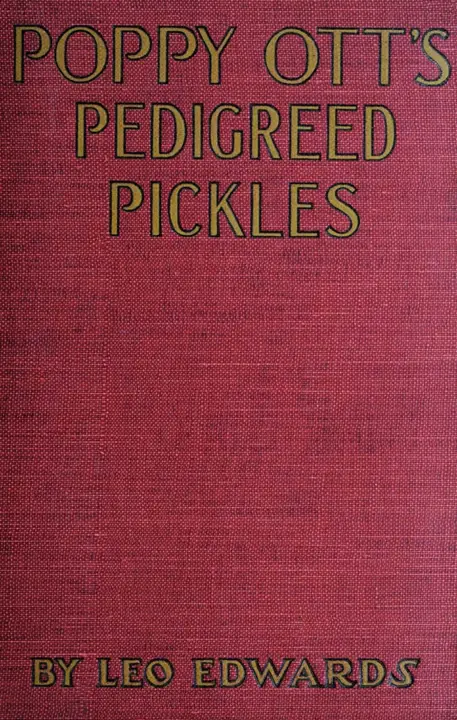
"Poppy Ott's Pedigreed Pickles" by Leo Edwards is a children's novel written in the late 1920s. It follows the adventurous and entrepreneurial spirit of a boy named Poppy Ott, who, inspired by the taste of exceptional homemade pickles, decides to open a unique venture called a Pickle Parlor alongside his friend Jerry. The book captures the excitement and challenges of their new business endeavor, emphasizing themes of friendship, creativity, and determination. The opening of the story introduces readers to Poppy’s big idea of establishing Tutter’s first Pickle Parlor, despite the skepticism and laughter it provokes from others, including his friend Jerry. Poppy demonstrates great enthusiasm and confidence in the success of their business, leading to humorous exchanges as they navigate the logistics of starting their venture without any pickles to sell. Their journey begins with them discussing potential locations for the store and overhearing a conversation about the local pickle market, setting the stage for their entrepreneurial adventure. The tone is light-hearted, with a focus on their playful banter and aspirations, inviting readers to enjoy a whimsical tale of childhood ambition.
Introduction adapted from the source catalogue; source summaries may be automatically generated.
Free to read · English · 54,294 words · No account needed
MAKE TIME FOR A GOOD BOOK
On by default. Untick to stop anonymous reading totals. Each page counts after 10 seconds in view. How this works.
Anonymous counting is on unless you have switched it off.
“Gosh!” says I, when we hit the street. “Did you see the look on her face when we backed out of the house? I bet anything she thinks we’re cuckoo.”
“How could she think different,” grinned Poppy, “with you along?”
The balance of our calls were no more successful than the first two. Of the six women, three had contributed pickles to the food sale. But the pickles that we sampled weren’t the pickles that we were looking for. In fact, at one house the pickles were no good at all. They tasted to me as though they had been put up in dish water.
“Hey!” a kid called to us across the street. “Mr. Stair wants to see
you.”
Hurrying to the newspaper office, we were given fourteen more letters
and a telegram.
“Evidently,” grinned the editor, “there’s a lot of people hereabouts who want to wear diamonds.” Then he looked at us curiously. “By the way,” he inquired, “what was it that you found in the pickles?”
“An idea,” says Poppy.
“But you said it was something of great value.”
“The right kind of an idea,” says Poppy, “is frequently worth a lot of
money.”
“If it’s news ...” came the hint.
“I hope it will be big news some day,” says Poppy, thinking of a new factory. “But I can’t tell you about it now.”
The editor continued to regard us curiously.
“I understand that you boys are going to start up a pickle store.”
“A Pickle Parlor,” came the polite correction.
The newspaper man laughed.
“Pickles? A Pickle Parlor? Evidently,” he used his head, “this ‘big idea’ of yours has something to do with pickles.”
“If you were to guess for the next thousand years,” grinned Poppy, “you couldn’t guess any closer than that.”
“Aren’t you the boy,” the man’s eyes then showed their admiration, “who brought the stilt idea to town?”
“We’re the boys,” corrected Poppy, which shows what kind of a pal he is. Yes, sir, as I’ve said before, when the angels were putting old Poppy together they dumped in an extra gob of fairness. And then to sort of balance things they put in another extra gob of squareness, with the result that he’s the fairest and squarest pal I ever had or ever hope to have if I live a million years.
“Wire collect complete detailed description of diamonds,” our telegram read. And when we saw that it was signed by the Peoria chief of police you could have sliced off our eyes with a baseball bat.
“Wow!” says Poppy. “This is getting kind of complicated.”
Your reading position is saved on this browser. Take it to another device with a library code. Reading pages adapt to text, rather than matching a printed edition.
Leo Edwards
Leo Edwards
Leo Edwards
Leo Edwards
BEHIND THE BOOK
This eBook is for the use of anyone anywhere in the United States and most other parts of the world at no cost and with almost no restrictions whatsoever. You may copy it, give it away or re-use it under the terms of the Project Gutenberg License included with this eBook or online at www.gutenberg.org. If you are not located in the United States, you will have to check the laws of the country where you are located before using this eBook. Read the source licence.
The original source file, including credits and licence, is retained by this library. Request an original-format copy at no charge. Please include the book title and Project Gutenberg identifier #71240.
KEEP YOUR CURIOSITY GOING
Coulson Kernahan

Maurice Baring
Frances Wright
Cécile Tormay

Frederic Jesup Stimson

W. H. P. (William Henry Pope) Jarvis