THE CLASSIC COLLECTION✦Jerry Todd and the rose-colored catCLASSIC FREE BOOKS
Jerry Todd and the rose-colored cat
Leo Edwards
THE CLASSIC COLLECTION · 1927
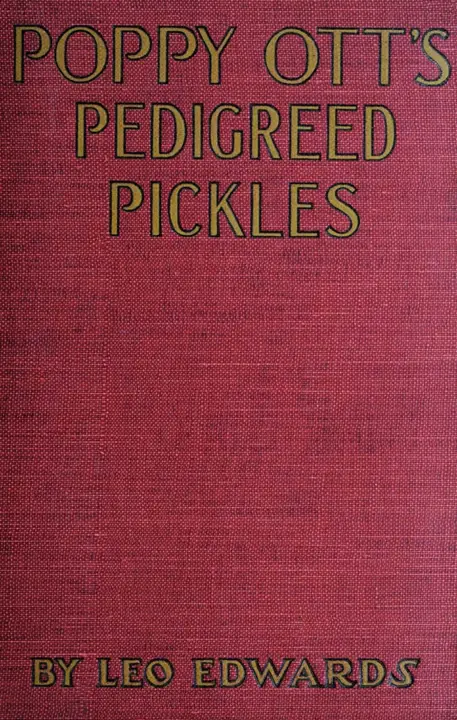
"Poppy Ott's Pedigreed Pickles" by Leo Edwards is a children's novel written in the late 1920s. It follows the adventurous and entrepreneurial spirit of a boy named Poppy Ott, who, inspired by the taste of exceptional homemade pickles, decides to open a unique venture called a Pickle Parlor alongside his friend Jerry. The book captures the excitement and challenges of their new business endeavor, emphasizing themes of friendship, creativity, and determination. The opening of the story introduces readers to Poppy’s big idea of establishing Tutter’s first Pickle Parlor, despite the skepticism and laughter it provokes from others, including his friend Jerry. Poppy demonstrates great enthusiasm and confidence in the success of their business, leading to humorous exchanges as they navigate the logistics of starting their venture without any pickles to sell. Their journey begins with them discussing potential locations for the store and overhearing a conversation about the local pickle market, setting the stage for their entrepreneurial adventure. The tone is light-hearted, with a focus on their playful banter and aspirations, inviting readers to enjoy a whimsical tale of childhood ambition.
Introduction adapted from the source catalogue; source summaries may be automatically generated.
Free to read · English · 54,294 words · No account needed
MAKE TIME FOR A GOOD BOOK
On by default. Untick to stop anonymous reading totals. Each page counts after 10 seconds in view. How this works.
Anonymous counting is on unless you have switched it off.
“Say, Jerry,” Tom told me, when I dragged myself wearily into the Pickle Parlor, “Mr. Pennykorn wants to see you.”
“What?” I stared in amazement.
“He stopped in here a few minutes ago. Talked as nice as pie, too. So you better run over and find out what he’s got up his sleeve.”
“Yah,” I sweat, “and get my beezer knocked off. Bu-lieve me, I know that old bird, all right.”
“Shucks! He wouldn’t dare to lay a finger on you even if he wanted to. You ought to know that.”
The last time I had talked with Mr. Pennykorn his eyes had blazed with hatred. But now, on meeting him in his office, he purred over me like an old pussy cat.
“I suppose,” says he, when I was seated, “that you’re wondering why I
sent for you.”
I nodded. I guess I was pretty stiff about it, too. For I couldn’t forget about that crooked letter.
“The--ah--point is,” he got down to business, “we have a market for cucumber pickles, but no new stock, largely due, of course, to your interference. On the other hand, as I understand the situation, you have a sizable stock but no market. So it would seem to me, putting aside all past differences that the thing for us to do is to get together in a friendly way. And here is my proposition: We will take over your entire pickle stock, assume all your debts, reimburse you for the money that you have paid out of your own pockets, absorb all your ordered raw stock, and, in addition, as an indication of our good faith, write a personal check for you in the amount of two hundred dollars--this, of course, in the event that the plan meets with your approval.”
Oh, boy, what a relief! Now we could get out from under, as the saying is, without losing a penny. Better, still, we’d be two hundred dollars to the good. Crooked as he had been with us, I was willing to forgive him.
“I’ll have to get Poppy on long distance,” says I, when he brought out a contract for me to sign.
“Not necessarily,” says he in that nice pussy-cat way.
“But we’re partners.”
“Your separate signature is binding.”
I shook my head.
“I don’t want to sign,” I held off, “unless Poppy knows about it.”
“This is a very generous offer, everything considered,” says he in a peculiarly steady voice. His eyes, too, were peculiar. Sort of deep and dangerous-like. “For your own good,” he added, “I would urge its immediate acceptance.”
I got up.
Your reading position is saved on this browser. Take it to another device with a library code. Reading pages adapt to text, rather than matching a printed edition.
Leo Edwards
Leo Edwards
Leo Edwards
Leo Edwards
BEHIND THE BOOK
This eBook is for the use of anyone anywhere in the United States and most other parts of the world at no cost and with almost no restrictions whatsoever. You may copy it, give it away or re-use it under the terms of the Project Gutenberg License included with this eBook or online at www.gutenberg.org. If you are not located in the United States, you will have to check the laws of the country where you are located before using this eBook. Read the source licence.
The original source file, including credits and licence, is retained by this library. Request an original-format copy at no charge. Please include the book title and Project Gutenberg identifier #71240.
KEEP YOUR CURIOSITY GOING
Coulson Kernahan

Maurice Baring
Frances Wright
Cécile Tormay

Frederic Jesup Stimson

W. H. P. (William Henry Pope) Jarvis