Drawings
Frederic Remington
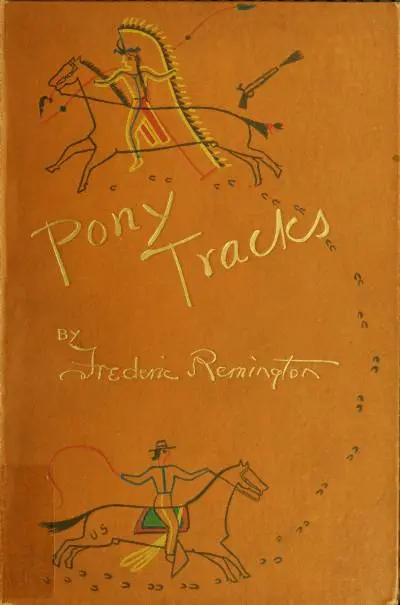
THE CLASSIC COLLECTION · 1895
"Pony Tracks" by Frederic Remington is a collection of vignettes focusing on the American West, written in the late 19th century. This illustrated work captures the essence of life on the frontier through a mix of narrative and art, portraying the experiences of cowboys, soldiers, and Native Americans during that era. The topics explored include military expeditions, rodeos, and the daily lives of those living in remote ranches. The opening of "Pony Tracks" introduces readers to the setting and context through a lively scene where a troop is preparing for a journey under the command of General Miles. The narrator reflects on the rugged nature of the terrain and the challenges of following the general on horseback. As the narrative progresses, it captures glimpses of military camaraderie, the camaraderie between the soldiers and scouts, and the thrill of adventure as they traverse the natural landscape. The descriptions also highlight the contrasts between military life and the earthy reality of the scouts and cowboys, setting the tone for the rest of the collection.
Introduction adapted from the source catalogue; source summaries may be automatically generated.
Free to read · English · 51,046 words · No account needed
MAKE TIME FOR A GOOD BOOK
On by default. Untick to stop anonymous reading totals. Each page counts after 10 seconds in view. How this works.
Anonymous counting is on unless you have switched it off.
“I felt fear of Emmittstowne, as I had information that the insurgents were in force there. We picked up a man on the road who seemed to be one of our sympathizers, and he informed us that there were pickets all along the road which we were travelling, and also mounted patrols. He said that there were a terrible lot of insurgents in Emmittstowne, but mostly drunk.
“Captain Bidewell, who was in command of the advance, did a rather clever piece of work here. He suspected that he would find a picket at a certain place, and sent a dismounted squad on either side of the road, which was bounded by meadow land with stone-walls, brush, and trees on either side, and he himself walked down the road with two men. They talked loudly, as though drunk, and sure enough, were shortly held up by the picket. They surrendered and expostulated in a loud voice, and offered their captors a bottle of whiskey. The advance closed in on them and even got in their rear, and, of course, held up the picket without a shot. A six-shooter argument used on these people shortly disclosed the conditions, and we advanced.”
“Say, colonel, I know that Bidewell; he is organizing a bike regiment out West now--met him as I came through,” interpolated a medical major.
“Yes--nice fellow--held the ten-mile record for two years before this trouble,” replied Pedal; “but, as I was saying--
“Here is How! gentlemen!
“Well, to continue--to show you a curious phase of bicycling--my advance ran a picket farther along the road and were fired on, but, bless me, they had gone through so quickly and silently that they were not hurt, and the sergeant, who was very wise, dismounted and blew his whistle for us to advance. Bidewell dismounted and immediately advanced, and the picket, hearing his men smashing brush, retreated, and the sergeant turned a pistol loose in their faces and bellowed for them to go out in the road, throw up their hands, and surrender, which they did. You see, Colonel Ladigo, it is very hard to estimate bike forces in the night, they go so silently--they simply flit; and when you first notice them you wonder how many have gone before. A sleepy picket is waked up by a lot of bellowing and shots and smashing of brush, and he doesn’t know anything, especially if the row is half in his rear. Well, the shooting must have aroused the village of Emmittstowne, and I made up my mind to run right into the town. The moon was rising, and we could see fairly well; but first I tried a little ruse with the captured picket. We advanced down the road a piece, and the men ensconced themselves in the brush, while one of the captured men stood in the middle of the road. We heard quite a party coming up the road rapidly, and the picket called out to them that it was nothing--that they had fired at some shadows, and that they might go back. Two men actually advanced to him, but he insisted that all was right, and that they might return; in fact, he protested too much, since he knew that he was lying for his life, and that the date of his demise was fixed at the instant he told the truth. We gave the town half an hour to settle down, and then started on a down grade--coasting silently. All was still. There were lights in a few saloons, and a half-dozen men, who were immediately held up and disarmed. There was evidence of a great many people in the village, since wagons and horses stood about, and tents and huts were everywhere except on the main street. I stopped in front of the hotel, and, do you know, my column got three-quarters of the way through the town before we were discovered. My column is three-quarters of a mile long, you must remember, and that was very fortunate. Some one fired a shot from a darkened window of the hotel, and I ordered my men to use their revolvers. A man can shoot a revolver with great accuracy from a wheel, as it glides so smoothly. Well, there was a deuce of a popping, and it must have fairly riddled the town. The fire was shortly returned, but in a desultory way which did not seem to do any damage, and shortly the tail of the column passed down the street. I had set the hotel on fire before we left, and I really do not think that those fellows know what really happened there yet. I immediately cut the telegraph line, and now had nothing to interfere with my march to North Colville. I had two bikes ruined by shots, and abandoned the riders; but they made their way to our lines later. As we proceeded the country grew more flat, and we made the pedals spin; at times we overtook night prowlers--tramps, for the most part--and one rather large party of drunken insurgents, all of whom we disarmed and left tied to trees and fences along the road. Do you know, Ladigo, that one cannot hear my whole regiment on a road until it is right on top of you. I have frequently seen men ride a bicycle right up beside a man, who never heard a word until ordered to throw up his hands.”
Your reading position is saved on this browser. Take it to another device with a library code. Reading pages adapt to text, rather than matching a printed edition.
Frederic Remington
Frederic Remington
Frederic Remington
Frederic Remington
BEHIND THE BOOK
This eBook is for the use of anyone anywhere in the United States and most other parts of the world at no cost and with almost no restrictions whatsoever. You may copy it, give it away or re-use it under the terms of the Project Gutenberg License included with this eBook or online at www.gutenberg.org. If you are not located in the United States, you will have to check the laws of the country where you are located before using this eBook. Read the source licence.
The original source file, including credits and licence, is retained by this library. Request an original-format copy at no charge. Please include the book title and Project Gutenberg identifier #41011.
KEEP YOUR CURIOSITY GOING
Wilfrid Scawen Blunt
Wilfrid Scawen Blunt

E. W. (Edgar Watson) Howe
Francis Greenleaf Allinson & Anne C. E. (Anne Crosby Emery) Allinson
Cyrenus Cole

John Martineau