Drawings
Frederic Remington
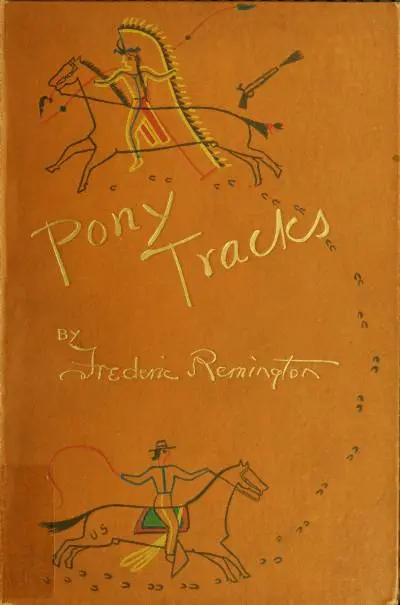
THE CLASSIC COLLECTION · 1895
"Pony Tracks" by Frederic Remington is a collection of vignettes focusing on the American West, written in the late 19th century. This illustrated work captures the essence of life on the frontier through a mix of narrative and art, portraying the experiences of cowboys, soldiers, and Native Americans during that era. The topics explored include military expeditions, rodeos, and the daily lives of those living in remote ranches. The opening of "Pony Tracks" introduces readers to the setting and context through a lively scene where a troop is preparing for a journey under the command of General Miles. The narrator reflects on the rugged nature of the terrain and the challenges of following the general on horseback. As the narrative progresses, it captures glimpses of military camaraderie, the camaraderie between the soldiers and scouts, and the thrill of adventure as they traverse the natural landscape. The descriptions also highlight the contrasts between military life and the earthy reality of the scouts and cowboys, setting the tone for the rest of the collection.
Introduction adapted from the source catalogue; source summaries may be automatically generated.
Free to read · English · 51,046 words · No account needed
MAKE TIME FOR A GOOD BOOK
On by default. Untick to stop anonymous reading totals. Each page counts after 10 seconds in view. How this works.
Anonymous counting is on unless you have switched it off.
All of these episodes opened my eyes to the fact that if I followed General Miles I would have to do some riding such as I had rarely done before. In coming back to the railroad we left the Pine Ridge Agency in the evening without supper, and I was careful to get an even start. My horse teetered and wanted to gallop, but I knew that the twenty-eight miles would have to be done at full speed, so I tried to get him down to a fast trot, which gait I knew would last better; but in the process of calming him down to a trot I lost sight of the general and his orderly as they went tearing like mad over a hill against the last gleam of the sunset. I rode at a very rapid trot over the hills in the moonlight for over three hours, but I never saw the general again until I met him at dinner. Then I further concluded that if I followed the general I would have no time to regait my horses, but must take them as I found them, gallop or trot. So on this cool morning at Keough I took observations of the horses which were tied to the post, with my mind full of misgivings.
Patter, patter, patter--clank, clank, clank; up comes the company of Cheyenne scouts who are to escort the general--fine-looking, tall young men, with long hair, and mounted on small Indian ponies. They were dressed and accoutred as United States soldiers, and they fill the eye of a military man until nothing is lacking. Now the general steps out of the car and hands the commission into a six-mule ambulance. I am given a horse, and, mounting, we move off over the plain and into the hills. The sun comes streaming over the landscape, and the general is thinking about this old trail, and how years before he had ploughed his way through the blinding snow to the Lame Deer fight. I am secretly wishing that it would occupy his mind more fully, so that my breakfast might settle at the gentle gait we are going, but shortly he says, “It’s sixty miles, and we must move along.” We break into a gallop. The landscape is gilded by the morning sun, and the cool of the October air makes it a perfect thing, but there are elements in the affair which complicate its perfection. The “bad lands” are rough, and the general goes down a hill with even more rapidity than up it. The horses are not the perfect animals of the bridle-path, but poor old cavalry brutes, procured by the government under the old contract system, by which the government pays something like $125 for a $60 horse. This could be remedied by allowing the officers of each regiment to buy their own horses; but in our army nothing is remedied, because a lot of nice old gentlemen in Washington are too conservative to do anything but eat and sleep. There is a bit of human nature at the bottom of our army organization, and where is the man who can change that? Men who were the very jewels of the profession years ago have reached in due time the upper grades of rank, and occupy the bureaus of the department. These men who have acquired rank, years, and discretion naturally do nothing, and with sedate gravity insist that no one else shall do anything. The ambitious young men have to wait patiently for their retirement, and in process of waiting they, too, become old and conservative. Old soldiers are pardonable rubbish, since soldiers, like other men, must age and decay, the only distinction being that youthful vigor is of prime importance to a soldier, while in the case of the citizen any abatement of vigor is rewarded by being shelved. What to do with old soldiers is a problem which I will hand over to the economists as being beyond my depth. But to return to the going downhill. General Miles has acquired his knowledge of riding from wild Indians, and wild Indians go uphill and downhill as a matter of course at whatever gait they happen to be travelling. He would make his horse climb a tree with equal gravity if he was bound that way. The general has known Indians to ride for two days and a night at a rapid gallop, and it never occurs to him that he cannot do anything which any one else can; so he spurs along, and we go cutting around the coulies and bluffs like frightened antelopes or mad creatures. The escort strings out behind. This is observed with a grim humor by the general, who desires nothing so much as to leave his escort far in the rear. He turns in his saddle, and seeing the dust of the escort far behind, says: “Shake up the young men a little; do ’em good. They get sleepy;” and away we go.
Your reading position is saved on this browser. Take it to another device with a library code. Reading pages adapt to text, rather than matching a printed edition.
Frederic Remington
Frederic Remington
Frederic Remington
Frederic Remington
BEHIND THE BOOK
This eBook is for the use of anyone anywhere in the United States and most other parts of the world at no cost and with almost no restrictions whatsoever. You may copy it, give it away or re-use it under the terms of the Project Gutenberg License included with this eBook or online at www.gutenberg.org. If you are not located in the United States, you will have to check the laws of the country where you are located before using this eBook. Read the source licence.
The original source file, including credits and licence, is retained by this library. Request an original-format copy at no charge. Please include the book title and Project Gutenberg identifier #41011.
KEEP YOUR CURIOSITY GOING
Wilfrid Scawen Blunt
Wilfrid Scawen Blunt

E. W. (Edgar Watson) Howe
Francis Greenleaf Allinson & Anne C. E. (Anne Crosby Emery) Allinson
Cyrenus Cole

John Martineau