
Letters to a Friend, Written to Mrs. Ezra S. Carr, 1866-1879
John Muir
THE CLASSIC COLLECTION · 1906
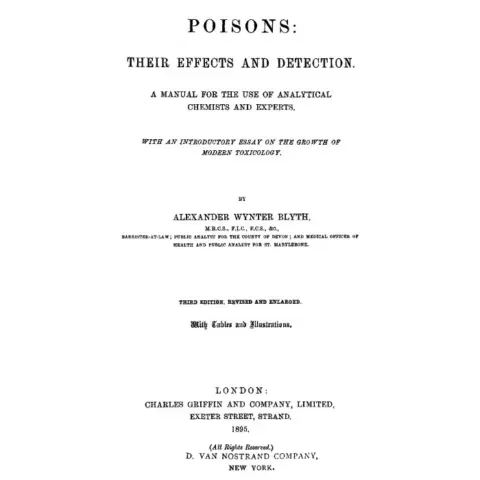
"Poisons, Their Effects and Detection" by Alexander Wynter Blyth is a scientific publication written in the late 19th century. This work serves as a comprehensive manual for analytical chemists and forensic experts, detailing the nature, effects, and detection methods of various toxic substances. It explores the historical context of poison knowledge, its physiological effects, and diagnostics, proving essential for anyone involved in toxicology or forensic medicine. The beginning of this manual outlines the origins of poison knowledge, highlighting the significance of the word "toxicology" and its connection to ancient practices involving poisons used on weaponry. It references mythological figures associated with poison, such as Hecate and Medea, and sets a tone of intrigue surrounding early toxicological research. Blyth emphasizes how ancient civilizations perceived poisons and the supernatural beliefs attached to them, paving the way through history to modern understandings of toxins and their effects on health and life.
Introduction adapted from the source catalogue; source summaries may be automatically generated.
Free to read · English · 336,607 words · No account needed
MAKE TIME FOR A GOOD BOOK
On by default. Untick to stop anonymous reading totals. Each page counts after 10 seconds in view. How this works.
Anonymous counting is on unless you have switched it off.
Use =stomach-pump= or =tube=, if the mucous membrane of the throat is not inflamed; or, administer hypodermic dose of =apomorphine=, or give emetics--=sulphate of zinc, mustard,= or =ipecacuanha=.
Allay pain with =morphine=. Give plenty of water and =demulcent drinks=.
Use =stomach-pump= or =tube=, and, when the stomach is emptied, introduce by the same means =warm coffee=, or give a hypodermic injection of =apomorphine=, or administer emetics of =sulphate of zinc=, or =mustard=, or =ipecacuanha.=
An =enema of coffee= will be useful.
Keep the limbs warm.
Administer hypodermically 2 or 3 drops of the solution of =strychnine= at intervals of from fifteen to twenty minutes.
Rouse the patient by various means, such as shouting, shaking, flapping the skin with a wet towel, &c.
Inhalations of =amyl nitrite= are recommended.
=Artificial respiration= may be necessary.
Use the same treatment as for =nitrate of potash= (which see, p.
696).
CHLORIDE OF ZINC.--See ZINC.
CHLOROFORM--(Inhaled).
Give plenty of =fresh air=, pull the tongue forward, and commence at once =artificial respiration=. If the heart has stopped, strike the chest two or three times very hard, over the region of the heart; this has been found occasionally to restore its beat. Apply the =battery=, but with a weak current only; one pole may be placed on the larynx, the other at the pit of the stomach.
Inhalations of =nitrite of amyl= are useful. The hot and cold =douche=
may also be used.
CHLOROFORM--(Swallowed).
Empty the stomach by =pump= or =tube=, or by emetics, such as 5 drops of the hypodermic solution of =apomorphine=, or =sulphate of zinc=, or =mustard=.
Give an enema of =hot coffee=.
Administer large draughts of =water=, which may advantageously contain a little =sodic carbonate= in solution.
Attempt to rouse the patient. =Nitrite of amyl= inhalations, and, if necessary, =artificial respiration= may be used.
CHROMATE OF POTASH.--See CHROMIUM.
CHROMIC ACID.--See CHROMIUM.
Empty the stomach by =pump= or =tube=; administer a subcutaneous injection of =apomorphine=, or give =sulphate of zinc=, =mustard=, or =ipecacuanha= as emetics. Follow up by administering, suspended in water, calcined magnesia, or carbonate of magnesia, or chalk.
=Demulcent drinks=, such as =barley-water=, &c.
COCCULUS INDICUS.--See PICROTOXIN.
Use =stomach-pump= or =tube=, or empty the stomach by emetics, such as =sulphate of zinc=, or =mustard=, or =ipecacuanha=; or, better than all, give a hypodermic injection of 4 or 5 drops of the solution of =apomorphine=.
Give =tannin= or =gallic acid= in ½-drachm doses, or strong tea or
coffee.
Allay the pain in the bowels and purging by small doses of =opium= or
=morphine=.
Your reading position is saved on this browser. Take it to another device with a library code. Reading pages adapt to text, rather than matching a printed edition.
BEHIND THE BOOK
This eBook is for the use of anyone anywhere in the United States and most other parts of the world at no cost and with almost no restrictions whatsoever. You may copy it, give it away or re-use it under the terms of the Project Gutenberg License included with this eBook or online at www.gutenberg.org. If you are not located in the United States, you will have to check the laws of the country where you are located before using this eBook. Read the source licence.
The original source file, including credits and licence, is retained by this library. Request an original-format copy at no charge. Please include the book title and Project Gutenberg identifier #42709.
KEEP YOUR CURIOSITY GOING
John Muir

Asa Gray
Asa Gray

Florence Nightingale
Elizabeth Robins Pennell
Denison Olmsted