
Letters to a Friend, Written to Mrs. Ezra S. Carr, 1866-1879
John Muir
THE CLASSIC COLLECTION · 1906
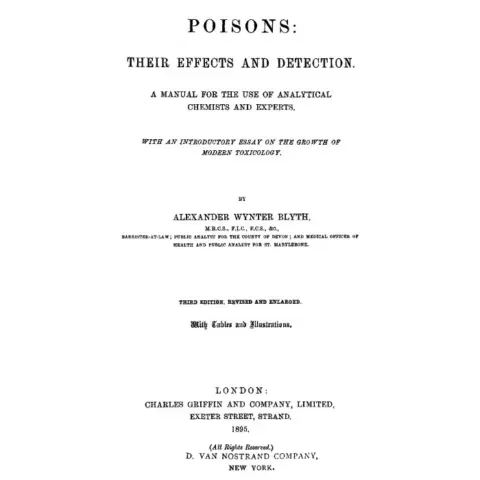
"Poisons, Their Effects and Detection" by Alexander Wynter Blyth is a scientific publication written in the late 19th century. This work serves as a comprehensive manual for analytical chemists and forensic experts, detailing the nature, effects, and detection methods of various toxic substances. It explores the historical context of poison knowledge, its physiological effects, and diagnostics, proving essential for anyone involved in toxicology or forensic medicine. The beginning of this manual outlines the origins of poison knowledge, highlighting the significance of the word "toxicology" and its connection to ancient practices involving poisons used on weaponry. It references mythological figures associated with poison, such as Hecate and Medea, and sets a tone of intrigue surrounding early toxicological research. Blyth emphasizes how ancient civilizations perceived poisons and the supernatural beliefs attached to them, paving the way through history to modern understandings of toxins and their effects on health and life.
Introduction adapted from the source catalogue; source summaries may be automatically generated.
Free to read · English · 336,607 words · No account needed
MAKE TIME FOR A GOOD BOOK
On by default. Untick to stop anonymous reading totals. Each page counts after 10 seconds in view. How this works.
Anonymous counting is on unless you have switched it off.
Asparagin, 36·36 21·21 Methylamine, 38·71 45·17 Betaine, 44·44 10·37 Theobromine, 46·67 31·11 Theine, 49·48 28·86 Indican, 49·60 2·22 Muscarine, 50·42 11·77 Lauro-cerasin, 52·47 1·53 Amanitine, 57·69 13·46 Narceine, 59·63 3·02 Colchicine, 60·53 4·15 Oxyacanthine, 60·57 4·42 Solanine, 60·66 1·68 Trimethylamine, 61·02 23·73 Jervine, 61·03 5·14 Sabadilline, 61·29 3·46 Aconitine, 61·21 2·16 Nepaline, 63·09 2·12 Colchicein, 63·44 4·38 Veratroidine, 63·8 3·1 Narcotine, 63·92 3·39 Veratrine, 64·42 2·91 Delphinine, 64·55 3·42 Physostigmine, 65·49 15·27 Rhœadine, 65·79 3·65 Cocaine, 66·44 4·84 Gelsemine, 67·00 7·10 Conhydrine, 67·12 9·79 Staphisagrine, 67·5 3·6 Chelidonine, 68·06 12·34 Atropine, Hyoscyamine, 70·58 4·84 Sanguinarine, 70·59 4·33 Papaverine, 70·79 4·13 Delphinoidine, 70·9 3·9 Morphine and Piperine, 71·58 4·91 Berberine, 71·64 4·18 Codeine, 72·24 4·68 Thebaine, 73·31 4·50 Cytisine, 73·85 12·92 Nicotine, 74·08 17·28 Quinine, 75·02 8·64 Coniine, 76·81 11·20 Strychnine, 77·24 8·92 Curarine, 81·51 5·28
§ 317. =Quantitative Estimation of the Alkaloids.=--For medico-legal purposes the alkaloid obtained is usually weighed directly, but for technical purposes other processes are used. One of the most convenient of these is titration with normal or decinormal sulphuric acid, a method applicable to a few alkaloids of marked basic powers--e.g., quinine is readily and with accuracy estimated in this way, the alkaloid being dissolved in a known volume of the acid, and then titrated back with soda. If a large number of observations are to be made, an acid may be prepared so that each c.c. equals 1 mgrm. of quinine. A reagent of general application is found in the so-called Mayer’s reagent, which consists of 13·546 grms. of mercuric chloride, and 49·8 grms. of iodide of potassium in a litre of water. Each c.c. of such solution precipitates--
Of Strychnine, ·0167 grm.
„ Brucine, ·0233 „
„ Quinine, ·0108 „
„ Cinchonine, ·0102 „
„ Quinidine, ·0120 „
„ Atropine, ·0145 „
„ Aconitine, ·0268 „
„ Veratrine, ·0269 „
„ Morphine, ·0200 „
„ Narcotine, ·0213 „
„ Nicotine, ·00405 „
„ Coniine, ·00416 „
The final reaction is found by filtering, from time to time, a drop on to a glass plate, resting on a blackened surface, and adding the test until no precipitate appears. The results are only accurate when the strength of the solution of the alkaloid is about 1 : 200; so that it is absolutely necessary first to ascertain approximatively the amount present, and then to dilute or concentrate, as the case may be, until the proportion mentioned is obtained.
A convenient method of obtaining the sulphate of an alkaloid for quantitative purposes, and especially from organic fluids, is that recommended by Wagner. The fluid is acidulated with sulphuric acid, and the alkaloid precipitated by a solution of iodine in iodide of potassium. The precipitate is collected and dissolved in an aqueous solution of hyposulphite of soda. The filtered solution is again precipitated with the iodine reagent, and the precipitate dissolved in sulphurous acid, which, on evaporation, leaves behind the pure sulphate of the base.
It is also very useful for quantitative purposes to combine an alkaloid with gold or platinum, by treating the solution with the chlorides of either of those metals--the rule as to selection being to give that metal the preference which yields the most insoluble and the most crystallisable compound.
The following table gives the percentage of gold or platinum left on ignition of the double salt:--
Gold. Platinum.
Your reading position is saved on this browser. Take it to another device with a library code. Reading pages adapt to text, rather than matching a printed edition.
BEHIND THE BOOK
This eBook is for the use of anyone anywhere in the United States and most other parts of the world at no cost and with almost no restrictions whatsoever. You may copy it, give it away or re-use it under the terms of the Project Gutenberg License included with this eBook or online at www.gutenberg.org. If you are not located in the United States, you will have to check the laws of the country where you are located before using this eBook. Read the source licence.
The original source file, including credits and licence, is retained by this library. Request an original-format copy at no charge. Please include the book title and Project Gutenberg identifier #42709.
KEEP YOUR CURIOSITY GOING
John Muir

Asa Gray
Asa Gray

Florence Nightingale
Elizabeth Robins Pennell
Denison Olmsted