
Letters to a Friend, Written to Mrs. Ezra S. Carr, 1866-1879
John Muir
THE CLASSIC COLLECTION · 1906
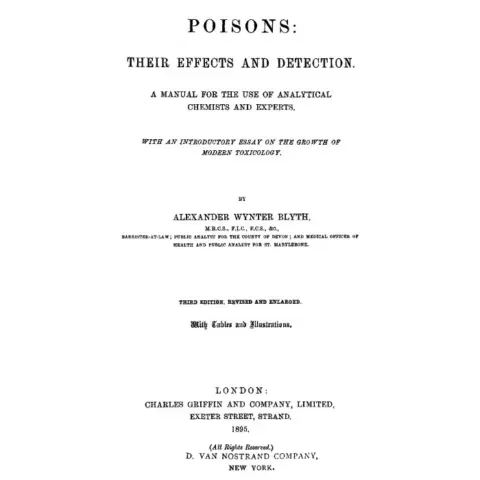
"Poisons, Their Effects and Detection" by Alexander Wynter Blyth is a scientific publication written in the late 19th century. This work serves as a comprehensive manual for analytical chemists and forensic experts, detailing the nature, effects, and detection methods of various toxic substances. It explores the historical context of poison knowledge, its physiological effects, and diagnostics, proving essential for anyone involved in toxicology or forensic medicine. The beginning of this manual outlines the origins of poison knowledge, highlighting the significance of the word "toxicology" and its connection to ancient practices involving poisons used on weaponry. It references mythological figures associated with poison, such as Hecate and Medea, and sets a tone of intrigue surrounding early toxicological research. Blyth emphasizes how ancient civilizations perceived poisons and the supernatural beliefs attached to them, paving the way through history to modern understandings of toxins and their effects on health and life.
Introduction adapted from the source catalogue; source summaries may be automatically generated.
Free to read · English · 336,607 words · No account needed
MAKE TIME FOR A GOOD BOOK
On by default. Untick to stop anonymous reading totals. Each page counts after 10 seconds in view. How this works.
Anonymous counting is on unless you have switched it off.
=Bismuthic potassic iodide= in solution precipitates alkaloids, and the compounds formed are of great insolubility, but it also forms compounds with the various albuminoid bodies.
=Chloride of gold= forms with the alkaloids compounds, many of which are crystalline, and most admit of utilisation for quantitative determinations. Chloride of gold does not precipitate amides or ammonium compounds, and on this account its value is great. The precipitates are yellow, and after a while are partly decomposed, when the colour is of a reddish-brown.
=Platinic chloride= also forms precipitates with most of the alkaloids, but since it also precipitates ammonia and potassic salts, it is inferior to gold chloride in utility.
§ 303. (1.) =Phosphomolybdic Acid as a Reagent for Alkaloids.=--Preparation; Molybdate of ammonia is precipitated by phosphate of soda; and the well-washed yellow precipitate is suspended in water and warmed with carbonate of soda, until it is entirely dissolved. This solution is evaporated to dryness, and the ammonia fully expelled by heating. If the molybdic acid is fairly reduced by this means, it is to be moistened by nitric acid, and the heating repeated. The now dry residue is warmed with water, nitric acid added to strong acid reaction, and the mixture diluted with water, so that 10 parts of the solution contain 1 of the dry salt. The precipitates of the alkaloids are as follows:--
Aniline, Bright-yellow, flocculent. Morphine, „ „ Narcotine, Brownish-yellow, „ Quinine, Whitish-yellow, „ Cinchonine, „ „ Codeine, Brownish-yellow, voluminous. Strychnine, White-yellow, „ Brucine, Yelk-yellow, flocculent. Veratrine, Bright-yellow, „ Jervine, „ „ Aconitine, „ „ Emetine, „ „ Theine, Bright-yellow, voluminous. Theobromine, „ „ Solanine, Citron-yellow, pulverulent. Atropine, Bright-yellow, flocculent. Hyoscyamine, „ „ Colchicine, Orange-yellow, „ Delphinine, Grey-yellow, voluminous. Berberine, Dirty-yellow, flocculent. Coniine, Bright-yellow, voluminous. Nicotine, „ „ Piperine, Brownish-yellow, flocculent.
(2.) =Silico-Tungstic Acid as a Reagent for Alkaloids.=--Sodium tungstate is boiled with freshly precipitated gelatinous silica. To the solution is added mercurous nitrate, which precipitates the yellow mercurous silico-tungstate. This is filtered, well-washed, and decomposed by an equivalent quantity of hydrochloric acid; silico-tungstic acid then goes into solution, and mercurous chloride (calomel) remains behind. The clear filtrate is evaporated to drive off the excess of hydrochloric acid, and furnishes, on spontaneous evaporation, large, shining, colourless octahedra of silico-tungstic acid, which effloresce in the air, melt at 36°, and are easily soluble in water or alcohol.
Your reading position is saved on this browser. Take it to another device with a library code. Reading pages adapt to text, rather than matching a printed edition.
BEHIND THE BOOK
This eBook is for the use of anyone anywhere in the United States and most other parts of the world at no cost and with almost no restrictions whatsoever. You may copy it, give it away or re-use it under the terms of the Project Gutenberg License included with this eBook or online at www.gutenberg.org. If you are not located in the United States, you will have to check the laws of the country where you are located before using this eBook. Read the source licence.
The original source file, including credits and licence, is retained by this library. Request an original-format copy at no charge. Please include the book title and Project Gutenberg identifier #42709.
KEEP YOUR CURIOSITY GOING
John Muir

Asa Gray
Asa Gray

Florence Nightingale
Elizabeth Robins Pennell
Denison Olmsted