
Letters to a Friend, Written to Mrs. Ezra S. Carr, 1866-1879
John Muir
THE CLASSIC COLLECTION · 1906
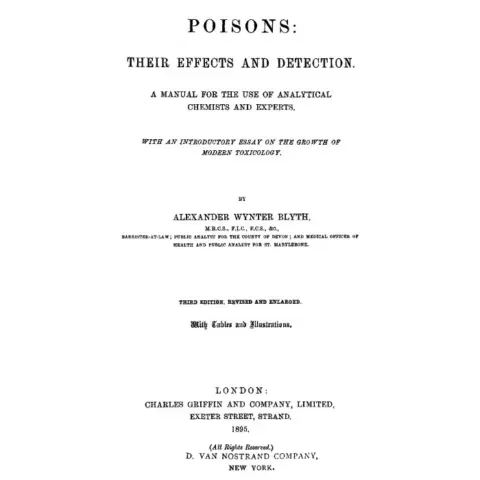
"Poisons, Their Effects and Detection" by Alexander Wynter Blyth is a scientific publication written in the late 19th century. This work serves as a comprehensive manual for analytical chemists and forensic experts, detailing the nature, effects, and detection methods of various toxic substances. It explores the historical context of poison knowledge, its physiological effects, and diagnostics, proving essential for anyone involved in toxicology or forensic medicine. The beginning of this manual outlines the origins of poison knowledge, highlighting the significance of the word "toxicology" and its connection to ancient practices involving poisons used on weaponry. It references mythological figures associated with poison, such as Hecate and Medea, and sets a tone of intrigue surrounding early toxicological research. Blyth emphasizes how ancient civilizations perceived poisons and the supernatural beliefs attached to them, paving the way through history to modern understandings of toxins and their effects on health and life.
Introduction adapted from the source catalogue; source summaries may be automatically generated.
Free to read · English · 336,607 words · No account needed
MAKE TIME FOR A GOOD BOOK
On by default. Untick to stop anonymous reading totals. Each page counts after 10 seconds in view. How this works.
Anonymous counting is on unless you have switched it off.
Actual deaths in
ten years ending 1892.
Caustic potash 19
Poisonous fungi 23
Aconite 59
Mercury 60
Belladonna 76
Sulphuric acid 93
Ammonia 98
Chlorodyne 102
Alcohol 108
Arsenic 110
Chloroform 113
Vermin-killer 127
Chloral 127
Phosphorus 155
Cyanide of potassium 166
Strychnine 201
Nitric acid 204
Prussic acid 260
Carbolic acid 762
Lead 1043
Opiates 1324
In each decade there are changes in the position on the list. The most significant difference between the statistics now given and the statistics for the ten years ending 1880, published in the last edition of this work, is that in the former decade carbolic acid occupied a comparatively insignificant place; whereas in the ten years ending 1892, deaths from carbolic acid poisoning are the most frequent form of fatal poisoning save lead and opiates.
The following table gives some German statistics of poisoning:--
TABLE SHOWING THE ADMISSIONS INTO VARIOUS MEDICAL INSTITUTIONS[30] IN BERLIN OF PERSONS SUFFERING FROM THE EFFECTS OF POISON DURING THE THREE YEARS 1876, 1877, 1878.
[30] Viz., the Königl. Charité, Allg. Städtisches Krankenhaus, Städtisches Baracken-Lazareth, Bethanien, St. Helwög’s-Lazarus, Elisabethen-Krankenhaus, Augusta Hospital, and the Institut für Staatsarzneikunde.
+--------------------------------------+--------+--------+--------+ | | Males. |Females.| Total. | +--------------------------------------+--------+--------+--------+ | Charcoal Vapour, | 77 | 78 | 155 | | Sulphuric Acid, | 24 | 54 }| | | Hydrochloric Acid, | 4 | 4 }| 93 | | Nitric Acid, and Aqua Regia, | 7 | ... }| | | Phosphorus, | 13 | 28 | 41 | | Cyanide of Potassium, | 29 | 3 }| | | Prussic Acid, | 5 | 1 }| 38 | | Oxalic Acid, and Oxalate of Potash, | 11 | 8 | 19 | | Alcohol, | 12 | 2 | 14 | | Arsenic, | 7 | 5 | 12 | | Morphine, | 8 | 1 }| | | Opium, | 2 | 1 }| 12 | | Potash or Soda Lye, | 2 | 6 | 8 | | Chloral, | 3 | 4 | 7 | | Chloroform, | 4 | 2 | 6 | | Sewer Gas, | 5 | ... | 5 | | Strychnine, | ... | 4 | 4 | | Atropine, | 1 | 2 | 3 | | Copper Sulphate, | 1 | 2 | 3 | | Nitrobenzol, | 2 | ... | 2 | | Carbolic Acid, | ... | 2 | 2 | | Chromic Acid, | 1 | 1 | 2 | | Burnt Alum, | ... | 1 | 1 | | Ammonium Sulphide, | 1 | ... | 1 | | Datura Stramonium, | ... | 1 | 1 | | Petroleum, | ... | 1 | 1 | | Benzine, | 1 | ... | 1 | | Ether, | 1 | ... | 1 | | Prussic Acid and Morphine, | 1 | ... | 1 | | Prussic Acid and Chloral, | 1 | ... | 1 | | Turpentine and Sal Ammoniac, | ... | 1 | 1 | | +--------+--------+--------+ | | 223 | 212 | 435 | +--------------------------------------+--------+--------+--------+
=Suicidal Poisoning.=--Poisons which kill more than one person suicidally each year are only 19 in number, as follows:--
Deaths from suicide
during the ten years
ending 1892.
Potassic bichromate 10
Chloroform 14
Chloral 15
Chlorodyne 16
Aconite 19
Belladonna 20
Mercury 24
Nitric acid 27
Ammonia 34
Sulphuric acid 53
Arsenic 77
Phosphorus 84
Vermin-killer 118
Prussic acid 122
Hydrochloric acid 138
Strychnine 150
Oxalic acid 200
Prussic acid 222
Opiates 281
Phenol 290
In the ten years ending 1880, suicidal deaths from vermin-killers, from prussic acid, from cyanide of potassium, and from opiates were all more numerous than deaths from phenol, whereas at present phenol appears to be the poison most likely to be chosen by a suicidal person.
Criminal Poisoning.
§ 22. Some useful statistics of criminal poisoning have been given by Tardieu[31] for the 21 years 1851-1871, which may be summarised as follows:--
[31] Étude Médico-Légale sur l’Empoisonnement, Paris, 1875.
Total accusations of Poisoning in the 21 years, 793
RESULTS OF THE POISONING:-- Death, 280 } Illness, 346 } 872 Negative, 246 }
ACCUSED:--
Men, 304 } 703
Women, 399 }
NATURE OF POISON EMPLOYED:-- Arsenic, 287 Phosphorus, 267
{ Sulphate, 120 } Copper { Acetate (Verdigris), 39 } 159
{ Sulphuric Acid, 36 } Acids { Hydrochloric Acid, 8 } 47 { Nitric Acid, 3 }
Cantharides, 30
Nux Vomica, 5 } 12 Strychnine, 7 }
{ Opium, 6 } Opiates { Laudanum, 3 } 10 { Sedative Water, 1 }
Salts of Mercury, 8
Sulphate of Iron, 6
Preparations of Antimony, 5
Ammonia, 4
Cyanides {Prussic Acid, 2 } {Cyanide of Potassium, 2 } 4
Hellebore, 3
Datura Stramonium, 3
Powdered Glass, 3
Digitalin, 2
Potash, 2
Your reading position is saved on this browser. Take it to another device with a library code. Reading pages adapt to text, rather than matching a printed edition.
BEHIND THE BOOK
This eBook is for the use of anyone anywhere in the United States and most other parts of the world at no cost and with almost no restrictions whatsoever. You may copy it, give it away or re-use it under the terms of the Project Gutenberg License included with this eBook or online at www.gutenberg.org. If you are not located in the United States, you will have to check the laws of the country where you are located before using this eBook. Read the source licence.
The original source file, including credits and licence, is retained by this library. Request an original-format copy at no charge. Please include the book title and Project Gutenberg identifier #42709.
KEEP YOUR CURIOSITY GOING
John Muir

Asa Gray
Asa Gray

Florence Nightingale
Elizabeth Robins Pennell
Denison Olmsted