THE CLASSIC COLLECTION✦Books and menCLASSIC FREE BOOKS
Books and men
Agnes Repplier
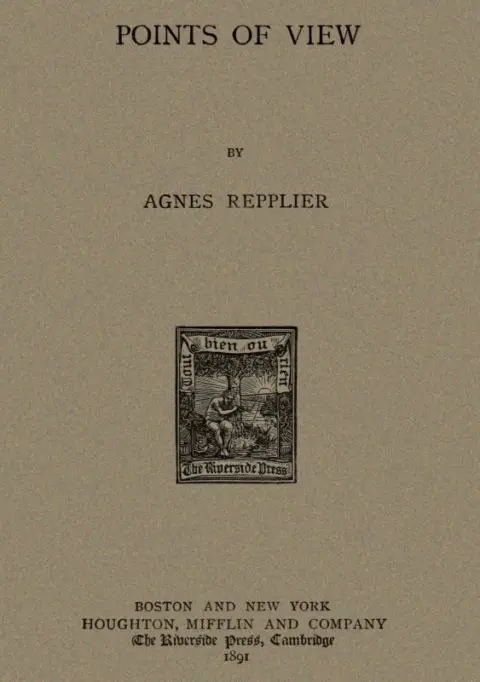
THE CLASSIC COLLECTION · 1891
"Points of View" by Agnes Repplier is a collection of essays written in the late 19th century. The work reflects on a variety of subjects including literature, humor, and the morality of storytelling, exploring the evolution and implications of these themes in society. Repplier's sharp wit and insightful commentary reveal her contemplative style as she discusses celebrated literary figures, contemporary critiques, and the changing nature of humor and earnestness in writing. The opening of the book introduces the theme of humor, tracing its decline and lamenting its rarity in modern literature. Repplier critiques the serious tone that has overtaken many literary works, suggesting that the joy of mirth has been overshadowed by moral tendencies. She references a range of authors, including Cervantes and Brontë, to illustrate her points, highlighting the tension between entertainment and moral responsibility in literature. As she delves into her concerns, it becomes clear that the essays serve as a plea for a return to light-heartedness and human connection through laughter, setting the stage for her broader explorations in the chapters to follow.
Introduction adapted from the source catalogue; source summaries may be automatically generated.
Free to read · English · 45,702 words · No account needed
MAKE TIME FOR A GOOD BOOK
On by default. Untick to stop anonymous reading totals. Each page counts after 10 seconds in view. How this works.
Anonymous counting is on unless you have switched it off.
Exactly as if they were shrimps or periwinkles! Very good measure, if you chance to like the stuff! “Dorothy, a Home Journal for Ladies,” in a rather attractive pale green cover, gives you every week a complete story, nearly half the length of an average English novel, and fairly well illustrated with full-page cuts. Each number contains, in addition, Dorothy’s Letter-Box, where all reasonable questions are answered, and Dorothy’s Drawing-Room, with items of fashionable news,--the whereabouts of the Queen, and the interesting fact that “the Duke and Duchess of Portland have been living quietly and giving no parties at Langwell, the Duke being desirous of affording the Duchess every chance of better regaining her health.” Also Hints for Practical Dressmaking, by “Busy Bee;” Our Homes, by “Lady Bird;” an occasional poem; and Notes on Handwriting, where you may learn that you have “ambition, an ardent, tender, affectionate, and sensitive nature, easily impressed, and inclined to jealousy. There is also some sense of beauty, vivid fancy, and sequence of ideas.” Now and then a doubting maid sends a scrap of her lover’s penmanship to be deciphered, and receives the following gentle encouragement:--
“LOVE LIES BLEEDING.--I hardly like to say whether the writer of the morsel you inclose would make a good husband; but I should imagine him as thoughtful for others, romantic and loving, very orderly in his habits, and fairly well educated; rather hot-tempered, but forgives and forgets quickly.”
All this for a penny,--two cents of American money! No wonder “Dorothy” reaches her millions of readers. No wonder the little green books lie in great heaps on the counters of every railway station in England. She is, perhaps, the most high-toned of such weekly issues; but “The Princess,” in a bright blue cover, follows closely in her wake, with a complete story, illustrated, and Boudoir Gossip about Prince George of Wales, and Mrs. Mackay, and the Earl and Countess of Jersey. “Bow Bells” and “The Wide World Novelettes” are on a distinctly lower scale: the fiction more sensational, the cuts coarser, and the pink cover of “Bow Bells” flaunting and vulgar. “A Magazine of Short Stories” aims at being lively and vivacious in the style of Rhoda Broughton, and gives a good pennyworth of tales, verses, Answers to Correspondents, and a column of Familiar Quotations Verified that alone is worth the money. But the final triumph of quantity over quality, of matter over mind, is in the “Book for All,” published weekly at the price of one penny, and containing five separate departments, for women, girls, men, boys, and children. Each of these departments has a short illustrated story, poetry, anecdotes, puzzles, confidential talks with the editor, advice on every subject, and information of every description. Here you can learn “how to preserve your beauty” and how to make “royal Battenberg” lace, how to run a Texas ranch and how to go into mourning for your mother, how to cure stammering and how to rid a dog of fleas. Here you may acquire knowledge upon the most varied topics, from lung diseases in animals to Catherine of Russia’s watch, from the aborigines of Australia to scientific notes on the Lithuanian language. The Unknown Public must indeed be athirst for knowledge, if it can absorb such quantities week after week with unabated zeal; and, from the Answers to Correspondents, we are led to suppose it is ever eager for more. One inquiring mind is comforted by the assurance that “narrative monophone will appear in its turn,” and an ambitious but elderly reader is gently warned that “a person aged fifty might learn to play on the guitar, and perhaps be able to sing; but the chances are that, in both instances, the performance will not be likely to captivate those who are compelled to listen to it.” On the whole, after an exhaustive study of penny weeklies, I should say that, were I expected to provide a large family with reading matter and encyclopædic information at the modest rate of one dollar and four cents a year, the “Book for All” would be the journal of my choice.
Your reading position is saved on this browser. Take it to another device with a library code. Reading pages adapt to text, rather than matching a printed edition.
Agnes Repplier
Agnes Repplier
Agnes Repplier
Agnes Repplier
BEHIND THE BOOK
This eBook is for the use of anyone anywhere in the United States and most other parts of the world at no cost and with almost no restrictions whatsoever. You may copy it, give it away or re-use it under the terms of the Project Gutenberg License included with this eBook or online at www.gutenberg.org. If you are not located in the United States, you will have to check the laws of the country where you are located before using this eBook. Read the source licence.
The original source file, including credits and licence, is retained by this library. Request an original-format copy at no charge. Please include the book title and Project Gutenberg identifier #59018.
KEEP YOUR CURIOSITY GOING

David Patterson (Spirit) Hatch

David Patterson (Spirit) Hatch

David Patterson (Spirit) Hatch

Ralph Waldo Emerson

Maurice Baring

Oscar Wilde & James McNeill Whistler