THE CLASSIC COLLECTION✦Books and menCLASSIC FREE BOOKS
Books and men
Agnes Repplier
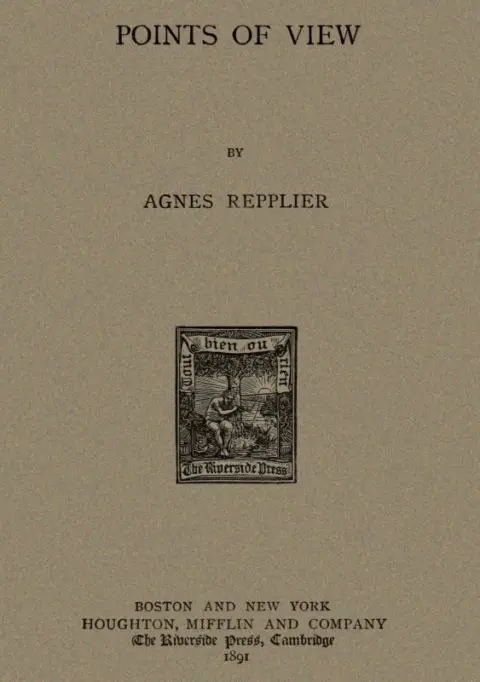
THE CLASSIC COLLECTION · 1891
"Points of View" by Agnes Repplier is a collection of essays written in the late 19th century. The work reflects on a variety of subjects including literature, humor, and the morality of storytelling, exploring the evolution and implications of these themes in society. Repplier's sharp wit and insightful commentary reveal her contemplative style as she discusses celebrated literary figures, contemporary critiques, and the changing nature of humor and earnestness in writing. The opening of the book introduces the theme of humor, tracing its decline and lamenting its rarity in modern literature. Repplier critiques the serious tone that has overtaken many literary works, suggesting that the joy of mirth has been overshadowed by moral tendencies. She references a range of authors, including Cervantes and Brontë, to illustrate her points, highlighting the tension between entertainment and moral responsibility in literature. As she delves into her concerns, it becomes clear that the essays serve as a plea for a return to light-heartedness and human connection through laughter, setting the stage for her broader explorations in the chapters to follow.
Introduction adapted from the source catalogue; source summaries may be automatically generated.
Free to read · English · 45,702 words · No account needed
MAKE TIME FOR A GOOD BOOK
On by default. Untick to stop anonymous reading totals. Each page counts after 10 seconds in view. How this works.
Anonymous counting is on unless you have switched it off.
In reading the recently published letters of Edward Fitzgerald, we cannot fail to be struck with the amount of unmixed pleasure he derived from his books, merely because he approached them with such instinctive honesty and singleness of purpose. He was perfectly frank in his satisfaction, and he was wholly innocent of any didactic tendency. Those subjects which he confessed he enjoyed because he only partly understood them, “just as the old women love sermons,” he refrained from interpreting to his friends; those “large, still books,” like “Clarissa Harlowe,” for which he shared all Tennyson’s enthusiasm, he forbore to urge upon less leisurely readers. And what a world of meaning in that single line, “For human delight, Shakespeare, Cervantes, and Scott”! For human delight! The words sound like a caress; a whole sunny vista opens before us; idleness and pleasure lure us gently on; a warm and mellow atmosphere surrounds us; we are invited, not driven, to be happy. I cannot but compare Fitzgerald reading Scott, “for human delight,” in the quiet winter evenings, with a very charming old gentleman whom I recently saw working conscientiously--so I thought--through Tolstoï’s “Peace and War.” He sighed a little when he spoke to me, and held up the book for inspection. “My daughter-in-law sent it to me,” he explained resignedly, “and said I must be sure and read it. But,”--this with a sudden sense of gratitude and deliverance,--“thank Heaven! one volume was lost on the way.” Now we have Mr. Andrew Lang’s word for it that the Englishmen of to-day, “those poor islanders,” indeed, are better acquainted with “Anna Karenina” than with “The Fortunes of Nigel,” and we cannot well doubt the assertion, in view of the too manifest regret with which it is uttered. But then nobody reads “The Fortunes of Nigel” because he has been told to read it, nor because his neighbors are reading it, nor because he wants to say that he has read it. The hundred and one excellent reasons for becoming acquainted with Tolstoï or Ibsen resolve themselves into a single motive when we turn to Scott. It is “for human delight” or nothing. And if, even to children, this joy has grown somewhat tasteless of late years, I fear the reason lies in their lack of healthy unconsciousness. They are taught so much they did not use to know about the correct standing of authors, they are so elaborately directed in their recreations as well as in their studies, that the old simple charm of self-forgetful absorption in a book seems well-nigh lost to them. It is not very encouraging to see a bright little girl of ten making believe she enjoys Miss Austen’s novels, and to hear her mother’s complacent comments thereon, when we realize how exclusively the fine, thin perfection of Miss Austen’s work appeals to the mature observation of men and women, and how utterly out of harmony it must be with the crude judgment and expansive ideality of a child. I am willing to believe that these abnormally clever little people, who read grown-up books so conspicuously in public, love their Shakespeares, and their Grecian histories, and their “Idylls of the King.” I have seen literature of the delicately elusive order, like “The Marble Faun,” and “Elsie Venner,” and “Lamia,” devoured with a wistful eagerness that plainly revealed the awakened imagination responding with quick delight to the sweet and subtle charm of mystery. But I am impelled to doubt the attractiveness of Thackeray to the youthful mind, even when I have just been assured that “Henry Esmond” is “a lovely story;” and I am still more skeptical as to Miss Austen’s marvelous hair-strokes conveying any meaning at all to the untrained faculties of a child. Can it be that our boys and girls have learned from Emerson and Carlyle not to wish to be amused? Or is genuine amusement so rare that, like Mr. Payn’s young friend, they have grown reconciled to a pretended sensation, and strive dutifully to make the most of it? Alas! such pretenses are not always the facile things they seem, and if a book is ever to become a friend to either young or old, it must be treated with that simple integrity on which all lasting amity is built. “Read, not to contradict and confute,” says Lord Bacon, “nor to believe and take for granted, nor to find talk and discourse;” and, in the delicate irony of this advice, we discern the satisfaction of the philosopher in having deprived the mass of mankind of the only motives which prompt them to read at all.
Your reading position is saved on this browser. Take it to another device with a library code. Reading pages adapt to text, rather than matching a printed edition.
Agnes Repplier
Agnes Repplier
Agnes Repplier
Agnes Repplier
BEHIND THE BOOK
This eBook is for the use of anyone anywhere in the United States and most other parts of the world at no cost and with almost no restrictions whatsoever. You may copy it, give it away or re-use it under the terms of the Project Gutenberg License included with this eBook or online at www.gutenberg.org. If you are not located in the United States, you will have to check the laws of the country where you are located before using this eBook. Read the source licence.
The original source file, including credits and licence, is retained by this library. Request an original-format copy at no charge. Please include the book title and Project Gutenberg identifier #59018.
KEEP YOUR CURIOSITY GOING

David Patterson (Spirit) Hatch

David Patterson (Spirit) Hatch

David Patterson (Spirit) Hatch

Ralph Waldo Emerson

Maurice Baring

Oscar Wilde & James McNeill Whistler