THE CLASSIC COLLECTION✦Books and menCLASSIC FREE BOOKS
Books and men
Agnes Repplier
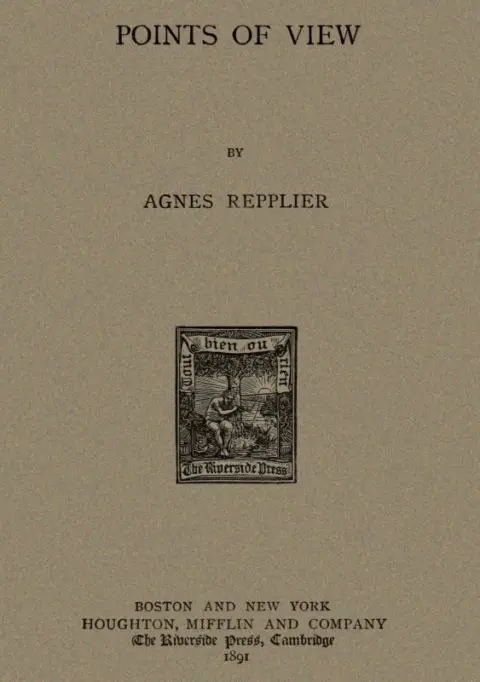
THE CLASSIC COLLECTION · 1891
"Points of View" by Agnes Repplier is a collection of essays written in the late 19th century. The work reflects on a variety of subjects including literature, humor, and the morality of storytelling, exploring the evolution and implications of these themes in society. Repplier's sharp wit and insightful commentary reveal her contemplative style as she discusses celebrated literary figures, contemporary critiques, and the changing nature of humor and earnestness in writing. The opening of the book introduces the theme of humor, tracing its decline and lamenting its rarity in modern literature. Repplier critiques the serious tone that has overtaken many literary works, suggesting that the joy of mirth has been overshadowed by moral tendencies. She references a range of authors, including Cervantes and Brontë, to illustrate her points, highlighting the tension between entertainment and moral responsibility in literature. As she delves into her concerns, it becomes clear that the essays serve as a plea for a return to light-heartedness and human connection through laughter, setting the stage for her broader explorations in the chapters to follow.
Introduction adapted from the source catalogue; source summaries may be automatically generated.
Free to read · English · 45,702 words · No account needed
MAKE TIME FOR A GOOD BOOK
On by default. Untick to stop anonymous reading totals. Each page counts after 10 seconds in view. How this works.
Anonymous counting is on unless you have switched it off.
There is a lingering sweetness in these lines, for all their manifest unwisdom, that is surpassed only by a pathetic sonnet of Drayton’s, where the pain of parting, bravely borne at first, grows suddenly too sharp for sufferance, and the lover’s pride breaks and melts into the passion of a last appeal:--
“Since there’s no helpe,--come, let us kisse and parte.
Nay, I have done,--you get no more of me;
And I am glad,--yea, glad with all my hearte,
That thus so cleanly I myself can free.
Shake hands forever!--cancel all our vows;
And when we meet at any time againe,
Be it not seene in either of our brows,
That we one jot of former love retaine.
“Now--at the last gaspe of Love’s latest breath-- When, his pulse failing, passion speechless lies; When Faith is kneeling by his bed of death, And Innocence is closing up his eyes, Now! if thou would’st--when all have given him over-- From death to life thou might’st him yet recover.”
Here, at least, we have grace of sentiment and beauty of form combined to make a perfect whole. It seems strange indeed that Mr. Saintsbury, who gives such generous praise to Drayton’s patriotic poems, his legends, his epistles, even his prose prefaces, should have no single word to spare for this most tender and musical of leave-takings.
As for the capricious humors and overwrought imagery which disfigure so many of the early love-songs, they have received their full allotment of censure, and have provoked the scornful mirth of critics too staid or too sensitive to be tolerant. We hear more of them, sometimes, than of the merits which should win them forgiveness. Lodge, dazzled by Rosalynde’s beauty, is ill disposed to pass lightly over the catalogue of her charms. Her lips are compared to budded roses, her teeth to ranks of lilies; her eyes are
“sapphires set in snow,
Refining heaven by every wink,”
her cheeks are blushing clouds, and her neck is a stately tower where the god of love lies captive. All things in nature contribute to her excellence:--
“With Orient pearl, with ruby red,
With marble white, with sapphire blue,
Her body every way is fed,
Yet soft to touch, and sweet in view.”
But when this fair representative of all flowers and gems, “smiling to herself to think of her new entertained passion,” lifts up the music of her voice in that enchanting madrigal,--
“Love in my bosom, like a bee,
Doth suck his sweet;
Now with his wings he plays with me,
Now with his feet,”--
Your reading position is saved on this browser. Take it to another device with a library code. Reading pages adapt to text, rather than matching a printed edition.
Agnes Repplier
Agnes Repplier
Agnes Repplier
Agnes Repplier
BEHIND THE BOOK
This eBook is for the use of anyone anywhere in the United States and most other parts of the world at no cost and with almost no restrictions whatsoever. You may copy it, give it away or re-use it under the terms of the Project Gutenberg License included with this eBook or online at www.gutenberg.org. If you are not located in the United States, you will have to check the laws of the country where you are located before using this eBook. Read the source licence.
The original source file, including credits and licence, is retained by this library. Request an original-format copy at no charge. Please include the book title and Project Gutenberg identifier #59018.
KEEP YOUR CURIOSITY GOING

David Patterson (Spirit) Hatch

David Patterson (Spirit) Hatch

David Patterson (Spirit) Hatch

Ralph Waldo Emerson

Maurice Baring

Oscar Wilde & James McNeill Whistler