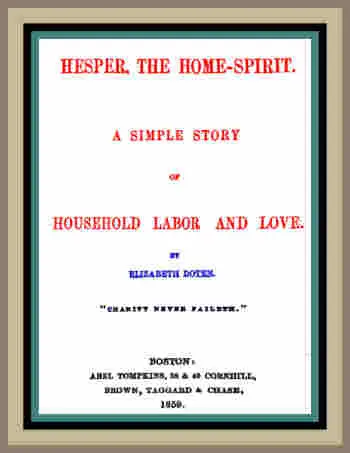
Hesper, the Home-Spirit: A simple story of household labor and love
Lizzie Doten
THE CLASSIC COLLECTION · 1873
"Poems of Progress" by Lizzie Doten is a collection of poetry written in the late 19th century. The work delves into themes of spirituality, human experience, and the eternal quest for truth and understanding, likely drawing inspiration from the author's involvement in the Spiritualist movement. Through her verses, Doten explores complex emotions and societal issues, reflecting a belief in the transformative power of love and the potential of the human spirit. At the start of the collection, the author addresses the reader with a "Declaration of Faith," firmly asserting her commitment to Spiritualism and the positive impact it has had on society. She defends the movement against criticisms, stressing its focus on the purification of the human spirit and the importance of love and compassion. The opening portion establishes a philosophical foundation for the poems to follow, which will likely explore the interplay between life, death, and the essence of existence.
Introduction adapted from the source catalogue; source summaries may be automatically generated.
Free to read · English · 33,809 words · No account needed
MAKE TIME FOR A GOOD BOOK
On by default. Untick to stop anonymous reading totals. Each page counts after 10 seconds in view. How this works.
Anonymous counting is on unless you have switched it off.
“Beautiful Angels, fair and bright,
Holding the hem of your garments white,
Let me go forth to the world of light.”
Poor old Margery Miller!
So earnest grown!
Was she left alone?
His humble child did the Lord disown?
O, sweet was the sound of the Christmas bell,
As its musical changes rose and fell,
With a low refrain or a solemn swell.
But sweeter by far was the blesséd strain,
That soothed old Margery Miller’s pain,
And gave her comfort and peace again.
Poor old Margery Miller!
In silence alone,
Her faith had grown;
And now the blossom had brightly blown.
Out of the glory that burned like flame,
Calmly a great white angel came--
Softly he whispered her humble name.
“Child of the highest,” he gently said,
“Thy toils are ended, thy tears are shed,
And life immortal now crowns thy head.”
Poor old Margery Miller!
No longer alone,
Unsought, unknown,
God had not forgotten she was his own.
A change o’er her pallid features passed;
She felt that her feet were nearing fast
The land of safety and peace, at last.
She faintly murmured, “God’s name be blest!”
And folding her hands on her dying breast,
She calmly sank to her dreamless rest.
Poor old Margery Miller!
Sitting alone,
Without one moan,
Her patient spirit at length had flown.
Next morning a stranger found her there,
Her pale hands folded as if in prayer,
Sitting so still in her old arm-chair.
He spoke--but she answered not again,
For, far away from all earthly pain,
Her voice was singing a joyful strain.
Poor old Margery Miller!
Her spirit had flown
To the world unknown,
Where true hearts never can be alone.
Deeply musing
On the many mysteries of life;
Half excusing
All man’s seeming failures in the strife;
Through the city
Did I take my lonely way at night;
Filled with pity
For the miseries that met my sight,
In the faces, sickly, sad and sunken,
In the faces, meager, mean and shrunken,
Wanton, leering, passionate and drunken,
Which I saw that night,
Passing through the city--
Saw them by the street-lamps’ changing light.
Burning brightly,
Looked the watching stars from heaven above;
As if lightly
They beheld these wrecks of human love.
“O, how distant,”
Said I, “are they from this earth apart!
How resistant
To the woes that rend the human heart!
Countless worlds! your radiant courses rounding,
With your light the depth of distance sounding,
Is there not some fount of love abounding?
O, thou starlit night
Brooding o’er the city!
Would that truth might as thy stars shine bright.”
Your reading position is saved on this browser. Take it to another device with a library code. Reading pages adapt to text, rather than matching a printed edition.
BEHIND THE BOOK
This eBook is for the use of anyone anywhere in the United States and most other parts of the world at no cost and with almost no restrictions whatsoever. You may copy it, give it away or re-use it under the terms of the Project Gutenberg License included with this eBook or online at www.gutenberg.org. If you are not located in the United States, you will have to check the laws of the country where you are located before using this eBook. Read the source licence.
The original source file, including credits and licence, is retained by this library. Request an original-format copy at no charge. Please include the book title and Project Gutenberg identifier #55032.
KEEP YOUR CURIOSITY GOING

David Patterson (Spirit) Hatch

David Patterson (Spirit) Hatch

David Patterson (Spirit) Hatch

Edwin Abbott Abbott

Richard Watson
T. G. (Theophilus Gould) Steward