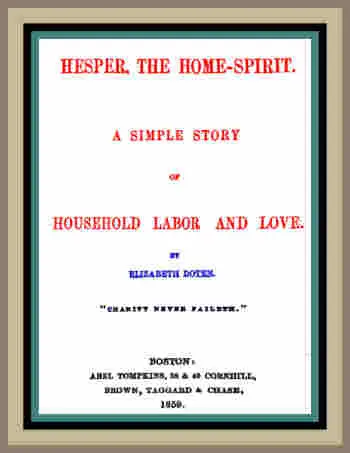
Hesper, the Home-Spirit: A simple story of household labor and love
Lizzie Doten
THE CLASSIC COLLECTION · 1873
"Poems of Progress" by Lizzie Doten is a collection of poetry written in the late 19th century. The work delves into themes of spirituality, human experience, and the eternal quest for truth and understanding, likely drawing inspiration from the author's involvement in the Spiritualist movement. Through her verses, Doten explores complex emotions and societal issues, reflecting a belief in the transformative power of love and the potential of the human spirit. At the start of the collection, the author addresses the reader with a "Declaration of Faith," firmly asserting her commitment to Spiritualism and the positive impact it has had on society. She defends the movement against criticisms, stressing its focus on the purification of the human spirit and the importance of love and compassion. The opening portion establishes a philosophical foundation for the poems to follow, which will likely explore the interplay between life, death, and the essence of existence.
Introduction adapted from the source catalogue; source summaries may be automatically generated.
Free to read · English · 33,809 words · No account needed
MAKE TIME FOR A GOOD BOOK
On by default. Untick to stop anonymous reading totals. Each page counts after 10 seconds in view. How this works.
Anonymous counting is on unless you have switched it off.
She sang of the love, of the free, great love,
Which the Father has for all,
From the worlds of light, in the heavens above,
To the flowers and the insects small.
“Ah!” sighed the Brier, the brown old Brier,
“What has he done for me?”
Does he give me leaves in the early spring,
Or flowers like the locust tree?”
“Our God is just, and our God is true,”
Still warbled the happy child;
“He sendeth his sunshine and silver dew
To the desert and lonely wild;
And the secret force in the tempest cloud
To the smallest flower is given,
That all, by his wisdom and strength endowed,
May live for the Lord of Heaven.”
She passed. The old Brier was lost in thought.
“And is it, then, really so?
Can this wondrous change by myself be wrought?
Have I power in myself to grow?”
Then up from the gray old mother Earth
Rich juices he quickly drew,
Till the sluices and channels small were filled
With the fresh sap trickling through.
He called to the winds, to the warm spring winds,
As they played with the flowers near by,
And he prayed the sunshine, with golden wings,
On his cold, damp roots to lie.
The spring winds blew, and the sunshine came,
And the Brier grew fresh and fair,
Till his blossoms, like wreaths of incense cups,
With their fragrance filled the air.
Again the child to the green-wood came;
But her step was sad and slow;
Her eye beamed not with its love-lit flame,
And her voice was soft and low.
“I am changed,” she said; “O ye birds and flowers!
With a yearning heart I weep
To lay me down in these quiet bowers,
In a long, untroubled sleep.
For O, my heart like a flower is crushed,
And I cling to the world no more;
The sacred fount from its urn hath gushed,
And the joy of my life is o’er.”
The summer winds through the green-wood passed,
And the sweet Brier bowed his head;
A garland fair at her feet he cast,
And in gentle tones he said,--
“Return to the world, dear child, return;
No longer receive, but give!
From a humble Brier this lesson learn:
Thou hast power in thyself to live.
Sung at the celebration of the 20th anniversary of
Modern Spiritualism,
March 31, 1868.
THE world hath felt a quickening breath
From Heaven’s eternal shore,
And souls triumphant over Death
Return to earth once more.
For this we hold our jubilee,
For this with joy we sing--
“O Grave, where is thy victory?
O Death, where is thy sting?”
Your reading position is saved on this browser. Take it to another device with a library code. Reading pages adapt to text, rather than matching a printed edition.
BEHIND THE BOOK
This eBook is for the use of anyone anywhere in the United States and most other parts of the world at no cost and with almost no restrictions whatsoever. You may copy it, give it away or re-use it under the terms of the Project Gutenberg License included with this eBook or online at www.gutenberg.org. If you are not located in the United States, you will have to check the laws of the country where you are located before using this eBook. Read the source licence.
The original source file, including credits and licence, is retained by this library. Request an original-format copy at no charge. Please include the book title and Project Gutenberg identifier #55032.
KEEP YOUR CURIOSITY GOING

David Patterson (Spirit) Hatch

David Patterson (Spirit) Hatch

David Patterson (Spirit) Hatch

Edwin Abbott Abbott

Richard Watson
T. G. (Theophilus Gould) Steward