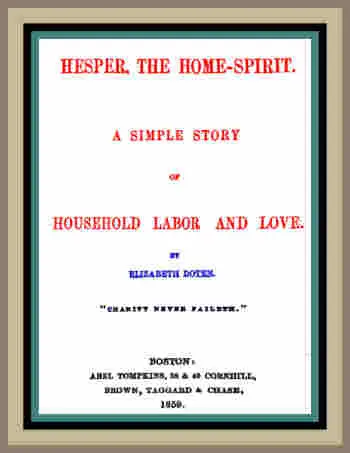
Hesper, the Home-Spirit: A simple story of household labor and love
Lizzie Doten
THE CLASSIC COLLECTION · 1873
"Poems of Progress" by Lizzie Doten is a collection of poetry written in the late 19th century. The work delves into themes of spirituality, human experience, and the eternal quest for truth and understanding, likely drawing inspiration from the author's involvement in the Spiritualist movement. Through her verses, Doten explores complex emotions and societal issues, reflecting a belief in the transformative power of love and the potential of the human spirit. At the start of the collection, the author addresses the reader with a "Declaration of Faith," firmly asserting her commitment to Spiritualism and the positive impact it has had on society. She defends the movement against criticisms, stressing its focus on the purification of the human spirit and the importance of love and compassion. The opening portion establishes a philosophical foundation for the poems to follow, which will likely explore the interplay between life, death, and the essence of existence.
Introduction adapted from the source catalogue; source summaries may be automatically generated.
Free to read · English · 33,809 words · No account needed
MAKE TIME FOR A GOOD BOOK
On by default. Untick to stop anonymous reading totals. Each page counts after 10 seconds in view. How this works.
Anonymous counting is on unless you have switched it off.
That which ye ca’ the power o’ law,
Is but a puir invention;
It counts the deed as evil seed,
But winks at the intention.
Could men but be mair truly free,
In some things less restrickéd,
The world wad find the human kind
Wad na’ be half sae wicked.
The pent-up steed kept short o’ feed
Is wildest in his roamin’;
And dammed-up streams, wi’ angry gleams,
Dash o’er each hindrance foamin’.
Therefore (I pray take what I say
In spirit, not in letter)
Mankind should be like rivers, free--
The less they’re damned the better.
You need na’ heed the grousome creed
Which tells ye o’ God’s anger;
On Nature’s page frae age to age,
His love is written stranger.
God’s providence, in ony sense,
Has never been one-sided,
And for the weal o’ chick, or chiel,
He amply has provided.
The winter’s snaw, the birken shaw,[24]
The gowans[25] brightly springing,
The murky night, the rosy light,
The laverocks[26] gayly singing,
The spring’s return, the wimplin burn,[27]
The cushat[28] fondly mated,
All join to tell how unco well
God lo’es all things created.
Then dinna strive to live and thrive
Sae selfish and unthinkin’,
But firmly stand, and lend a hand
To keep the weak frae sinkin’.
’Tis love can make, for love’s sweet sake,
A trusty fier[29] in sorrow,
Wha spends his gear[30] wi’out a fear
O’ what may be to-morrow.
The preachers say, there’s far awa’
A land o’ milk and honey,
Where all is free as barley brie,
And wi’out price or money;
But here the meat o’ love is sweet,
For souls in sinful blindness,
And there’s a milk that’s guid for ilk[31]--
“The milk o’ human kindness.”
The lift aboon[32] will welcome sune
The wayworn and the weary,
And angels fair will greet them there,
Sae winsome and sae cheery.
But while they stay, make smooth the way,
Through all life’s wintry weather,
Until ane bield[33] and common shield,
Shall hauld ye all thegither.
ONCE, when Death, the mighty hunter,
Bent his bow and sent an arrow
Through the shadows of the forest,
Harming not the Bear or Panther,
Harming not the Owl or Raven,
In the bosom of Oweena,
Fairest of the Indian maidens,
Was the fatal arrow hidden.
On the lodge of Massa-wam-sett
Fell a deep and dreadful shadow;
He, the wise and warlike Sachem,
Mourned in silence for Oweena;
But the mother, Nah-me-o-ka,
Like a tall pine in the tempest,
Tossed her arms in wildest anguish,
Pouring forth her lamentation:
Your reading position is saved on this browser. Take it to another device with a library code. Reading pages adapt to text, rather than matching a printed edition.
BEHIND THE BOOK
This eBook is for the use of anyone anywhere in the United States and most other parts of the world at no cost and with almost no restrictions whatsoever. You may copy it, give it away or re-use it under the terms of the Project Gutenberg License included with this eBook or online at www.gutenberg.org. If you are not located in the United States, you will have to check the laws of the country where you are located before using this eBook. Read the source licence.
The original source file, including credits and licence, is retained by this library. Request an original-format copy at no charge. Please include the book title and Project Gutenberg identifier #55032.
KEEP YOUR CURIOSITY GOING

David Patterson (Spirit) Hatch

David Patterson (Spirit) Hatch

David Patterson (Spirit) Hatch

Edwin Abbott Abbott

Richard Watson
T. G. (Theophilus Gould) Steward