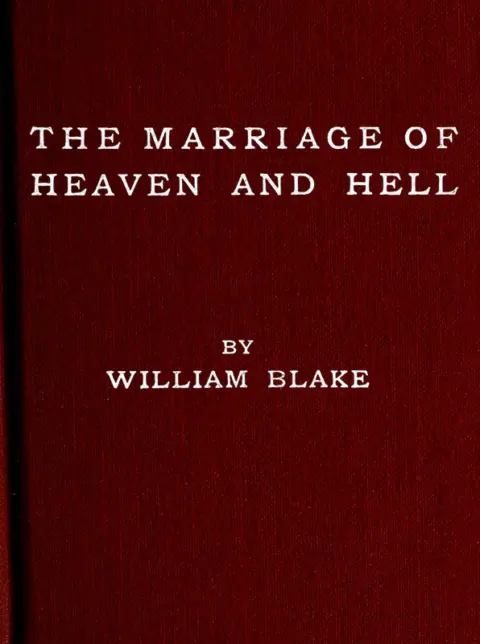
The Marriage of Heaven and Hell
William Blake
THE CLASSIC COLLECTION · 1783
Poems by William Blake. Explore this classic work in a free online edition. Subjects include English poetry -- 19th century; English poetry -- 18th century. Read the locally hosted text below, adjust the reading display, and continue where you left off.
Introduction adapted from the source catalogue; source summaries may be automatically generated.
Free to read · English · 26,448 words · No account needed
MAKE TIME FOR A GOOD BOOK
On by default. Untick to stop anonymous reading totals. Each page counts after 10 seconds in view. How this works.
Anonymous counting is on unless you have switched it off.
Cruelty has a human heart,
And Jealousy a human face;
Terror the human form divine,
And Secrecy the human dress.
The human dress is forged iron,
The human form a fiery forge,
The human face a furnace sealed,
The human heart its hungry gorge.
A Cradle Song
Sleep, sleep, beauty bright,
Dreaming in the joys of night;
Sleep, sleep; in thy sleep
Little sorrows sit and weep.
Sweet babe, in thy face
Soft desires I can trace,
Secret joys and secret smiles,
Little pretty infant wiles.
As thy softest limbs I feel,
Smiles as of the morning steal
O’er thy cheek, and o’er thy breast
Where thy little heart doth rest.
O, the cunning wiles that creep
In thy little heart asleep!
When thy little heart doth wake,
Then the dreadful light shall break.
The Schoolboy
I love to rise in a summer morn,
When the birds sing on every tree;
The distant huntsman winds his horn,
And the skylark sings with me;
O, what sweet company!
But to go to school in a summer morn,—
O, it drives all joy away!
Under a cruel eye outworn,
The little ones spend the day
In sighing and dismay.
Ah, then at times I drooping sit,
And spend many an anxious hour;
Nor in my book can I take delight,
Nor sit in learning’s bower,
Worn through with the dreary shower.
How can the bird that is born for joy
Sit in a cage and sing?
How can a child when fears annoy,
But droop his tender wing,
And forget his youthful spring?
O father and mother, if buds are nipped,
And blossoms blown away;
And if the tender plants are stripped
Of their joy in the springing day,
By sorrow and care’s dismay,—
How shall the summer arise in joy,
Or the summer fruits appear?
Or how shall we gather what griefs destroy,
Or bless the mellowing year,
When the blasts of winter appear?
To Tirzah
Whate’er is born of mortal birth
Must be consumed with the earth,
To rise from generation free:
Then what have I to do with thee?
The sexes sprung from shame and pride,
Blowed in the morn, in evening died;
But mercy changed death into sleep;
The sexes rose to work and weep.
Thou, mother of my mortal part,
With cruelty didst mould my heart,
And with false self-deceiving tears
Didst blind my nostrils, eyes, and ears,
Didst close my tongue in senseless clay,
And me to mortal life betray.
The death of Jesus set me free:
Then what have I to do with thee?
The Voice of the Ancient
Bard
Your reading position is saved on this browser. Take it to another device with a library code. Reading pages adapt to text, rather than matching a printed edition.
William Blake
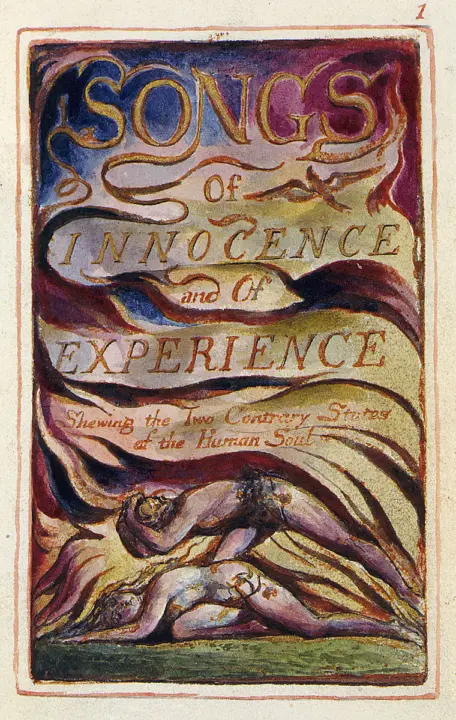
William Blake
BEHIND THE BOOK
This eBook is for the use of anyone anywhere in the United States and most other parts of the world at no cost and with almost no restrictions whatsoever. You may copy it, give it away or re-use it under the terms of the Project Gutenberg License included with this eBook or online at www.gutenberg.org. If you are not located in the United States, you will have to check the laws of the country where you are located before using this eBook. Read the source licence.
The original source file, including credits and licence, is retained by this library. Request an original-format copy at no charge. Please include the book title and Project Gutenberg identifier #79363.
KEEP YOUR CURIOSITY GOING

Eric Mackay
Edmund Gosse
Sophia Margaretta Hensley
Gilbert Parker
George MacDonald

Elizabeth Bibesco