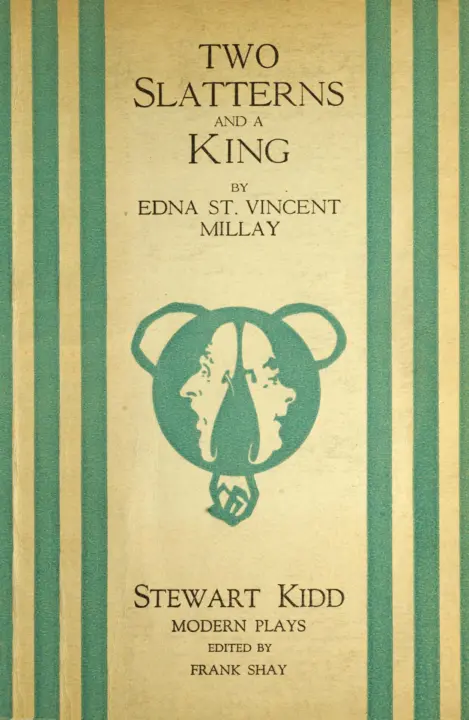
Two Slatterns and a King: A Moral Interlude
Edna St. Vincent Millay
THE CLASSIC COLLECTION · 1923
"Poems by Edna St. Vincent Millay" is a collection of poetry written in the early 20th century. The book showcases Millay's lyrical and emotive style, conveying themes of love, nature, existence, and personal reflection through her captivating verse. Millay, a prominent figure in American literature, infuses her work with deep emotional currents and innovative structures, making her poetry resonate powerfully with readers. The collection features a diverse array of poems that explore various aspects of human experience. From the profound introspection of "Renascence" to the spirited melancholy in "Sorrow," Millay's voice ranges from joyful exuberance to poignant despair. The poems evoke vivid imagery and emotion, addressing topics such as love's fleeting nature, the beauty of the natural world, and existential musings on life and death. Millay’s ability to intertwine personal sentiment with universal truths invites readers to traverse the landscapes of both the heart and the mind, rendering her work timeless and deeply relatable.
Introduction adapted from the source catalogue; source summaries may be automatically generated.
Free to read · English · 14,334 words · No account needed
MAKE TIME FOR A GOOD BOOK
On by default. Untick to stop anonymous reading totals. Each page counts after 10 seconds in view. How this works.
Anonymous counting is on unless you have switched it off.
Always before about my dooryard,
Marking the reach of the winter sea,
Rooted in sand and dragging drift-wood,
Straggled the purple wild sweet-pea;
Always I climbed the wave at morning,
Shook the sand from my shoes at night,
That now am caught beneath great buildings
Stricken with noise, confused with light.
If I could hear the green piles groaning
Under the windy wooden piers,
See once again the bobbing barrels,
And the black sticks that fence the weirs,
If I could see the weedy mussels
Crusting the wrecked and rotting hulls,
Hear once again the hungry crying
Overhead, of the wheeling gulls,
Feel once again the shanty straining
Under the turning of the tide,
Fear once again the rising freshet,
Dread the bell in the fog outside,--
I should be happy,--that was happy
All day long on the coast of Maine!
I have a need to hold and handle
Shells and anchors and ships again!
I should be happy, that am happy
Never at all since I came here.
I am too long away from water.
I have a need of water near.
The Death of Autumn
When reeds are dead and a straw to thatch the marshes, And feathered pampas-grass rides into the wind Like agèd warriors westward, tragic, thinned Of half their tribe, and over the flattened rushes, Stripped of its secret, open, stark and bleak, Blackens afar the half-forgotten creek,-- Then leans on me the weight of the year, and crushes My heart. I know that Beauty must ail and die, And will be born again,--but ah, to see Beauty stiffened, staring up at the sky! Oh, Autumn! Autumn!--What is the Spring to me?
Ode to Silence
Aye, but she?
Your other sister and my other soul,
Grave Silence, lovelier
Than the three loveliest maidens, what of her?
Clio, not you,
Not you, Calliope,
Nor all your wanton line,
Not Beauty’s perfect self shall comfort me
For Silence once departed,
For her the cool-tongued, her the tranquil-hearted,
Whom evermore I follow wilfully,
Wandering Heaven and Earth and Hell and the four seasons through;
Thalia, not you,
Not you, Melpomene,
Not your incomparable feet, O thin Terpsichore,
I seek in this great hall,
But one more pale, more pensive, most beloved of you all.
I seek her from afar.
I come from temples where her altars are,
From groves that bear her name,
Noisy with stricken victims now and sacrificial flame,
And cymbals struck on high and strident faces
Obstreperous in her praise
They neither love nor know,
A goddess of gone days,
Departed long ago,
Abandoning the invaded shrines and fanes
Of her old sanctuary,
A deity obscure and legendary,
Of whom there now remains,
For sages to decipher and priests to garble,
Only and for a little while her letters wedged in marble,
Which even now, behold, the friendly mumbling rain erases,
And the inarticulate snow,
Leaving at last of her least signs and traces
None whatsoever, nor whither she is vanished from these places.
Your reading position is saved on this browser. Take it to another device with a library code. Reading pages adapt to text, rather than matching a printed edition.
Edna St. Vincent Millay
Edna St. Vincent Millay
Edna St. Vincent Millay
Edna St. Vincent Millay
BEHIND THE BOOK
This eBook is for the use of anyone anywhere in the United States and most other parts of the world at no cost and with almost no restrictions whatsoever. You may copy it, give it away or re-use it under the terms of the Project Gutenberg License included with this eBook or online at www.gutenberg.org. If you are not located in the United States, you will have to check the laws of the country where you are located before using this eBook. Read the source licence.
The original source file, including credits and licence, is retained by this library. Request an original-format copy at no charge. Please include the book title and Project Gutenberg identifier #59167.
KEEP YOUR CURIOSITY GOING

Eric Mackay
Edmund Gosse
Sophia Margaretta Hensley
Gilbert Parker
George MacDonald

Elizabeth Bibesco