
Love Letters of a Violinist, and Other Poems
Eric Mackay
THE CLASSIC COLLECTION · 1902
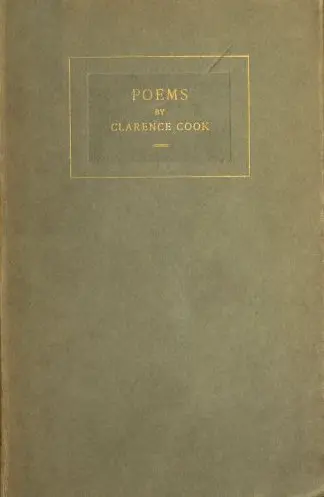
"Poems by Clarence Cook" is a collection of poetry written by Clarence Cook and privately printed in the early 20th century. This volume features a compilation of both published and unpublished verses, showcasing Cook's reflections on nature, love, mortality, and the human experience. The poems exhibit the characteristics of 19th-century poetic traditions, echoing the Romantic movement's emphasis on emotion and individualism. In this collection, Cook explores a variety of themes through vivid imagery and contemplative language. The poems, such as "The Maple Tree" and "Regret," depict the beauty of nature while intertwining personal reflections on life and loss. The poet often employs personification, addressing abstract concepts like aspiration, ennui, and death. Throughout the verses, there is a sense of longing and introspection, as Cook grapples with existential questions and the passage of time, ultimately seeking solace in the transience of beauty and the enduring power of love.
Introduction adapted from the source catalogue; source summaries may be automatically generated.
Free to read · English · 7,290 words · No account needed
MAKE TIME FOR A GOOD BOOK
On by default. Untick to stop anonymous reading totals. Each page counts after 10 seconds in view. How this works.
Anonymous counting is on unless you have switched it off.
Say, does this trouble thee
That all things fickle be?
The wind that buffets so
Was kind an hour ago.
The sun, a cloud doth hide,
Cheered thee at morning tide.
The busy pleasuring bee
Sought thee for company.
The little sparrows near
Sang thee their ballads clear.
The maples on thy head
Their spicy blossoms shed.
Because the storm made dumb
The wild bees booming hum;
Because for shivering
The sparrows cannot sing;
Is this the reason why
Thou look’st so woefully?
To-morrow’s laughing sun
Will cheer thee, pallid one;
To-morrow will bring back
The gay bee on his track,
Bursting thy cloister dim
With his wild roistering.
Canst thou not wait the morrow,
That rids thee of thy sorrow?
Art thou too desolate
To smile at any fate?
Then there is naught for thee
But Death’s delivery.
The Roses, May 4, 1853.
Look out, sad heart, through wintry eyes
To see thy summer go:
How pallid are thy bluest skies
Behind this veiling snow.
Look out upon thy purple hills,
That all the summer long,
Laughed with an hundred laughing rills,
And sang their summer song.
You only see the sheeted snow
That covers grass and tree;
The frozen streamlets cannot flow,
No bird dares sing to thee.
Look out upon Life’s summer days
That fade like summer flowers;
What golden fruitage for thy praise,
From all those bounteous hours?
Sings any bird, or any wind
Amid thy falling leaves?
Why is it, if thou look’st behind,
Thy heart forever grieves?
Newburgh, January 4, 1854.
Oh April grass, so truly
My wish for spring divining,
Oh April sun, so gaily
In at my window shining,
What cheer can ye impart
Unto a faded heart?
Oh thoughts of Summer days
Born of the violet’s blue.
Oh wooing western wind,
That maketh all things new--
What cheer can ye impart
Unto a faded heart?
Oh mountains brown and sere,
Mantled in morning light,
Oh golden sunset sea
Wrecked on the shores of night,
What cheer can ye impart
Unto a faded heart?
Oh longings evermore
For some ungiven good,
Oh yearnings to make clear
The dimly understood,
What cheer can ye impart
Unto a faded heart?
Cover thy weary eyes
With hands too weak for prayer,
Think on the happy past,
From other thoughts forbear
Which can no cheer impart
Unto a hopeless heart.
The Roses, April 20, 1853.
Thou sea, whose tireless waves
Forever seek the shore,
Striving to clamber higher,
Yet failing evermore;
Why wilt thou still aspire
Though losing thy desire?
Your reading position is saved on this browser. Take it to another device with a library code. Reading pages adapt to text, rather than matching a printed edition.
BEHIND THE BOOK
This eBook is for the use of anyone anywhere in the United States and most other parts of the world at no cost and with almost no restrictions whatsoever. You may copy it, give it away or re-use it under the terms of the Project Gutenberg License included with this eBook or online at www.gutenberg.org. If you are not located in the United States, you will have to check the laws of the country where you are located before using this eBook. Read the source licence.
The original source file, including credits and licence, is retained by this library. Request an original-format copy at no charge. Please include the book title and Project Gutenberg identifier #53072.
KEEP YOUR CURIOSITY GOING
Eric Mackay
Edmund Gosse
Sophia Margaretta Hensley
Gilbert Parker
George MacDonald

Elizabeth Bibesco