Astronomy in a nutshell
Garrett Putman Serviss
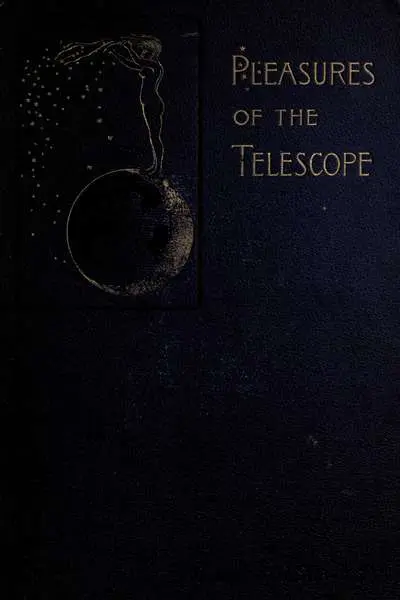
THE CLASSIC COLLECTION · 1901
"Pleasures of the Telescope" by Garrett Putman Serviss is an illustrated guide for amateur astronomers written in the early 20th century. This work serves both as a practical resource for novice stargazers and as an engaging overview of the wonders of the heavens, including detailed descriptions of celestial bodies and phenomena. The book aims to inspire readers to explore the night sky and enjoy the beauty of astronomy through the use of telescopes. At the start of the book, the author emphasizes the joy and potential discoveries that can be made with a good telescope. He shares his personal experiences of exploring the night sky with a small pocket telescope and expresses a desire to encourage others to partake in this exciting hobby. The opening chapters lay a foundation for understanding telescope selection, testing, and practical advice for observing celestial objects, including detailed logical explanations of the optical principles behind refracting and reflecting telescopes. With a promise of extensive illustrations and star maps throughout, the book invites readers to deepen their understanding of the universe and enhance their observational skills.
Introduction adapted from the source catalogue; source summaries may be automatically generated.
Free to read · English · 50,092 words · No account needed
MAKE TIME FOR A GOOD BOOK
On by default. Untick to stop anonymous reading totals. Each page counts after 10 seconds in view. How this works.
Anonymous counting is on unless you have switched it off.
The conclusion, then, seems to be that we are not justified in assuming that the solar system is unique simply because it differs widely from the double and multiple star systems; and that we should rather regard it as probable that the vast multitude of stars which do not appear, when viewed with the telescope, or studied by spectroscopic methods, to have any attendants comparable with themselves in magnitude, have originated in a manner resembling that of the sun's origin, and may be the centers of true planetary systems like ours. The argument, I think, goes further than to show the mere possibility of the existence of such planetary systems surrounding the single stars. If those stars did not originate in a manner quite unlike the origin of the sun, then the existence of planets in their neighborhood is almost a foregone conclusion, for the sun could hardly have passed through the process of formation out of a rotating nebula without evolving planets during its contraction. And so, notwithstanding the eccentricities of the double stars, we may still cherish the belief that there are eyes to see and minds to think out in celestial space.
NOTE.--Double, triple, multiple, and colored stars, star clusters, nebulae, and temporary stars will be found arranged under the heads of their respective constellations.
ANDROMEDA, Map No. 24, 125.
Stars: alpha, 126.
gamma, 128.
, 126. 36, 128.
Temporary star: 1885, 127.
Cluster: 457, 128.
Variable: R, 128.
Nebula: 116, 126.
AQUARIUS, Map No. 18, 107.
Stars: zeta, 106.
tau, 108.
psi, 108. 41, 106.
Sigma 2729, 106.
Sigma 2745 (12), 106.
Sigma 2998, 108.
Variables: R, 108.
S, 108.
T, 106.
Nebulae: 4628 (Rosse's "Saturn"), 108.
4678, 108.
AQUILA, Map No. 16, 95.
Stars: pi, 94.
11, 94.
23, 94.
57, 94.
Sigma 2644, 94.
Sigma 2544, 94.
Cluster: 4440, 94.
Variables: eta, 94.
R, 94.
ARGO: Map No. 2, 31; Map No. 7, 55.
Stars: Sigma 1097, 33.
Sigma 1146 (5), 35.
Clusters: 1551, 35.
1564, 35.
1571, 35.
1630, 56.
Nebula: 1564, 35.
ARIES, Map No. 22, 119.
Stars: gamma, 118.
epsilon, 120.
lambda, 118.
pi, 118.
14, 118.
30, 118.
41, 118.
52, 120.
Sigma 289, 118.
AURIGA, Map No. 5, 45.
Stars: alpha (Capella), 44.
beta (Menkalina), 46.
epsilon, 50.
theta, 48.
lambda, 50.
14, 50.
26, 50.
41, 51.
Sigma 616, 48.
Temporary star: 1892, 48.
Clusters: 996, 51.
1067, 51.
1119, 51.
1166, 51.
1295, 48.
BOOeTES, Map No. 11, 67.
Stars: alpha (Arcturus), 66.
delta, 71.
epsilon (Mirac), 71.
zeta, 70.
iota, 71.
kappa, 71.
, 71.
xi, 70.
pi, 70.
Sigma 1772, 70.
Sigma 1890 (39), 71.
Sigma 1909 (44), 71.
Sigma 1910 (279), 70.
Sigma 1926, 71.
CAMELOPARDALUS, Map No. 25, 133.
Stars: 1, 134.
2, 134.
7, 135.
Sigma 385, 134.
Sigma 390, 134.
Cluster: 940, 135.
CANES VENATICI, Map No. 26, 137; Map No. 11, 67.
Stars: 2, 136.
12 (Cor Caroli), 136.
Sigma 1606, 136.
Sigma 1768 (25), 72.
Cluster: 3936, 72.
Nebula: 3572, 136.
CANIS MAJOR, Map No. 2, 31.
Stars: alpha (Sirius), 30.
delta, 33.
, 33.
Clusters: 1454, 33.
1479, 33.
1512, 33.
Variable: gamma, 33.
Nebula: 1511, 33.
CANIS MINOR, Map No. 3, 34.
Stars: alpha (Procyon), 36.
14, 36.
Sigma 1126 (31 Can. Min. Bode), 36.
CANCER, Map No. 4, 39.
Stars: zeta, 43.
iota, 44.
66, 44.
Sigma 1223, 44.
Sigma 1291, 44.
Sigma 1311, 44.
Clusters: Praesepe, 43.
1712, 44.
CAPRICORNUS, Map No. 13, 83; Map No. 18, 107.
Stars: alpha, 84.
beta, 85.
omicron, 85.
pi, 85.
rho, 85.
sigma, 85.
Cluster: 4608, 85.
CASSIOPEIA, Map No. 25, 133.
Stars: eta, 132.
iota, 132.
sigma, 132.
psi, 132.
Temporary star: 1572 (Tycho's), 134.
Cluster: 392, 134.
CEPHEUS, Map No. 25, 133.
CETUS, Map No. 20, 112.
Stars: alpha, 118.
gamma, 113.
zeta, 111.
eta, 111.
26, 111.
42, 111.
Variables: omicron (Mira), 111.
R, 113.
S, 113.
COLUMBA, Map No. 2, 31.
COMA BERENICES, Map No. 6, 53.
Stars: 2, 54.
12, 54.
17, 54.
24, 54.
35, 54.
42, 54.
Clusters: 2752, 56.
3453, 56.
CORONA BOREALIS, Map No. 11, 67.
Stars: gamma, 72.
zeta, 73.
eta, 72.
nu, 73.
sigma, 73.
Sigma 1932, 72.
Temporary star: 1866, 73.
CORVUS, Map No. 8, 58.
Star: delta, 57.
CRATER, Map No. 8, 58.
Variable: R, 57.
Your reading position is saved on this browser. Take it to another device with a library code. Reading pages adapt to text, rather than matching a printed edition.
Garrett Putman Serviss
Garrett Putman Serviss
Garrett Putman Serviss
Garrett Putman Serviss
BEHIND THE BOOK
This eBook is for the use of anyone anywhere in the United States and most other parts of the world at no cost and with almost no restrictions whatsoever. You may copy it, give it away or re-use it under the terms of the Project Gutenberg License included with this eBook or online at www.gutenberg.org. If you are not located in the United States, you will have to check the laws of the country where you are located before using this eBook. Read the source licence.
The original source file, including credits and licence, is retained by this library. Request an original-format copy at no charge. Please include the book title and Project Gutenberg identifier #28752.
KEEP YOUR CURIOSITY GOING

John Muir

Asa Gray
Asa Gray

Florence Nightingale
Elizabeth Robins Pennell
Denison Olmsted