Gamblers and Gambling
Henry Ward Beecher
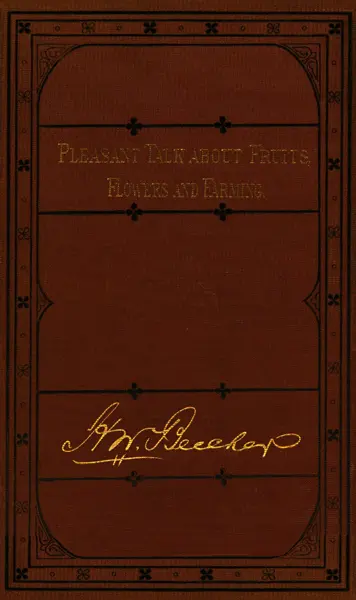
THE CLASSIC COLLECTION · 1874
"Pleasant Talk About Fruits, Flowers and Farming" by Henry Ward Beecher is a collection of essays focused on horticulture, agriculture, and the joys of rural life written in the late 19th century. This work reflects the author's deep appreciation for nature, plants, and their relationships with people, as well as the philosophical insights they inspire. The book combines practical advice on gardening and farming with thoughtful observations about the impact of these activities on human life. At the start of the work, Beecher introduces the origins of his writings, discussing how they were derived from articles he contributed to newspapers over many years. He shares anecdotes about the cultural significance of the apple, emphasizing it as a quintessentially American fruit, and its accessibility to all people, symbolizing democracy and the common good. Through this exploration, he highlights not only the practical aspects of fruit cultivation but also its broader social and political implications, setting the tone for a pleasurable and informative discourse throughout the collection.
Introduction adapted from the source catalogue; source summaries may be automatically generated.
Free to read · English · 161,689 words · No account needed
MAKE TIME FOR A GOOD BOOK
On by default. Untick to stop anonymous reading totals. Each page counts after 10 seconds in view. How this works.
Anonymous counting is on unless you have switched it off.
The same neglect or casual notice is bestowed upon the leaf. If anything about it is remarkable it is mentioned, not otherwise: but is there a page of any book that was ever printed, that has more reading on it than is on a leaf, if one is only taught to read it? It, too, is not only a sign of difference but very often of quality. Mr. D. has availed himself of this criterion in describing peaches. Is it a legible sign only in the peach orchard? He that is ignorant of these marks, and only can tell one fruit from another, is yet in the a b c of pomology. Who but a tyro, on importing Coe’s Golden Drop, would not at once perceive the imposition, if there was one, the moment his eye saw a bud, or its shoulder? Van Mons learned to select stocks for his experiments, as well by the wood and bud in winter, as by the leaf and growth of summer. In a large bed of seedlings every experimenter ought to know by wood and leaf what to select as prognosticating good fruit, and what to reject, without waiting to see the fruit. Nurserymen of our acquaintance, without book, label, or stake, can tell every well-known variety on their grounds. One of our acquaintance never had a mark, label, stake, or register, of any kind upon his ground; a culpable reliance on his ability to read tree-faces; for, on his throwing up the business suddenly, his successor fell into innumerable mistakes. It is just as easy for a pomologist to know the face of every variety, as for a shepherd to know the face of every sheep in his flock, or a grazier every animal of his herd.
3. Although the “Fruit and Fruit-trees of America” professes to give the process of management only for the garden and the orchard, it ought to include, and we presume was designed to embrace the essential features of nursery culture. Every cultivator of fruit must be a private nurseryman; he needs the same information, the same directions as if were a commercial gardener. He that designs planting an orchard ought to know the disposition of each variety of fruit-tree, that he may suit the circumstances of his soil, or provide for the peculiarities of a tree, as a farmer needs to know the peculiarities of the different breeds of hogs and cattle. With a large number of persons it would be enough to say of fruits, “superb,” “extra-superb,” “superlatively grand,” “extra magnificent;” for such, a princely catalogue would answer every purpose. But such as have some knowledge, and every year, we are happy to believe, the number of such increases, ask, not the author’s bare eulogy, but a definite statement of all those special qualities on which such eulogy is founded. The exact taste of each variety of fruit should be studied in respect to soil; some, and but few, love strong clays; yet fewer thrive upon wet soils; but some will, as the Sweet or Carolina June, which does well on quite wet soils; some refuse their gifts except upon a warm and rich sand; some, and by far the greatest number, love a deep loam, with a subsoil moist without being wet. The buds of some varieties escape the vernal frosts by their hardiness; some by putting forth later than their orchard brethren. Some varieties thrive admirably by ground or root grafting, while very many, so worked, are killed off during the first winter; some varieties, if budded, grow off with alacrity, others are dull and unwilling; some form their tops with facility and beauty; others, like many men, are rambling, awkward, and averse to any head at all. Some sorts, put upon what stock you will, have singularly massive roots; others have fine and slender ones. Every variety of tree has traits of disposition peculiar to itself; and in respect to traits possessed in common, even these may be classified. In every description there should be, at least, an attempt at giving these various nursery peculiarities. It cannot be done, as yet, with any considerable accuracy. Fruit-trees have not yet been minutely studied. A florist can give you a thousand times more minute and special information in respect to the peculiar habits and wants of his flowers, than an orchardist can of his trees. Doubtless, it is easier to do it in plants which have a short period; whose whole life passes along before the eye every season, than in plants whose very youth outlasts ten generations of Dahlias, Pansies, Balsams, etc. But that only makes it the more important that we should be up and doing. Let no work be regarded as classic which does not take into its design the most thorough enunciation of all the peculiarities of fruits, and pomology will receive more advantage in ten years, than it could by a hundred years of rambling, unregulated, discursive descriptions.
Your reading position is saved on this browser. Take it to another device with a library code. Reading pages adapt to text, rather than matching a printed edition.
Henry Ward Beecher
Henry Ward Beecher
BEHIND THE BOOK
This eBook is for the use of anyone anywhere in the United States and most other parts of the world at no cost and with almost no restrictions whatsoever. You may copy it, give it away or re-use it under the terms of the Project Gutenberg License included with this eBook or online at www.gutenberg.org. If you are not located in the United States, you will have to check the laws of the country where you are located before using this eBook. Read the source licence.
The original source file, including credits and licence, is retained by this library. Request an original-format copy at no charge. Please include the book title and Project Gutenberg identifier #56640.
KEEP YOUR CURIOSITY GOING

David Patterson (Spirit) Hatch

David Patterson (Spirit) Hatch

David Patterson (Spirit) Hatch

Ralph Waldo Emerson

Maurice Baring

Oscar Wilde & James McNeill Whistler