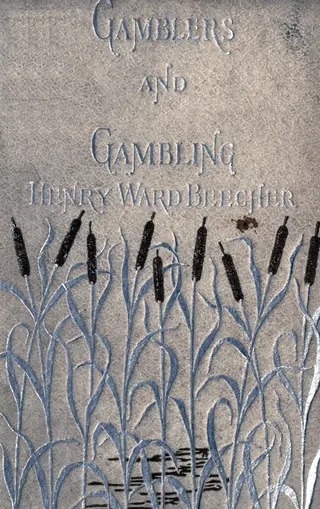
Gamblers and Gambling
Henry Ward Beecher
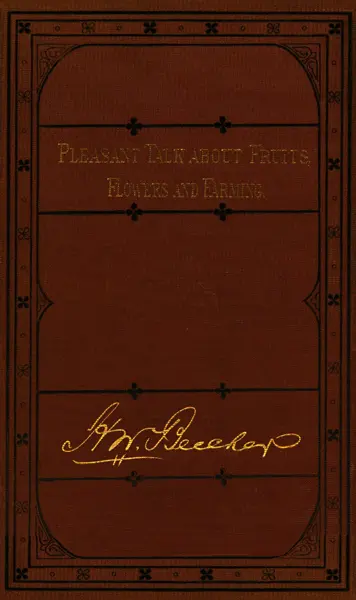
THE CLASSIC COLLECTION · 1874
"Pleasant Talk About Fruits, Flowers and Farming" by Henry Ward Beecher is a collection of essays focused on horticulture, agriculture, and the joys of rural life written in the late 19th century. This work reflects the author's deep appreciation for nature, plants, and their relationships with people, as well as the philosophical insights they inspire. The book combines practical advice on gardening and farming with thoughtful observations about the impact of these activities on human life. At the start of the work, Beecher introduces the origins of his writings, discussing how they were derived from articles he contributed to newspapers over many years. He shares anecdotes about the cultural significance of the apple, emphasizing it as a quintessentially American fruit, and its accessibility to all people, symbolizing democracy and the common good. Through this exploration, he highlights not only the practical aspects of fruit cultivation but also its broader social and political implications, setting the tone for a pleasurable and informative discourse throughout the collection.
Introduction adapted from the source catalogue; source summaries may be automatically generated.
Free to read · English · 161,689 words · No account needed
MAKE TIME FOR A GOOD BOOK
On by default. Untick to stop anonymous reading totals. Each page counts after 10 seconds in view. How this works.
Anonymous counting is on unless you have switched it off.
SUBSOIL PLOW.—A plow having a narrow “double share, or a small share on each side of the coulter, and no mold-board.” It is designed to break up and soften the subsoil, but not to bring it up to the top.
MOLD.—A soil in which decayed vegetable matter largely predominates over earths. Thus, leaf-mold is soil principally composed of rotten leaves; dung-mold, of dung reduced to a fine powdery matter; heath-mold, a black vegetable soil found in heath-lands; peat-mold, forest-mold, garden-mold, etc.
LOAM.—Clay, or any of the primitive earths, reduced to a mellow, friable state by intermixture of sand, or vegetable matter, is called loam. Clay lands well manured with sand, dung, or muck, are turned, gradually, to a loam.
ARGILLACEOUS.—From the Latin (argillaceus,) soil principally
composed of clay.
ALUMINA OR ALUMINE.—Generally employed to signify pure clay. It is, chemically speaking, a metallic oxide; aluminium is the metallic base, and is an elementary substance.
It is generally known that the diamond is pure carbon (charcoal is carbon in an impure state), but it is not as generally known that the ruby and the sapphire, “two of the most beautiful gems with which we are acquainted, are composed almost solely of alumina,” or pure clay in a crystallized state.
SILICIOUS.—An earth composed largely of silex. Silex or silica is considered to be a primitive earth constituting flint, and containing most kinds of sands, and sandstones, etc. China or porcelain, ware is formed from silica and alumina united, i. e. from silicious sand and clay.
CALCAREOUS.—A soil into the composition of which lime enters largely. Limestone lands are calcareous. Pure clay manured freely with marl becomes calcareous, for marl is, mostly, clay and carbonate of lime.
ALLUVIAL.—Strictly speaking, alluvium or our alluvial soil, is a soil formed by causes yet in existence. Thus a bottom-land is formed by the wash of a river. It is usually a mixture of decayed vegetable matter and sand.
DILUVIAL.—A diluvial soil or deposit is one formed by causes no longer in existence. Thus a deposit by a deluge is termed diluvial. The word is derived from the Latin (diluvium), signifying a deluge.
The terms argillaceous, calcareous, silicious, alluvial and diluvial are constantly employed in all works which treat of husbandry.
FRIABLE.—A friable soil is one which crumbles easily. Clay is adhesive, or in common language clammy: leaf-mold is friable, or crumbling. Clay becomes friable when, by exposure to air or frost, or by addition of sand, vegetable matter, etc., it is thoroughly mellowed.
Your reading position is saved on this browser. Take it to another device with a library code. Reading pages adapt to text, rather than matching a printed edition.
Henry Ward Beecher
Henry Ward Beecher
BEHIND THE BOOK
This eBook is for the use of anyone anywhere in the United States and most other parts of the world at no cost and with almost no restrictions whatsoever. You may copy it, give it away or re-use it under the terms of the Project Gutenberg License included with this eBook or online at www.gutenberg.org. If you are not located in the United States, you will have to check the laws of the country where you are located before using this eBook. Read the source licence.
The original source file, including credits and licence, is retained by this library. Request an original-format copy at no charge. Please include the book title and Project Gutenberg identifier #56640.
KEEP YOUR CURIOSITY GOING

David Patterson (Spirit) Hatch

David Patterson (Spirit) Hatch

David Patterson (Spirit) Hatch

Ralph Waldo Emerson

Maurice Baring

Oscar Wilde & James McNeill Whistler