Gamblers and Gambling
Henry Ward Beecher
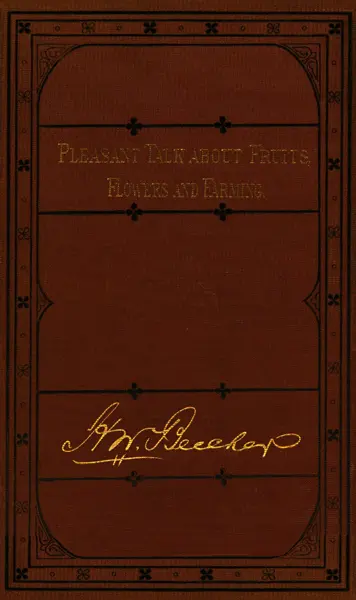
THE CLASSIC COLLECTION · 1874
"Pleasant Talk About Fruits, Flowers and Farming" by Henry Ward Beecher is a collection of essays focused on horticulture, agriculture, and the joys of rural life written in the late 19th century. This work reflects the author's deep appreciation for nature, plants, and their relationships with people, as well as the philosophical insights they inspire. The book combines practical advice on gardening and farming with thoughtful observations about the impact of these activities on human life. At the start of the work, Beecher introduces the origins of his writings, discussing how they were derived from articles he contributed to newspapers over many years. He shares anecdotes about the cultural significance of the apple, emphasizing it as a quintessentially American fruit, and its accessibility to all people, symbolizing democracy and the common good. Through this exploration, he highlights not only the practical aspects of fruit cultivation but also its broader social and political implications, setting the tone for a pleasurable and informative discourse throughout the collection.
Introduction adapted from the source catalogue; source summaries may be automatically generated.
Free to read · English · 161,689 words · No account needed
MAKE TIME FOR A GOOD BOOK
On by default. Untick to stop anonymous reading totals. Each page counts after 10 seconds in view. How this works.
Anonymous counting is on unless you have switched it off.
GYPSUM.—“Time and practice” have ascertained the circumstances under which gypsum should be applied. As a reason why, after repeated applications, it no longer benefits, Prof. Liebig says, “when we increase the crop of hay in a meadow by means of gypsum, we remove a greater quantity of potash with the hay, than can, under ordinary circumstances, be restored. Hence it happens that, after the lapse of several years, the crops of grass on lands manured with gypsum, diminish, owing to the deficiency of potash.” In such a case, if spent ashes were employed either in connection or alternately with gypsum—potash would be resupplied from the ashes.
The other day we were riding past a large farm, and were much gratified at a device of the owner for the preservation of his tools. A good plow, apparently new in the spring, had been left in one corner of the field, standing in the furrow, just where, four months before, the boy had finished his stint. Probably the timber needed seasoning—it was certainly getting it. Perhaps it was left out for acclimation. May-be the farmer left it there to save time in the hurry of the spring-work, in dragging it from the shed. Perhaps he covered the share to keep it from the elements, and save it from rusting. Or, again, perhaps he is troubled with neighbors that borrow, and had left it where it would be convenient for them. He might, at least, have built a little shed over it. Can any one tell what a farmer leaves a plow out a whole season for? It is barely possible that he was an Irishman, and had planted for a spring crop of plows.
After we got to sleep that night, we dreamed a dream. We went into that man’s barn; boards were kicked off, partitions were half broken down, racks broken, floor a foot deep with manure, hay trampled under foot and wasted, grain squandered. The wagon had not been hauled under the shed, though it was raining. The harness was scattered about—hames in one place, the breeching in another—the lines were used for halters. We went to the house. A shed stood hard by, in which a family wagon was kept for wife and daughters to go to town in. The hens had appropriated it as a roost, and however plain it was once, it was ornamented now, inside and out. (Here, by the way, let it be remembered that hen-dung is the best manure for melons, squashes, cucumbers, etc.) We peeped into the smoke-house, but of all the “fixings” that we ever saw! A Chinese Museum is nothing to it. Onions, soap-grease, squashes, hogs’ bristles, soap, old iron, kettles, a broken spinning-wheel, a churn, a grindstone, bacon, hams, washing tubs, a barrel of salt, bones with the meat half cut off, scraps of leather, dirty bags, a chest of Indian meal, old boots, smoked sausages, the ashes and brands that remained since the last “smoke,” stumps of brooms, half a barrel of rotten apples, together with rats, bacon bugs, earwigs, sowbugs, and other vermin which collect in damp dirt. We started for the house; the window near the door had twelve lights, two of wood, two of hats, four of paper, one of a bunch of rags, one of a pillow, and the rest of glass. Under it stood several cooking pots, and several that were not for cooking. As we were meditating whether to enter, such a squall arose from a quarrelling man and woman, that we awoke—and lo! it was a dream. So that the man who left his plow out all the season, may live in the neatest house in the county, for all that we know; only, was it not strange that we should have dreamed all this from just seeing a plow left out in the furrow.
Your reading position is saved on this browser. Take it to another device with a library code. Reading pages adapt to text, rather than matching a printed edition.
Henry Ward Beecher
Henry Ward Beecher
BEHIND THE BOOK
This eBook is for the use of anyone anywhere in the United States and most other parts of the world at no cost and with almost no restrictions whatsoever. You may copy it, give it away or re-use it under the terms of the Project Gutenberg License included with this eBook or online at www.gutenberg.org. If you are not located in the United States, you will have to check the laws of the country where you are located before using this eBook. Read the source licence.
The original source file, including credits and licence, is retained by this library. Request an original-format copy at no charge. Please include the book title and Project Gutenberg identifier #56640.
KEEP YOUR CURIOSITY GOING

David Patterson (Spirit) Hatch

David Patterson (Spirit) Hatch

David Patterson (Spirit) Hatch

Ralph Waldo Emerson

Maurice Baring

Oscar Wilde & James McNeill Whistler