THE CLASSIC COLLECTION✦Lost DiariesCLASSIC FREE BOOKS
Lost Diaries
Maurice Baring
THE CLASSIC COLLECTION · 1920
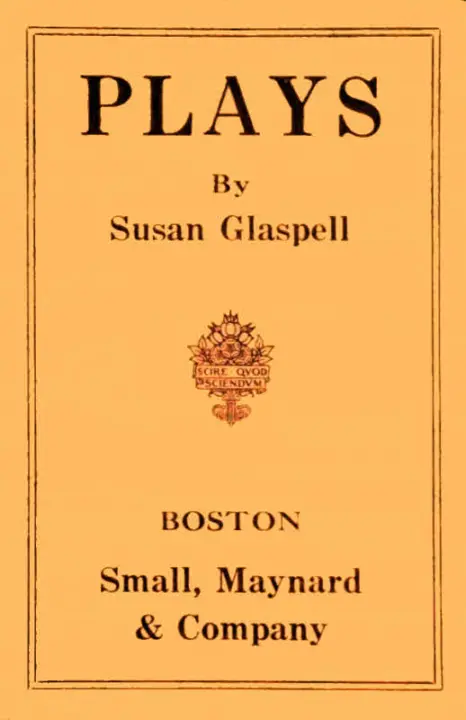
"Plays by Susan Glaspell" is a collection of dramatic works written in the early 20th century. This volume contains several one-act plays, including the well-known piece "Trifles," which explores themes of gender roles, social justice, and the complexities of human experience through the lives of its characters. The collection often revolves around women's perspectives and the societal issues they face, highlighting their experiences in a male-dominated society. The opening of the collection introduces "Trifles," setting the stage in a gloomy farmhouse where a group of men, including the County Attorney and Sheriff, are investigating the murder of John Wright. They are joined by their wives, Mrs. Peters and Mrs. Hale, who initially seem to occupy trivial roles. However, as the men dismiss various domestic objects as insignificant, the women begin to uncover deeper truths about Wright’s life and the emotional turmoil of his wife, Minnie. As the men search for tangible evidence, the women piece together the psychological narrative that ultimately reveals the motivations behind the crime, highlighting the theme of understanding versus ignorance across gender lines.
Introduction adapted from the source catalogue; source summaries may be automatically generated.
Free to read · English · 51,046 words · No account needed
MAKE TIME FOR A GOOD BOOK
On by default. Untick to stop anonymous reading totals. Each page counts after 10 seconds in view. How this works.
Anonymous counting is on unless you have switched it off.
She dreams she’s a hen. She is told to step lively. She becomes violently agitated. What can it mean?
[Turning impatiently from him.] Mabel, do you know anything about
psychoanalysis?
[Feebly.] Oh--not much. No--I--[Brightening.] It’s something about
the war, isn’t it?
Not that kind of war.
[Abashed.] I thought it might be the name of a new explosive.
It is.
[Apologetically to HENRIETTA, who is frowning.] You see, Henrietta, I--we do not live in touch with intellectual things, as you do. Bob being a dentist--somehow our friends--
[Softly.] Oh, to be a dentist!
[Goes to window and stands looking out.
Don’t you see anything more of that editorial writer--what was his name?
Lyman Eggleston?
Yes, Eggleston. He was in touch with things. Don’t you see him?
Yes, I see him once in a while. Bob doesn’t like him very well.
Your husband does not like Lyman Eggleston? [Mysteriously.] Mabel, are you perfectly happy with your husband?
[Sharply.] Oh, come now, Henrietta--that’s going a little strong!
Are you perfectly happy with him, Mabel?
[STEVE goes to work-table.
Why--yes--I guess so. Why--of course I am!
Are you happy? Or do you only think you are? Or do you only think you
ought to be?
Why, Henrietta, I don’t know what you mean!
[Seizes stack of books and magazines and dumps them on the breakfast table.] This is what she means, Mabel. Psychoanalysis. My work-table groans with it. Books by Freud, the new Messiah; books by Jung, the new St. Paul; the Psychoanalytical Review--back numbers two-fifty per.
But what’s it all about?
All about your sub-un-non-conscious mind and desires you know not of. They may be doing you a great deal of harm. You may go crazy with them. Oh, yes! People are doing it right and left. Your dreaming you’re a hen--
[Shakes his head darkly.
Any fool can ridicule anything.
[Hastily, to avert a quarrel.] But what do you say it is, Henrietta?
[Looking at his watch.] Oh, if Henrietta’s going to start that!
[During HENRIETTA’S next speech settles himself at work-table and sharpens a lead pencil.
It’s like this, Mabel. You want something. You think you can’t have it. You think it’s wrong. So you try to think you don’t want it. Your mind protects you--avoids pain--by refusing to think the forbidden thing. But it’s there just the same. It stays there shut up in your unconscious mind, and it festers.
Sort of an ingrowing mental toenail.
Your reading position is saved on this browser. Take it to another device with a library code. Reading pages adapt to text, rather than matching a printed edition.
BEHIND THE BOOK
This eBook is for the use of anyone anywhere in the United States and most other parts of the world at no cost and with almost no restrictions whatsoever. You may copy it, give it away or re-use it under the terms of the Project Gutenberg License included with this eBook or online at www.gutenberg.org. If you are not located in the United States, you will have to check the laws of the country where you are located before using this eBook. Read the source licence.
The original source file, including credits and licence, is retained by this library. Request an original-format copy at no charge. Please include the book title and Project Gutenberg identifier #59432.
KEEP YOUR CURIOSITY GOING
Maurice Baring
W. B. (William Butler) Yeats
Edward Martyn

John Brougham & Charlotte Brontë
Marguerite Merington
Leonid Andreyev