
Last letters from the living dead man
David Patterson (Spirit) Hatch
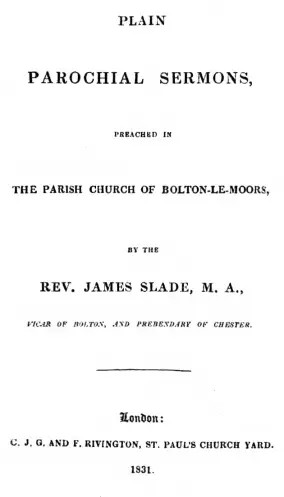
THE CLASSIC COLLECTION · 1831
"Plain Parochial Sermons, preached in the Parish Church of Bolton-le-Moors" by the Rev. James Slade, M.A. is a collection of Christian sermons written in the early 19th century. The work focuses on delivering spiritual guidance and moral teachings based on biblical scripture, aiming to edify the congregation of Bolton-le-Moors and beyond. Through these discourses, Slade emphasizes the importance of faith, moral integrity, and a personal relationship with God. At the start of the volume, the author offers a heartfelt introduction to his collected sermons, expressing gratitude for the encouragement he received to publish them and acknowledging his initial hesitance regarding their impact outside the pulpit. He sets the tone with an exploration of the need for spiritual awakening, using scriptural references to illustrate the human condition marked by sin and the transformative power of Christ's teachings. The opening chapter invites believers to awaken from spiritual slumber and recognize their need for divine illumination, laying a foundational message that resonates throughout the sermons.
Introduction adapted from the source catalogue; source summaries may be automatically generated.
Free to read · English · 71,099 words · No account needed
MAKE TIME FOR A GOOD BOOK
On by default. Untick to stop anonymous reading totals. Each page counts after 10 seconds in view. How this works.
Anonymous counting is on unless you have switched it off.
But let not this gracious offer of mercy be abused; let it not act as an encouragement to a continuance in sin, under a notion that transgressions, however multiplied and aggravated, may be, at any future day, repented and forgiven. The grace of repentance, like every other good gift, cometh from God; and the proffered mercy, which is long and obstinately rejected, may be, and often is, withdrawn. If we will not hear, while the Almighty now speaks; if we will not answer, while He is now calling, “the ear may become heavy that it cannot hear,” and we may be left to perish in our sins. One word more; think of the many sudden departures; you are not without awakening and awful examples; your eye may be closed in death, while it is turned away from your God; or if you should be permitted to experience a few days’ alarm, God alone knows what effect it may produce upon the heart. Seek Him “in health and wealth;” the work is of amazing magnitude and everlasting importance; it demands all your vigour, all the unclouded faculties of your soul.
And let those who have embraced the blessed gospel, in sincerity and truth, who are believing in the name of Jesus for salvation, and “are fruitful in every good word and work,” ever bear in mind the absolute necessity of persevering in the good and holy cause. For of what service can it be, to begin the race with animation, and to pursue it, for a season, with ever so great activity, if they loiter before the end, and relinquish their exertions “for the prize of their high calling?” “When the righteous turneth away from his righteousness and committeth iniquity, and doeth according to all the abominations that the wicked man doeth, shall he live? All his righteousness that he hath done shall not be mentioned; in his trespass that he hath trespassed, and in his sin that he hath sinned, in them shall he die.” Here also we must allow, that “the way of God is equal.” {204} For surely it argues the most depraved and abandoned state of mind and heart, to depart from our God and our Redeemer, after having been once convinced of the truth and the blessedness of His holy religion; having “tasted how gracious the Lord is,” having experienced the guidance and comfort and support of his all-powerful spirit, having had our “hopes full of immortality,” having enjoyed a foretaste of the happiness of heaven, after all to fall away, and prefer to these exalted objects, the miserable pleasures, the base indulgencies, the perishable possessions of earth! A change so disastrous must reduce the understanding and heart into the worst condition of which they are capable. It is the evil spirit, which had been once cast out, returning to his abode, with seven other spirits more wicked than himself, and dwelling there, as in a settled home, and the last state of that man is worse than the first. {205a} The Apostle represents the matter to us in this light: for so difficult is it for a person, in such a state, to be worked upon by any consideration, that he describes it, in his strong language, as an actual impossibility: “it is impossible, (he says) for those who were once enlightened, and have tasted of the heavenly gift, and were made partakers of the Holy Ghost, and have tasted the good word of God, and the powers of the world to come, if they shall fall away, to renew them again unto repentance;” {205b} and then he adds the reason, “seeing they crucify to themselves the Son of God afresh, and put Him to an open shame;” they maintain the horrid principles and character of those who “crucified the Lord of glory;” they deliberately renounce his friendship, and become “enemies to the cross of Christ;” they cast a shameful reproach upon Him, infinitely greater than it is possible for those enemies to do, who were never admitted into the privilege and happiness of His favour. Fain would we hope, that this is a case of rare occurrence; but it is possible, or why should the prophet and Apostle have represented it? “Therefore, let him that thinketh he standeth, take heed lest he fall;” {206a} “let him give all diligence to make his calling and election sure.” {206b} “The just shall live by his faith: but if that man, (however faithful and just he has been) draw back, my soul shall have no pleasure in him;” {206c} this is the proper translation of the passage. God Almighty of His infinite mercy grant, that the words which follow this text, addressed by the Apostle to the faithful disciples of old, may be realized by all of us here; “we, (says he,) are not of them who draw back unto perdition; but of them that believe to the saving of the soul.” Pray to God without ceasing for grace to persevere: His Holy Spirit, if sought and cherished and used, will enable us to be faithful and to overcome, will “make us more than conquerors, through Him that loved us.” {207a}
Your reading position is saved on this browser. Take it to another device with a library code. Reading pages adapt to text, rather than matching a printed edition.
BEHIND THE BOOK
This eBook is for the use of anyone anywhere in the United States and most other parts of the world at no cost and with almost no restrictions whatsoever. You may copy it, give it away or re-use it under the terms of the Project Gutenberg License included with this eBook or online at www.gutenberg.org. If you are not located in the United States, you will have to check the laws of the country where you are located before using this eBook. Read the source licence.
The original source file, including credits and licence, is retained by this library. Request an original-format copy at no charge. Please include the book title and Project Gutenberg identifier #62223.
KEEP YOUR CURIOSITY GOING
David Patterson (Spirit) Hatch

David Patterson (Spirit) Hatch

David Patterson (Spirit) Hatch

Edwin Abbott Abbott

Richard Watson
T. G. (Theophilus Gould) Steward