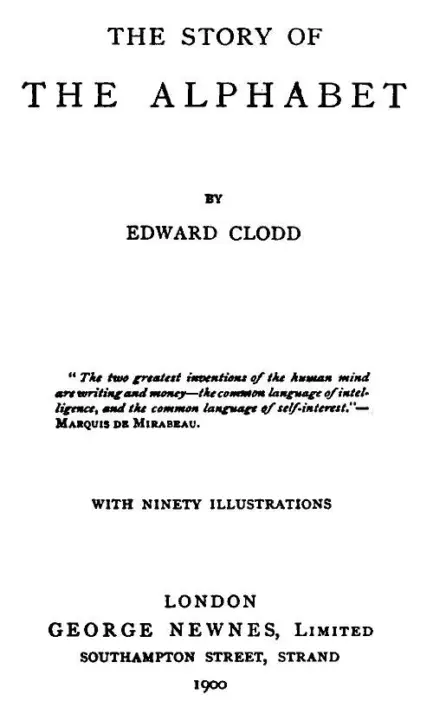
The Story of the Alphabet
Edward Clodd
THE CLASSIC COLLECTION · 1897
"Pioneers of Evolution from Thales to Huxley" by Edward Clodd is a historical account written in the late 19th century. The book explores the origins and development of the idea of evolution, tracing its roots from ancient Greek philosophers to its revival in modern science. It highlights key figures who played a crucial role in shaping evolutionary theory, such as Thales, Aristotle, and later theorists like Darwin and Huxley, while also delving into the belief systems that impeded scientific progress for centuries. The opening of the work establishes a framework for understanding the evolution concept, beginning with the Ionian philosophers who first speculated about the nature of the universe and the origins of life. Clodd emphasizes the substantial intellectual contributions of figures like Thales and Anaximander, who questioned traditional beliefs and proposed that natural phenomena were governed by fixed principles. This section sets a historical context by discussing the initial inquiries of Greek thinkers, outlining how these early ideas laid the groundwork for future scientific exploration while contrasting them with the theological constraints that stalled intellectual progress for many centuries.
Introduction adapted from the source catalogue; source summaries may be automatically generated.
Free to read · English · 70,270 words · No account needed
MAKE TIME FOR A GOOD BOOK
On by default. Untick to stop anonymous reading totals. Each page counts after 10 seconds in view. How this works.
Anonymous counting is on unless you have switched it off.
So far as the larger number of naturalists, and of the intelligent public who followed their lead, were concerned, there was an absolutely open mind on the question of the mutation of species. There had been, as the foregoing sections of this book have shown, a long time of preparation and speculation. We certainly find the keynote of Evolution in Heraclitus, and more than two thousand years after his time Herbert Spencer, above all men, had removed it from the empirical stage, and placed it on a base broad as the facts which supported it. But it needed the leaven of the human and personal to stir it into life, and touch man in his various interests; and not all that Mr. Spencer had done in application of the theory of development to social questions and institutions could avail much till Darwin's theory gave it practical shape. Dissertations on the passage of the "homogeneous to the heterogeneous"; explanations of the theory of the evolution of complex sidereal systems out of diffused vapours of seemingly simple texture, interested people only in a vague and wondering fashion. But when Darwin illustrated the theory of the modification of life-forms by familiar examples gathered from his own experiments and observations, and from intercourse with breeders of pigeons, horses, and dogs, this went to men's "business and bosoms," and if the vulgar interpreted Darwinism, as some, who should know better, interpret it even now, as explaining man's descent from a monkey, or how a bear became a whale by taking to swimming, the thoughtful accepted it as a master-key unlocking not the mystery of origins or of causes of variations, but the mystery of the ceaselessly-acting agent which, operating on favourable variations, has brought about myriads of species from simple forms.
As Huxley reminds us in the passage quoted above, the attitude of the clergy toward the theory of Evolution has undergone an astounding change. Dr. Whewell remarked that every great discovery in science has had to pass through three stages. First, people said, "It is absurd"; then they said, "It is contrary to the Bible"; finally, they said, "We always knew that it was so." Thus it has been with Evolution. It is calmly discussed; even claimed as a "defender of the faith," at Church Congresses nowadays. It was not so in the sixties. Here and there a single voice was raised in qualified sympathy--Charles Kingsley showed more than this--but both in the Old and the New World the "drum ecclesiastic" was beaten. Cardinal Manning declared Darwinism to be a "brutal philosophy, to wit, there is no God and the ape is our Adam." Protestant and Catholic agreed in condemning it as "an attempt to dethrone God"; as "a huge imposture," as "tending to produce disbelief of the Bible," and "to do away with all idea of God," as "turning the Creator out of doors." Such are fair samples to be culled from the anthology of invective which was the staple content of nearly every "criticism." Occasionally some parody of reasoning appears when the "argument" is advanced that there is "a simpler explanation of the presence of these strange forms among the works of God in the fall of Adam," but even this pseudo-concession to logic is rare; and one divine had no hesitation in predicting the fate of Darwin and his followers in the world to come. "If," said a Dr. Duffield in the Princeton Review, "the development theory of the origin of man shall, in a little while, take the place--as doubtless it will--with other exploded scientific speculations, then they who accept it with its proper logical consequences will, in the life to come, have their portion with those who in this life 'know not God and obey not the Gospel of His Son.'" But the most notable attack came from Samuel Wilberforce, then Bishop of Oxford, in the Quarterly Review of July, 1860. "It is," said Huxley, in his review of Haeckel's Evolution of Man, "a production which should be bound in good stout calf, or better, asses' skin, by the curious book-collector, together with Brougham's attack on the undulatory theory of light when it was first propounded by Young." The bishop declared "the principle of natural selection to be absolutely incompatible with the word of God" and as "contradicting the revealed relations of creation to its Creator." If by "revealed relations" and the "word of God" the Bible is intended, the evolutionist is in agreement with the bishop. But, at this time of day, it seems scarcely worth while to shake the dust off articles which have gone the way of all purely controversial matter, and justification for reference to them lies only in the fact that the contest between the biologists and the bishops is not yet ended.
Your reading position is saved on this browser. Take it to another device with a library code. Reading pages adapt to text, rather than matching a printed edition.
Edward Clodd
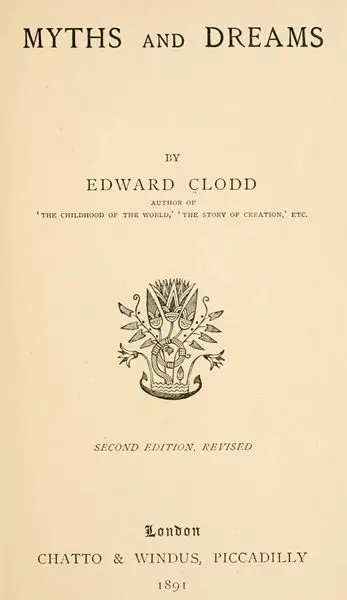
Edward Clodd
BEHIND THE BOOK
This eBook is for the use of anyone anywhere in the United States and most other parts of the world at no cost and with almost no restrictions whatsoever. You may copy it, give it away or re-use it under the terms of the Project Gutenberg License included with this eBook or online at www.gutenberg.org. If you are not located in the United States, you will have to check the laws of the country where you are located before using this eBook. Read the source licence.
The original source file, including credits and licence, is retained by this library. Request an original-format copy at no charge. Please include the book title and Project Gutenberg identifier #39526.
KEEP YOUR CURIOSITY GOING

David Patterson (Spirit) Hatch
Cécile Tormay

Moritz Busch
Coulson Kernahan
John L. Ransom

Ralph Waldo Emerson