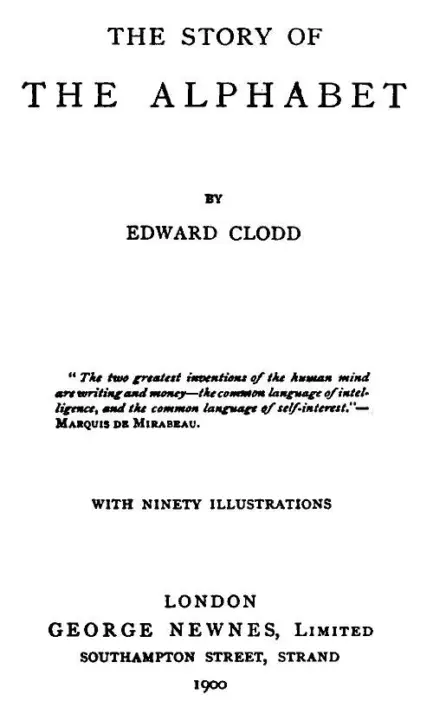
The Story of the Alphabet
Edward Clodd
THE CLASSIC COLLECTION · 1897
"Pioneers of Evolution from Thales to Huxley" by Edward Clodd is a historical account written in the late 19th century. The book explores the origins and development of the idea of evolution, tracing its roots from ancient Greek philosophers to its revival in modern science. It highlights key figures who played a crucial role in shaping evolutionary theory, such as Thales, Aristotle, and later theorists like Darwin and Huxley, while also delving into the belief systems that impeded scientific progress for centuries. The opening of the work establishes a framework for understanding the evolution concept, beginning with the Ionian philosophers who first speculated about the nature of the universe and the origins of life. Clodd emphasizes the substantial intellectual contributions of figures like Thales and Anaximander, who questioned traditional beliefs and proposed that natural phenomena were governed by fixed principles. This section sets a historical context by discussing the initial inquiries of Greek thinkers, outlining how these early ideas laid the groundwork for future scientific exploration while contrasting them with the theological constraints that stalled intellectual progress for many centuries.
Introduction adapted from the source catalogue; source summaries may be automatically generated.
Free to read · English · 70,270 words · No account needed
MAKE TIME FOR A GOOD BOOK
On by default. Untick to stop anonymous reading totals. Each page counts after 10 seconds in view. How this works.
Anonymous counting is on unless you have switched it off.
In this brief summary of the attitude of the Church toward science, it is not possible, and if it were so, it is not needful, to refer in detail to the contributions of the more speculative philosophers, who, although they made no discoveries, advocated those methods of research and directions of inquiry which made the discoveries possible. Among these a prominent name is that of Lord Bacon, whose system of philosophy, known as the Inductive, proceeds from the collection, examination and comparison of any group of connected facts to the relation of them to some general principle. The universal is thus explained by the particular. But the inductive method was no invention of Bacon's; wherever observation or testing of a thing preceded speculation about it, as with his greater namesake, there the Baconian system had its application. Lord Bacon, moreover, undervalued Greek science; he argued against the Copernican theory; and either knew nothing of, or ignored, Harvey's momentous discovery of the circulation of the blood. A more illustrious name than his is that of René Descartes, a man who combined theory with observation; "one who," in Huxley's words, "saw that the discoveries of Galileo meant that the remotest parts of the universe were governed by mechanical laws, while those of Harvey meant that the same laws presided over the operations of that portion of the world which is nearest to us, namely, our own bodily frame." The greatness of this man, a good Catholic, whom the Jesuits charged with Atheism, has no mean tribute in his influence on an equally remarkable man, Benedict Spinoza. Spinoza reduced the Cartesian analysis of phenomena into God, mind and matter to one phenomenon, namely, God, of whom matter and spirit, extension and thought, are but attributes. His short life fell within the longer span of Newton's, whose strange subjection to the theological influences of his age is seen in this immortal interpreter of the laws of the universe wasting his later years on an attempt to interpret unfulfilled prophecy. These and others, as Locke, Leibnitz, Herder, and Schelling, like the great Hebrew leader, had glimpses of a goodly land which they were not themselves to enter. But, perhaps, in the roll of illustrious men to whom prevision came, none have better claim to everlasting remembrance than Immanuel Kant. For in his Theory of the Heavens, published in 1755, he anticipates that hypothesis of the origin of the present universe which, associated with the succeeding names of Laplace and Herschel, has, under corrections furnished by modern physics, common acceptance among us. Then, as shown in the following extract, Kant foresees the theory of the development of life from formless stuff to the highest types: "It is desirable to examine the great domain of organized beings by means of a methodical comparative anatomy, in order to discover whether we may not find in them something resembling a system, and that too in connection with their mode of generation, so that we may not be compelled to stop short with a mere consideration of forms as they are--which gives no insight into their generation--and need not despair of gaining a full insight into this department of Nature. The agreement of so many kinds of animals in a certain common plan of structure, which seems to be visible not only in their skeletons, but also in the arrangement of the other parts--so that a wonderfully simple typical form, by the shortening or lengthening of some parts, and by the suppression and development of others, might be able to produce an immense variety of species--gives us a ray of hope, though feeble, that here perhaps some results may be obtained, by the application of the principle of the mechanism of Nature; without which, in fact, no science can exist. This analogy of forms (in so far as they seem to have been produced in accordance with a common prototype, notwithstanding their great variety) strengthens the supposition that they have an actual blood-relationship, due to derivation from a common parent; a supposition which is arrived at by observation of the graduated approximation of one class of animals to another, beginning with the one in which the principle of purposiveness seems to be most conspicuous, namely, man, and extending down to the polyps, and from these even down to mosses and lichens, and arriving finally at raw matter, the lowest stage of Nature observable by us. From this raw matter and its forces, the whole apparatus of Nature seems to have been derived according to mechanical laws (such as those which resulted in the production of crystals); yet this apparatus, as seen in organic beings, is so incomprehensible to us, that we feel ourselves compelled to conceive for it a different principle. But it would seem that the archæologist of Nature is at liberty to regard the great Family of creatures (for as a Family we must conceive it, if the above-mentioned continuous and connected relationship has a real foundation) as having sprung from their immediate results of her earliest revolutions, judging from all the laws of their mechanisms known to or conjectured by him."
Your reading position is saved on this browser. Take it to another device with a library code. Reading pages adapt to text, rather than matching a printed edition.
Edward Clodd
Edward Clodd
BEHIND THE BOOK
This eBook is for the use of anyone anywhere in the United States and most other parts of the world at no cost and with almost no restrictions whatsoever. You may copy it, give it away or re-use it under the terms of the Project Gutenberg License included with this eBook or online at www.gutenberg.org. If you are not located in the United States, you will have to check the laws of the country where you are located before using this eBook. Read the source licence.
The original source file, including credits and licence, is retained by this library. Request an original-format copy at no charge. Please include the book title and Project Gutenberg identifier #39526.
KEEP YOUR CURIOSITY GOING

David Patterson (Spirit) Hatch
Cécile Tormay

Moritz Busch
Coulson Kernahan
John L. Ransom

Ralph Waldo Emerson