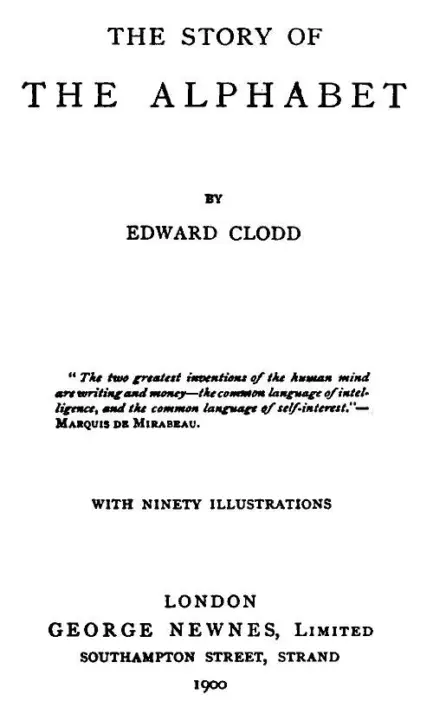
The Story of the Alphabet
Edward Clodd
THE CLASSIC COLLECTION · 1897
"Pioneers of Evolution from Thales to Huxley" by Edward Clodd is a historical account written in the late 19th century. The book explores the origins and development of the idea of evolution, tracing its roots from ancient Greek philosophers to its revival in modern science. It highlights key figures who played a crucial role in shaping evolutionary theory, such as Thales, Aristotle, and later theorists like Darwin and Huxley, while also delving into the belief systems that impeded scientific progress for centuries. The opening of the work establishes a framework for understanding the evolution concept, beginning with the Ionian philosophers who first speculated about the nature of the universe and the origins of life. Clodd emphasizes the substantial intellectual contributions of figures like Thales and Anaximander, who questioned traditional beliefs and proposed that natural phenomena were governed by fixed principles. This section sets a historical context by discussing the initial inquiries of Greek thinkers, outlining how these early ideas laid the groundwork for future scientific exploration while contrasting them with the theological constraints that stalled intellectual progress for many centuries.
Introduction adapted from the source catalogue; source summaries may be automatically generated.
Free to read · English · 70,270 words · No account needed
MAKE TIME FOR A GOOD BOOK
On by default. Untick to stop anonymous reading totals. Each page counts after 10 seconds in view. How this works.
Anonymous counting is on unless you have switched it off.
It forms no part of our story to tell how feuds between rival dynasties and rival sects of Islam, becoming more acute as time went on, enabled Christianity to recover lost ground, and, in the capture of Granada in 1492, to put an end to Moorish rule in Spain. Before that event, a knowledge of Greek philosophy had been diffused through Christendom by the translation of the works of Avicenna, Averroes, and other scholars, into Latin. That was about the middle of the twelfth century, when Aristotle, who had been translated into Arabic some three centuries earlier, also appeared in Latin dress. The detachment of any branch of knowledge from theology being a thing undreamed of, the deep reverence in which the Stagirite was held by his Arabian commentators ultimately led to his becoming "suspect" by the Christians, since that which approved itself to the followers of Mohammed must, ipso facto, be condemned by the followers of Jesus. Hence came reaction, and recourse to the Scriptures as sole guide to secular as well as sacred knowledge; recourse to a method which, as Hallam says, "had not untied a single knot, or added one unequivocal truth to the domain of philosophy."
So far as the scanty records tell (for we may never know how much was suppressed, or fell into oblivion, under ecclesiastical frowns and threats; nor how many thinkers toiled in secret and in dread), none seemed possessed either of courage or desire to supplement the revealed word by examination into things themselves. To supplant it was not dreamed of. But, in the middle of the thirteenth century, one notable exception occurred in the person of Roger Bacon, sometimes called Friar Bacon in virtue of his belonging to the order of Franciscans. He was born in 1214 at Ilchester, in Somerset, whence he afterward removed to Oxford, and thence to Paris. That this remarkable and many-sided man, classic and Arabic scholar, mathematician, and natural philosopher, has not a more recognised place in the annals of science is strange, although it is, perhaps, partly explained by the fact that his writings were not reissued for more than three centuries after his death. He has been credited with a number of inventions, his title to which is however doubtful, although the doubt in nowise impairs the greatness of his name. He shared the current belief in alchemy, but made a number of experiments in chemistry pointing to his knowledge of the properties of the various gases, and of the components of gunpowder. If he did not invent spectacles, or the microscope and telescope, he was skilled in optics, and knew the principles on which those instruments are made, as the following extract from his Opus Majus shows: "We can place transparent bodies in such a form and position between our eyes and other objects that the rays shall be refracted and bent toward any place we please, so that we shall see the object near at hand, or at a distance, under any angle we please; and thus from an incredible distance we may read the smallest letters, and may number the smallest particles of sand, by reason of the greatness of the angle under which they appear." He knew the "wisdom of the ancients" in the cataloguing of the stars, and suggested a reform of the calendar--following the then unknown poet-astronomer of Naishapur. But he believed in astrology, that bastard science which from remotest times had ruled the life of man, and which has no small number of votaries among ourselves to this day. Roger Bacon's abiding title to fame rests, however, on his insistence on the necessity of experiment, and his enforcement of this precept by practice. As a mathematician he laid stress on the application of this "first of all the sciences"; indeed, as "preceding all others, and as disposing us to them." His experiments, both from their nature and the seclusion in which they were made, laid him open to the charge of black magic, in other words, of being in league with the devil. This, in the hands of a theology thus "possessed," became an instrument of awful torture to mankind. Roger Bacon's denial of magic only aggravated his crime, since in ecclesiastical ears, this was tantamount to a denial of the activity, nay more, of the very existence of Satan. So, despite certain encouragement in his scientific work from an old friend who afterward became Pope Clement IV., for whose information he wrote his Opus Majus, he was, on the death of that potentate, thrown into prison, whence tradition says he emerged, after ten years, only to die.
Your reading position is saved on this browser. Take it to another device with a library code. Reading pages adapt to text, rather than matching a printed edition.
Edward Clodd
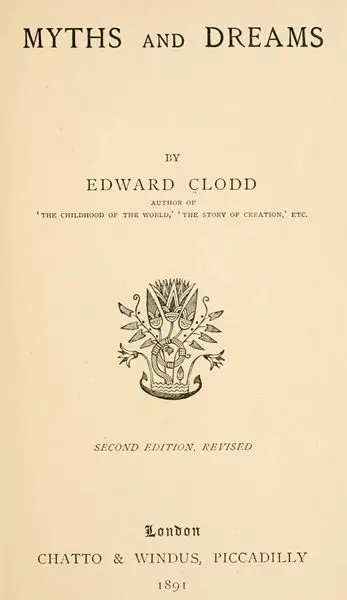
Edward Clodd
BEHIND THE BOOK
This eBook is for the use of anyone anywhere in the United States and most other parts of the world at no cost and with almost no restrictions whatsoever. You may copy it, give it away or re-use it under the terms of the Project Gutenberg License included with this eBook or online at www.gutenberg.org. If you are not located in the United States, you will have to check the laws of the country where you are located before using this eBook. Read the source licence.
The original source file, including credits and licence, is retained by this library. Request an original-format copy at no charge. Please include the book title and Project Gutenberg identifier #39526.
KEEP YOUR CURIOSITY GOING

David Patterson (Spirit) Hatch
Cécile Tormay

Moritz Busch
Coulson Kernahan
John L. Ransom

Ralph Waldo Emerson