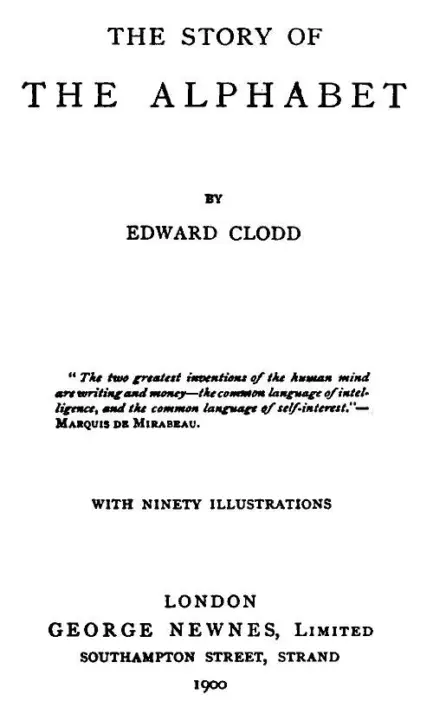
The Story of the Alphabet
Edward Clodd
THE CLASSIC COLLECTION · 1897
"Pioneers of Evolution from Thales to Huxley" by Edward Clodd is a historical account written in the late 19th century. The book explores the origins and development of the idea of evolution, tracing its roots from ancient Greek philosophers to its revival in modern science. It highlights key figures who played a crucial role in shaping evolutionary theory, such as Thales, Aristotle, and later theorists like Darwin and Huxley, while also delving into the belief systems that impeded scientific progress for centuries. The opening of the work establishes a framework for understanding the evolution concept, beginning with the Ionian philosophers who first speculated about the nature of the universe and the origins of life. Clodd emphasizes the substantial intellectual contributions of figures like Thales and Anaximander, who questioned traditional beliefs and proposed that natural phenomena were governed by fixed principles. This section sets a historical context by discussing the initial inquiries of Greek thinkers, outlining how these early ideas laid the groundwork for future scientific exploration while contrasting them with the theological constraints that stalled intellectual progress for many centuries.
Introduction adapted from the source catalogue; source summaries may be automatically generated.
Free to read · English · 70,270 words · No account needed
MAKE TIME FOR A GOOD BOOK
On by default. Untick to stop anonymous reading totals. Each page counts after 10 seconds in view. How this works.
Anonymous counting is on unless you have switched it off.
Middleton examined the matter on the spot, and in his celebrated Letter from Rome gives numerous examples of "an exact CONFORMITY between POPERY and PAGANISM." Since few read his book now-a-days, some of these may be cited, because their presence goes far to explain why the conglomerate religion which Christianity had become was proof against ideas spurned alike by pagans and ecclesiastics. Visiting the place for classical study, and "not to notice the fopperies and ridiculous ceremonies of the present Religion," Middleton soon found himself "still in old Heathen Rome," with its rituals of primitive Paganism, as if handed down by an uninterrupted succession from the priests of old to the priests of new Rome. The "smoak of the incense" in the churches transports him to the temple of the Paphian Venus described by Virgil (Æneid, I, 420); the surpliced boy waiting on the priest with the thurible reminds him of sculptures on ancient bas-reliefs representing heathen sacrifice, with a white-clad attendant on a priest holding a little chest or box in his hand. The use of holy water suggests numerous parallels. At the entrance to Pagan temples stood vases of holy liquid, a mixture of salt and common water; and, on bas-reliefs, the aspergillum or brush for the ceremony of sprinkling is carved. In the annual festival of the benediction of horses, when the animals were sent to the convent of St. Anthony to be sprinkled (Middleton had his own horses thus blest "for about eighteenpence of our money") there is the survival of a ceremony in the Circensian games. In the lamps and wax candles before the shrines of the Madonna and Saints he is reminded of a passage in Herodotus as to the use of lights in the Egyptian temples, while we know that lamps to the Madonna took the place of those before the images of the Lares, whose chapels stood at the corners of the streets. The Synod of Elviri (305 A. D.) forbade the lighting of wax candles during the day in cemeteries lest the spirits of the saints should be disquieted, but the custom was too deeply rooted to be abolished. As for votive offerings, Middleton truly says that "no one custom of antiquity is so frequently mentioned by all their writers" ... "but the most common of all offerings were pictures representing the history of the miraculous cure or deliverance vouchsafed upon the vow of the donor." Of which offerings, the blessed Virgin is so sure always to carry off the greatest share, that it may be truly said of her what Juvenal says of the Goddess Isis, whose religion was at that time in the greatest vogue in Rome, that the "painters got their livelihood out of her." Middleton tells the story from Cicero which, not without covert sympathy, Montaigne quotes in his Essay on Prognostications. Diagoras, surnamed the Atheist, being found one day in a temple, was thus addressed by a friend: "You, who think the gods take no care of human affairs, do not you see here by this number of pictures how many people, for the sake of their vows, have been saved in storms at sea, and got safe into harbour?" "Yes," answered Diagoras, "I see how it is; for those are never painted who happen to be drowned." There is nothing new under the sun. Horace (Odes, Bk. I, v) tells of the shipwrecked sailor who hung up his clothes as a thank-offering in the temple of the sea-god who had preserved him; Polydorus Vergilius, who lived in the early part of the sixteenth century, that is, some 1,500 years after Horace, describes the classic custom of ex voto offerings at length, while Pennant the antiquary, describing the well of Saint Winifred in Flintshire in the last century, tells of the votive offerings, in the shape of crutches and other objects, which were hung about it. To this day the store is receiving additions. The sick crowd thither as of old they crowded into the temples of Æsculapius and Serapis; mothers bring their sick children as in Imperial Rome they took them to the Temple of Romulus and Remus. A draught of water from the basin near the bath, or a plunge in the bath itself, is followed by prayers at the altar of the chapel which incloses the well. When the saint's feast-day is held, the afflicted gather to kiss the reliquary that holds her bones. Perhaps one of the most pathetic sights in Catholic churches, especially in out-of-the-way villages, is the altars on which are hung votive offerings, rude daubs depicting the disease or danger from which the worshipper has been delivered.
Your reading position is saved on this browser. Take it to another device with a library code. Reading pages adapt to text, rather than matching a printed edition.
Edward Clodd

Edward Clodd
BEHIND THE BOOK
This eBook is for the use of anyone anywhere in the United States and most other parts of the world at no cost and with almost no restrictions whatsoever. You may copy it, give it away or re-use it under the terms of the Project Gutenberg License included with this eBook or online at www.gutenberg.org. If you are not located in the United States, you will have to check the laws of the country where you are located before using this eBook. Read the source licence.
The original source file, including credits and licence, is retained by this library. Request an original-format copy at no charge. Please include the book title and Project Gutenberg identifier #39526.
KEEP YOUR CURIOSITY GOING

David Patterson (Spirit) Hatch
Cécile Tormay

Moritz Busch
Coulson Kernahan
John L. Ransom

Ralph Waldo Emerson