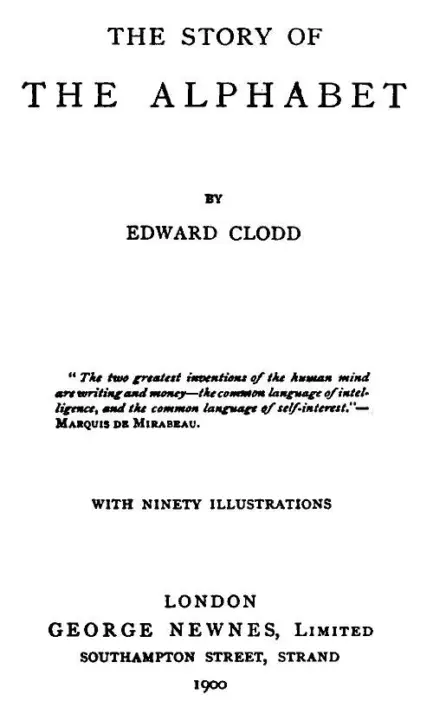
The Story of the Alphabet
Edward Clodd
THE CLASSIC COLLECTION · 1897
"Pioneers of Evolution from Thales to Huxley" by Edward Clodd is a historical account written in the late 19th century. The book explores the origins and development of the idea of evolution, tracing its roots from ancient Greek philosophers to its revival in modern science. It highlights key figures who played a crucial role in shaping evolutionary theory, such as Thales, Aristotle, and later theorists like Darwin and Huxley, while also delving into the belief systems that impeded scientific progress for centuries. The opening of the work establishes a framework for understanding the evolution concept, beginning with the Ionian philosophers who first speculated about the nature of the universe and the origins of life. Clodd emphasizes the substantial intellectual contributions of figures like Thales and Anaximander, who questioned traditional beliefs and proposed that natural phenomena were governed by fixed principles. This section sets a historical context by discussing the initial inquiries of Greek thinkers, outlining how these early ideas laid the groundwork for future scientific exploration while contrasting them with the theological constraints that stalled intellectual progress for many centuries.
Introduction adapted from the source catalogue; source summaries may be automatically generated.
Free to read · English · 70,270 words · No account needed
MAKE TIME FOR A GOOD BOOK
On by default. Untick to stop anonymous reading totals. Each page counts after 10 seconds in view. How this works.
Anonymous counting is on unless you have switched it off.
Without sacred books, priesthood, or organization, these earliest disciples, whom the fate of their leader had driven into hiding for a time, gathered themselves into groups for communion and worship. "In the church of Jerusalem," says Selden in his Table Talk (xiv), "the Christians were but another sect of Jews that did believe the Messias was come." From that sacred city there went forth preachers of this simple doctrine through the lands where Greek-speaking Jews, known as those of the Dispersion, had been long settled. These formed a very important element in the Roman Empire, being scattered from Asia Minor to Egypt, and thence in all the lands washed by the Mediterranean. As their racial isolation and national hopes made them the least contented among the subject-peoples, a series of tolerant measures securing them certain privileges, subject to loyal behaviour, had been prudently granted by their Roman masters. The new teaching spread from Antioch to Alexandria and Rome. But early in the onward career of the movement a division broke out among the immediate disciples of Jesus which ended in lasting rupture. A distinguished convert had been won to the faith in the person of the Apostle Paul. He is the real founder of Christianity as a more or less systematized creed, and all the development of dogma which followed are integral parts of the structure raised by him. He converted it from a local religion into a widespread faith. This came about, at the start, through his defeat of the narrower section headed by Peter, who would have compelled all non-Jewish converts to submit to the rite of circumcision.
The unity of the Empire gave Christianity its chance. Through the connection of Eurasia from the Euphrates to the Atlantic by magnificent roads, communication between peoples followed the lines of least resistance. Happily for the future of Christianity, the early missionaries travelled westward, in the wake of the dispersed Jews, along the Mediterranean seaboard, and thus its fortunes became identified with the civilizing portion of mankind. Had they travelled eastward, it might have been blended with Buddhism, or, as its Gnostic phases show, become merged in Oriental mysticism. The story of progress ran smoothly till A. D. 64, when we first hear of the "Christians"--for by such name they had become known--in "profane" history, as it was once oddly called. Tacitus, writing many years after the event, tells how on the night of the 18th July, in the sixty-fourth year of our era, a fierce fire broke out in Rome, causing the destruction of magnificent buildings raised by Augustus, and of priceless works of Greek art. Suspicion fell on Nero, and he, as has been suggested, was instigated by his wife Poppaea Sabina, an unscrupulous woman, and, according to some authorities, a convert to Judaism, "to put an end to the common talk, by imputing the fire to others, visiting, with a refinement of punishment, those detestable criminals who went by the name of Christians. The author of that denomination was Christus, who had been executed in the time of Tiberius, by the procurator, Pontius Pilate." Tacitus goes on to describe Christianity as "a pestilent superstition," and its adherents as guilty of "hatred to the human race." The indictment, on the face of it, seems strange, but it has an explanation, although the Christians were brutally murdered on the charge of arson, and not of superstition. So far as religious persecution went, they suffered this first at the hands of Jews, the Empire intervening to protect them. Broadly speaking, the Roman note was toleration. Throughout the Empire religion was a national affair, because it began and ended with the preservation of the State. Thereupon it was the binding duty--religio--of every citizen to pay due honour to the protecting gods on whose favour the safety of the State depended. That done, a man might believe what he chose. Polytheism is, from its nature, easy-going and tolerant; so long as there was no open opposition to the authorized public worship, the worshipper could explain it any way he chose. In Greece a man "might believe or disbelieve that the Mysteries taught the doctrine of immortality; the essential thing was that he should duly sacrifice his pig." In Rome, that vast Cosmopolis, "the ordinary pagan did not care two straws whether his neighbour worshipped twenty gods or twenty-one." Why should he care?
Your reading position is saved on this browser. Take it to another device with a library code. Reading pages adapt to text, rather than matching a printed edition.
Edward Clodd
Edward Clodd
BEHIND THE BOOK
This eBook is for the use of anyone anywhere in the United States and most other parts of the world at no cost and with almost no restrictions whatsoever. You may copy it, give it away or re-use it under the terms of the Project Gutenberg License included with this eBook or online at www.gutenberg.org. If you are not located in the United States, you will have to check the laws of the country where you are located before using this eBook. Read the source licence.
The original source file, including credits and licence, is retained by this library. Request an original-format copy at no charge. Please include the book title and Project Gutenberg identifier #39526.
KEEP YOUR CURIOSITY GOING

David Patterson (Spirit) Hatch
Cécile Tormay

Moritz Busch
Coulson Kernahan
John L. Ransom

Ralph Waldo Emerson