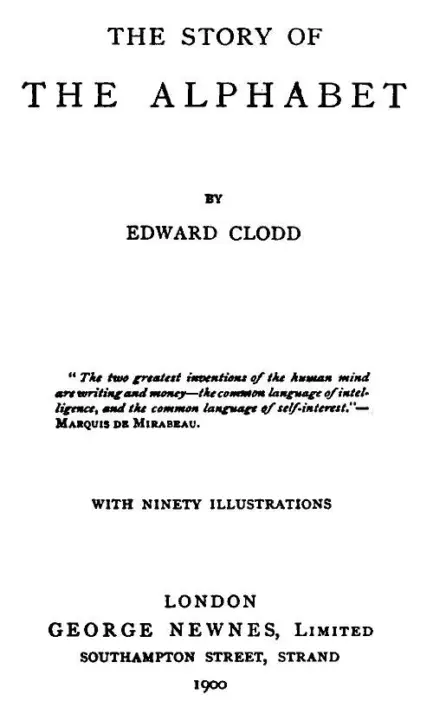
The Story of the Alphabet
Edward Clodd
THE CLASSIC COLLECTION · 1897
"Pioneers of Evolution from Thales to Huxley" by Edward Clodd is a historical account written in the late 19th century. The book explores the origins and development of the idea of evolution, tracing its roots from ancient Greek philosophers to its revival in modern science. It highlights key figures who played a crucial role in shaping evolutionary theory, such as Thales, Aristotle, and later theorists like Darwin and Huxley, while also delving into the belief systems that impeded scientific progress for centuries. The opening of the work establishes a framework for understanding the evolution concept, beginning with the Ionian philosophers who first speculated about the nature of the universe and the origins of life. Clodd emphasizes the substantial intellectual contributions of figures like Thales and Anaximander, who questioned traditional beliefs and proposed that natural phenomena were governed by fixed principles. This section sets a historical context by discussing the initial inquiries of Greek thinkers, outlining how these early ideas laid the groundwork for future scientific exploration while contrasting them with the theological constraints that stalled intellectual progress for many centuries.
Introduction adapted from the source catalogue; source summaries may be automatically generated.
Free to read · English · 70,270 words · No account needed
MAKE TIME FOR A GOOD BOOK
On by default. Untick to stop anonymous reading totals. Each page counts after 10 seconds in view. How this works.
Anonymous counting is on unless you have switched it off.
Some sixty years after the death of Lucretius there happened, in the subsequent belief of millions of mankind, an event for which all that had gone before in the history of this planet is said to have been a preparation. In the fulness of time the Omnipotent maker and ruler of a universe to which no boundaries can be set by human thought, sent to this earth-speck no less a person than His Eternal Son. He was said to have been born, not by the natural processes of generation, but to have been incarnated in the womb of a virgin, retaining his divine nature while subjecting it to human limitations. This he had done that he might, as sinless man, become an expiatory sacrifice to offended deity, and to the requirements of divine justice, for the sins which the human race had committed since the transgression of Adam and Eve, or which men yet to be born might commit.
The "miraculous" birth of Jesus took place at Nazareth in Galilee, in the reign of Cæsar Augustus, about 750 A. U. C., as the Romans reckoned time. Tradition afterward fixed his birthday on the 25th December, which, curiously enough, although, perhaps, explaining the choice, was the day dedicated to the sun-god Mithra, an Oriental deity to whom altars had been raised and sacrifices performed, with rites of baptisms of blood, in hospitable Rome.
Jesus is said to have lived in the obscurity of his native mountain village till his thirtieth year. Except one doubtful story of his going to Jerusalem with his parents when he was twelve years old, nothing is recorded in the various biographies of him between his birth and his appearance as a public teacher. Probably he followed his father's trade as a carpenter. The event that seems to have called him from home was the preaching of an enthusiastic ascetic named John the Baptist. At his hands Jesus submitted to the baptismal rite, and then entered on his career, wandering from place to place. The fragments of his discourses, which have survived in the short biographies known as the Gospels, show him to have been gifted with a simple, winning style, and his sermons, brightened by happy illustration or striking parable, went home to the hearts of his hearers. Women, often of the outcast class, were drawn to him by the sympathy which attracted even more than his teaching. Among a people to whom the unvarying order of Nature was an idea wholly foreign--for Greek speculations had not penetrated into Palestine--stories of miracle-working found easy credit, falling in, as they did, with popular belief in the constant intervention of deity. Thus, to the reports of what Jesus taught were added those of the wonders which he had wrought, from feeding thousands of folk with a few loaves of bread to raising the dead to life. His itinerant mission secured him a few devoted followers from various towns and villages, while the effect of success upon himself was to heighten his own conception of the importance of his work. The skill of the Romans in fusing together subject races had failed them in the case of the Jews, whose belief in their special place in the world as the "chosen people" never forsook them. Nor had their misfortunes weakened their belief that the Messiah predicted by their prophets would appear to deliver them, and plant their feet on the neck of the hated conqueror. This hope, as became a pious Jew, Jesus shared, but it set him brooding on some nobler, because more spiritual, conception of it than his fellow-countrymen nurtured. Finally, it led him to the belief, fostered by the ambition of his nearer disciples, which was, however, material in its hopes, that he was the spiritual Messiah. In that faith he repaired to Jerusalem at the time of the Passover feast when the city was crowded with devotees, that he might, before the chief priests and elders, make his appeal to the nation. According to the story, his daring in clearing the holy temple of money-changers and traders led to his appearance before the Sanhedrin, the highest judicial council; his plainness of speech raised the fury of the sects; and when, dreaming of a purer faith, he spoke ominous words about the destruction of the temple, the charge of blasphemy was laid against him. His guilt was made clear to his judges when, answering a question of the high priest, he declared himself to be the Messiah. This, involving claim to kingship over the Jews, and therefore rebellion against the Empire, was made the plea of haling him before the Roman governor, Pontius Pilate, for trial. Pilate, looking upon the whole affair as a local émeute, was disinclined to severity, but nothing short of the death of Jesus as a blasphemer (although his chief offence appears to have been his disclaimer of earthly sovereignty) would satisfy the angry mob. Amidst their taunts and jeers he was taken to a place named Calvary, and there put to death by the torturing process of crucifixion, or, the particular mode not being clear, of transfixion on a stake.
Your reading position is saved on this browser. Take it to another device with a library code. Reading pages adapt to text, rather than matching a printed edition.
Edward Clodd

Edward Clodd
BEHIND THE BOOK
This eBook is for the use of anyone anywhere in the United States and most other parts of the world at no cost and with almost no restrictions whatsoever. You may copy it, give it away or re-use it under the terms of the Project Gutenberg License included with this eBook or online at www.gutenberg.org. If you are not located in the United States, you will have to check the laws of the country where you are located before using this eBook. Read the source licence.
The original source file, including credits and licence, is retained by this library. Request an original-format copy at no charge. Please include the book title and Project Gutenberg identifier #39526.
KEEP YOUR CURIOSITY GOING

David Patterson (Spirit) Hatch
Cécile Tormay

Moritz Busch
Coulson Kernahan
John L. Ransom

Ralph Waldo Emerson