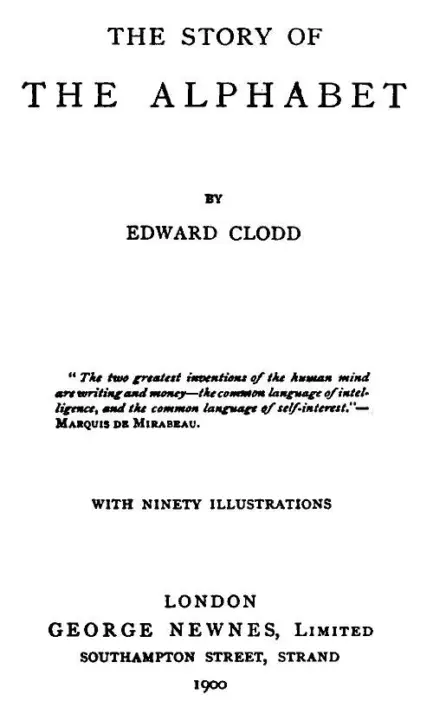
The Story of the Alphabet
Edward Clodd
THE CLASSIC COLLECTION · 1897
"Pioneers of Evolution from Thales to Huxley" by Edward Clodd is a historical account written in the late 19th century. The book explores the origins and development of the idea of evolution, tracing its roots from ancient Greek philosophers to its revival in modern science. It highlights key figures who played a crucial role in shaping evolutionary theory, such as Thales, Aristotle, and later theorists like Darwin and Huxley, while also delving into the belief systems that impeded scientific progress for centuries. The opening of the work establishes a framework for understanding the evolution concept, beginning with the Ionian philosophers who first speculated about the nature of the universe and the origins of life. Clodd emphasizes the substantial intellectual contributions of figures like Thales and Anaximander, who questioned traditional beliefs and proposed that natural phenomena were governed by fixed principles. This section sets a historical context by discussing the initial inquiries of Greek thinkers, outlining how these early ideas laid the groundwork for future scientific exploration while contrasting them with the theological constraints that stalled intellectual progress for many centuries.
Introduction adapted from the source catalogue; source summaries may be automatically generated.
Free to read · English · 70,270 words · No account needed
MAKE TIME FOR A GOOD BOOK
On by default. Untick to stop anonymous reading totals. Each page counts after 10 seconds in view. How this works.
Anonymous counting is on unless you have switched it off.
"So far as cerebral structure goes, therefore, it is clear that Man differs less from the Chimpanzee or the Orang than these do even from the Monkeys, and that the difference between the brains of the Chimpanzee and of Man is almost insignificant when compared with that between the Chimpanzee brain and that of a Lemur.... Thus, whatever system of organs be studied, the comparison of their modifications in the ape series leads to one and the same result,--that the structural differences which separate Man from the Gorilla and the Chimpanzee are not so great as those which separate the Gorilla from the lower apes. But in enunciating this important truth I must guard myself against a form of misunderstanding which is very prevalent ... that the structural differences between man and even the highest apes are small and insignificant. Let me then distinctly assert, on the contrary, that they are great and significant; that every bone of a Gorilla bears marks by which it might be distinguished from the corresponding bone of a Man; and that, in the present creation, at any rate, no intermediate link bridges over the gap between Homo and Troglodytes. It would be no less wrong than absurd to deny the existence of this chasm; but it is at least equally wrong and absurd to exaggerate its magnitude, and, resting on the admitted fact of its existence, to refuse to inquire whether it is wide or narrow. Remember, if you will, that there is no existing link between Man and the Gorilla, but do not forget that there is a no less sharp line of demarcation, a no less complete absence of any traditional form, between the Gorilla and the Orang, or the Orang and the Gibbon."
The brains of man and ape being fundamentally the same in structure, it follows that the functions which they perform are fundamentally the same. The large array of facts mustered by a series of careful observers prove how futile is the argument which, in his pride of birth, man advances against psychical continuity. Vain is the search after boundary lines between reflex action and instinct, and between instinct and reason. Barriers there are between man and brute, for articulate speech and the consequent power to transmit experiences has set up these, and they remain impassable. "The potentialities of language, as the vocal symbol of thought, lay in the faculty of modulating and articulating the voice. The potentialities of writing, as the visual symbol of thought, lay in the hand that could draw, and in the mimetic tendency which we know was gratified by drawing as far back as the days of Quaternary man" (Huxley's Essays on Controverted Questions, p. 47). But these specially human characteristics are no sufficing warrant for denying that the sensations, emotions, thoughts, and volitions of man vary in kind from those of the lower creation. "The essential resemblances in all points of structure and function, so far as they can be studied, between the nervous system of man and that of the dog, leave no reasonable doubt that the processes which go on in the one are just like those which take place in the other. In the dog, there can be no doubt that the nervous matter which lies between the retina and the muscles undergoes a series of changes, precisely analogous to those which, in the man, give rise to sensation, a train of thought, and volition." This passage occurs in Huxley's Reply to Mr. Darwin's Critics, which appeared in the Contemporary Review, 1871, and it may be supplemented by a quotation from the chapter on The Mental Phenomena of Animals in his Hume. "It seems hard to assign any good reason for denying to the higher animals any mental state or process in which the employment of the vocal or visual symbols of which language is composed is not involved; and comparative psychology confirms the position in relation to the rest of the animal world assigned to man by comparative anatomy. As comparative anatomy is easily able to show that, physically, man is but the last term of a long series of forms, which lead, by slow gradations, from the highest mammal to the almost formless speck of living protoplasm, which lies on the shadowy boundary between animal and vegetable life; so, comparative psychology, though but a young science, and far short of her elder sister's growth, points to the same conclusion."
Your reading position is saved on this browser. Take it to another device with a library code. Reading pages adapt to text, rather than matching a printed edition.
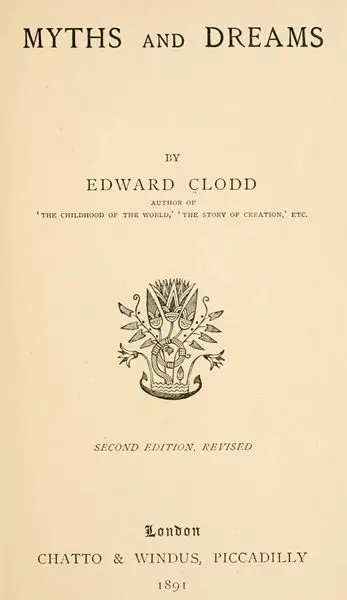
Edward Clodd
Edward Clodd
BEHIND THE BOOK
This eBook is for the use of anyone anywhere in the United States and most other parts of the world at no cost and with almost no restrictions whatsoever. You may copy it, give it away or re-use it under the terms of the Project Gutenberg License included with this eBook or online at www.gutenberg.org. If you are not located in the United States, you will have to check the laws of the country where you are located before using this eBook. Read the source licence.
The original source file, including credits and licence, is retained by this library. Request an original-format copy at no charge. Please include the book title and Project Gutenberg identifier #39526.
KEEP YOUR CURIOSITY GOING

David Patterson (Spirit) Hatch
Cécile Tormay

Moritz Busch
Coulson Kernahan
John L. Ransom

Ralph Waldo Emerson