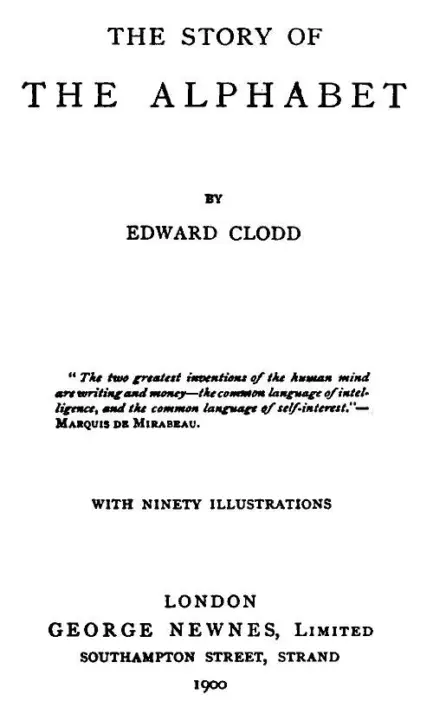
The Story of the Alphabet
Edward Clodd
THE CLASSIC COLLECTION · 1897
"Pioneers of Evolution from Thales to Huxley" by Edward Clodd is a historical account written in the late 19th century. The book explores the origins and development of the idea of evolution, tracing its roots from ancient Greek philosophers to its revival in modern science. It highlights key figures who played a crucial role in shaping evolutionary theory, such as Thales, Aristotle, and later theorists like Darwin and Huxley, while also delving into the belief systems that impeded scientific progress for centuries. The opening of the work establishes a framework for understanding the evolution concept, beginning with the Ionian philosophers who first speculated about the nature of the universe and the origins of life. Clodd emphasizes the substantial intellectual contributions of figures like Thales and Anaximander, who questioned traditional beliefs and proposed that natural phenomena were governed by fixed principles. This section sets a historical context by discussing the initial inquiries of Greek thinkers, outlining how these early ideas laid the groundwork for future scientific exploration while contrasting them with the theological constraints that stalled intellectual progress for many centuries.
Introduction adapted from the source catalogue; source summaries may be automatically generated.
Free to read · English · 70,270 words · No account needed
MAKE TIME FOR A GOOD BOOK
On by default. Untick to stop anonymous reading totals. Each page counts after 10 seconds in view. How this works.
Anonymous counting is on unless you have switched it off.
Postponing further reference to this theory until the great name of Lucretius, its Roman exponent, is reached, we find a genuine scientific method making its first start in the person of Aristotle. This remarkable man, the founder of the experimental school, and the Father of Natural History, was born 384 B. C. at Stagira in Macedonia. In his eighteenth year he left his native place for Athens, where he became a pupil of Plato. Disappointed, as it is thought, at not succeeding his master in the Academy, he removed to Mytilene in the island of Lesbos, where he received an invitation from Philip of Macedon to become tutor to his son, the famous Alexander the Great. When Alexander went on his expedition to Asia, Aristotle returned to Athens, teaching in the "school" which his genius raised to the first rank. There he wrote the greater part of his works, the completion of some of which was stopped by his death at Chalcis in 322. The range of his studies was boundless, but in this brief notice we must limit our survey--and the more so because Aristotle's speculations outside natural history abound in errors--to his pioneer work in organic evolution. Here, in the one possible method of reaching the truth, theory follows observation. Stagira lay on the Strymonic gulf, and a boyhood spent by the seashore gave Aristotle ample opportunity for noting the variations, and withal gradations, between marine plants and animals, among which last-named it should be noted as proof of his insight that he was keen enough to include sponges. Here was laid the foundation of a classification of life-forms on which all corresponding attempts were based. Then, he saw, as none other before him had seen, and as none after him saw for centuries, the force of heredity, that still unsolved problem of biology. Speaking broadly of his teaching, the details of which would fill pages, its main features are (1) His insistence on observation. In his History of Animals he says "we must not accept a general principle from logic only, but must prove its application to each fact. For it is in facts that we must seek general principles, and these must always accord with facts. Experience furnishes the particular facts from which induction is the pathway to general laws." (2) His rejection of chance and assertion of law, not, following a common error, of law personified as cause, but as the term by which we express the fact that certain phenomena always occur in a certain order. In his Physics Aristotle says that "Jupiter rains not that corn may be increased, but from necessity. Similarly, if some one's corn is destroyed by rain, it does not rain for this purpose, but as an accidental circumstance. It does not appear to be from fortune or chance that it frequently rains in winter, but from necessity." (3) On the question of the origin of life-forms he was nearest of all to its modern solution, setting forth the necessity "that germs should have been first produced, and not immediately animals; and that soft mass which first subsisted was the germ. In plants, also, there is purpose, but it is less distinct; and this shows that plants were produced in the same manner as animals, not by chance, as by the union of olives with grape vines. Similarly, it may be argued, that there should be an accidental generation of the germs of things, but he who asserts this subverts Nature herself, for Nature produces those things which, being continually moved by a certain principle contained in themselves, arrive at a certain end." In the eagerness of theologians to discover proof of a belief in one God among the old philosophers, the references made by Aristotle to a "perfecting principle," an "efficient cause," a "prime mover," and so forth, have been too readily construed as denoting a monotheistic creed which, reminding us of the "one god" of Xenophanes, is also akin to the Personal God of Christianity. "The Stagirite," as Mr. Benn remarks (Greek Philosophers, vol. i, p. 312), "agrees with Catholic theism, and he agrees with the First Article of the English Church, though not with the Pentateuch, in saying that God is without parts or passions, but there his agreement ceases. Excluding such a thing as divine interference with all Nature, his theology, of course, excludes the possibility of revelation, inspiration, miracles, and grace." He is a being who does not interest himself in human affairs.
Your reading position is saved on this browser. Take it to another device with a library code. Reading pages adapt to text, rather than matching a printed edition.
Edward Clodd
Edward Clodd
BEHIND THE BOOK
This eBook is for the use of anyone anywhere in the United States and most other parts of the world at no cost and with almost no restrictions whatsoever. You may copy it, give it away or re-use it under the terms of the Project Gutenberg License included with this eBook or online at www.gutenberg.org. If you are not located in the United States, you will have to check the laws of the country where you are located before using this eBook. Read the source licence.
The original source file, including credits and licence, is retained by this library. Request an original-format copy at no charge. Please include the book title and Project Gutenberg identifier #39526.
KEEP YOUR CURIOSITY GOING

David Patterson (Spirit) Hatch
Cécile Tormay

Moritz Busch
Coulson Kernahan
John L. Ransom

Ralph Waldo Emerson