
Life of Harriet Beecher Stowe Compiled From Her Letters and Journals by Her Son Charles Edward Stowe
Harriet Beecher Stowe
THE CLASSIC COLLECTION · 1871
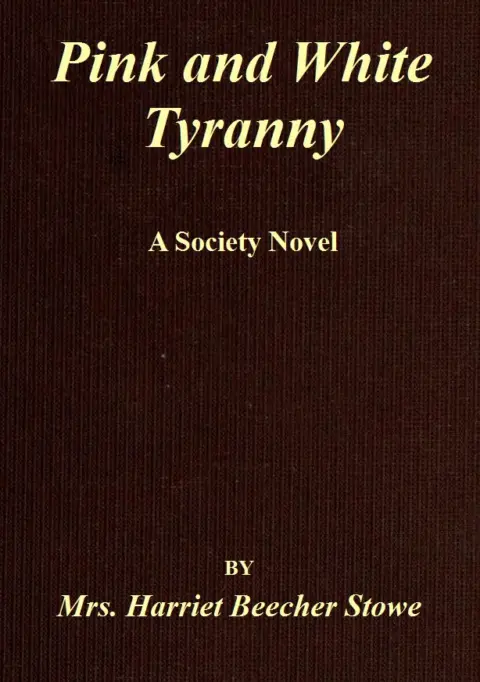
"Pink and White Tyranny" by Harriet Beecher Stowe is a society novel written during the late 19th century. The story revolves around the lives and relationships of a select circle of characters, particularly focusing on John Seymour and his engagement to Lillie Ellis, famed for her beauty and social charm. The narrative promises to explore themes of societal expectation, personal aspirations, and the complex dynamics of love and marriage. The opening of the novel introduces John Seymour, an earnest and respectable man, who is enchanted by the captivating Lillie Ellis. As he gazes at her, drawn to her ethereal beauty, John grapples with his insecurities and romantic ideals. Meanwhile, Lillie, a renowned belle, is presented as a shallow character whose interests lie predominantly in fashion and social status. As the narrative progresses, the reader learns of John's infatuation with Lillie and his hope that she will adapt to the domestic life he envisions for them. However, it becomes evident that their intentions diverge sharply; John seeks a sensible and beneficial partnership, while Lillie seems more inclined towards a life of luxury and superficiality. The contrast establishes a foundation for tension and exploration of character motivations in the unfolding story.
Introduction adapted from the source catalogue; source summaries may be automatically generated.
Free to read · English · 82,608 words · No account needed
MAKE TIME FOR A GOOD BOOK
On by default. Untick to stop anonymous reading totals. Each page counts after 10 seconds in view. How this works.
Anonymous counting is on unless you have switched it off.
“And the effect was perfectly sweet,” said Miss Clippins.
“Perhaps, Lillie, you had better have it ruffled,” said mamma.
“But three rows laid on plain has such a lovely effect,” said Miss
Nippins.
“Perhaps, then, she had better have three rows laid on plain,” said
mamma.
“Or she might have one row ruffled on the edge, with three rows laid on plain, with a satin fold,” said Miss Clippins. “That’s the way I fixed Miss Elliott’s.”
“That would be a nice way,” said mamma. “Perhaps, Lillie, you’d better
have it so.”
“Oh! come now, all of you, just hush,” said Lillie. “I know just how I
want it done.”
The words may sound a little rude and dictatorial; but Lillie had the advantage of always looking so pretty, and saying dictatorial things in such a sweet voice, that everybody was delighted with them; and she took the matter of arranging the trimming in hand with a clearness of head which showed that it was a subject to which she had given mature consideration. Mrs. Ellis shook her fat sides with a comfortable motherly chuckle.
“Lillie always did know exactly what she wanted: she’s a smart little
thing.”
And, when all the trying on and arranging of folds and frills and pinks and bows was over, Lillie threw herself comfortably upon the bed, to finish her letter.
Shrewd Miss Clippins detected the yawn with which she laid down the
missive.
“Seems to me your letters don’t meet a very warm reception,” she said.
“Well! every day, and such long ones!” Lillie answered, turning over the pages. “See there,” she went on, opening a drawer, “What a heap of them! I can’t see, for my part, what any one can want to write a letter every day to anybody for. John is such a goose about me.”
“He’ll get over it after he’s been married six months,” said Miss Clippins, nodding her head with the air of a woman that has seen life.
“I’m sure I shan’t care,” said Lillie, with a toss of her pretty head. “It’s borous any way.”
Our readers may perhaps imagine, from the story thus far, that our little Lillie is by no means the person, in reality, that John supposes her to be, when he sits thinking of her with such devotion, and writing her such long, “borous” letters.
Your reading position is saved on this browser. Take it to another device with a library code. Reading pages adapt to text, rather than matching a printed edition.
Harriet Beecher Stowe

Harriet Beecher Stowe
Harriet Beecher Stowe

Harriet Beecher Stowe
BEHIND THE BOOK
This eBook is for the use of anyone anywhere in the United States and most other parts of the world at no cost and with almost no restrictions whatsoever. You may copy it, give it away or re-use it under the terms of the Project Gutenberg License included with this eBook or online at www.gutenberg.org. If you are not located in the United States, you will have to check the laws of the country where you are located before using this eBook. Read the source licence.
The original source file, including credits and licence, is retained by this library. Request an original-format copy at no charge. Please include the book title and Project Gutenberg identifier #12354.
KEEP YOUR CURIOSITY GOING
Coulson Kernahan

Maurice Baring
Frances Wright
Cécile Tormay

Frederic Jesup Stimson

W. H. P. (William Henry Pope) Jarvis