THE CLASSIC COLLECTION✦The Letter of CreditCLASSIC FREE BOOKS
The Letter of Credit
Susan Warner
THE CLASSIC COLLECTION · 1877
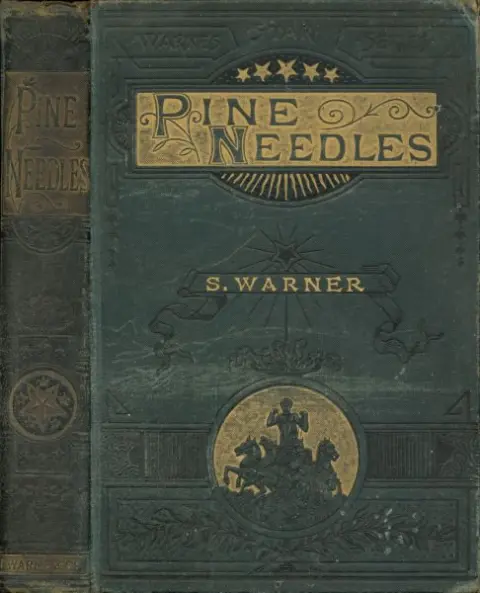
"Pine Needles" by Susan Warner and Louis Harms is a fictional work written in the late 19th century. The narrative unfolds primarily around the experiences of the Franklin and Candlish families at Mosswood, as they navigate the joys of friendship and the beauty of nature, intertwined with deeper themes of faith and heroism. The book appears to explore both ordinary familial interactions and significant moral questions reflecting on Christian values, suggesting a thoughtful examination of personal growth and the impact of relationships. The opening of the story sets the stage for the reuniting of the Franklin and Candlish families at Mosswood, introducing characters like Maggie, Meredith, Flora, and Esther. As they prepare for a day in the woods, the excitement among the children builds, particularly around their plans for a picnic and their desire to invite their Uncle Eden, highlighting themes of joy and youthful adventure. During their outing, Meredith engages with a missionary story from a German pastor, hinting at deeper discussions about morality, faith, and cultural history. This premise creates a rich tapestry of both light-hearted moments and thoughtful reflections, especially regarding the characters' appreciation of their environment and relationships.
Introduction adapted from the source catalogue; source summaries may be automatically generated.
Free to read · English · 81,976 words · No account needed
MAKE TIME FOR A GOOD BOOK
On by default. Untick to stop anonymous reading totals. Each page counts after 10 seconds in view. How this works.
Anonymous counting is on unless you have switched it off.
"'The story that I am now about to tell you is such a one as certainly nobody expects to hear from me; it is namely, the story of a night-watchman. But there is no sort of reason why you should laugh at this word, for indeed the story is a pretty one; and I wish all the night-watchmen in city and country would take after this man and do as he did; that is, provided they could do it from the bottom of their hearts. A poor cottager in one of our country villages, some years ago, out of curiosity, came to one of our mission festivals. There to his astonishment he heard that the Lord Jesus will have all men to be saved, that are in the whole earth, even the poor heathen; and that accordingly He has commanded His servants, the Christians, to cast the net of the gospel into the sea of the heathen world. He heard how the heathen are to be saved, because Jesus died for all men; how they can nevertheless no otherwise be saved than through faith in Him; because there is salvation for sinners in no other but only in the name of Him who was crucified for sinners and is risen again. Meanwhile however, by means of this mission festival the dear man himself is taken in the net of the gospel; for he sees that he also is a sinner, and therefore for him also there is no salvation except in Him who forgives sins, because He has made reconciliation for sinners with God. And now, finding himself salvation in Christ, this experience of his convinces him that nobody but Jesus can really help the poor heathen. But then since Jesus can come to the poor heathen in no way but by his Word and sacrament, and his Word and sacrament the heathen have not, it becomes very clear to his mind that the Word and sacrament must be carried to them. This, moreover, can be done only by messengers to the heathen, who must be sent to them, because they have not got wings to fly thither. Then he begins to ponder the question, how he can do something to help. So he buys himself a mission-box, that he may always be putting something in there when he has anything to spare. As nevertheless what goes in is only the mites of poverty, it looks to him a great deal too little. He makes the resolve now that every quarter of a year he will go round the village with his box to collect for the mission. But this is a resolve he cannot perform; for inasmuch as the mission is not known to the people of his village, he reflects that where there is no heart for the mission, naturally there are no gifts for it. And there he was quite right, and did a wise thing to let his collecting project alone. So about that he gives in, and quietly hangs up his mission box in his room, on a nail opposite the door, so that every one who comes into the room can see it. And people do observe it, and many a one asks what sort of a thing that can be? He makes answer, it is for this purpose: that whatever goes into it will be applied to the converting of the heathen. And so in this way some few mites do actually get in; which, however, at the end of each year bring but a small sum. Now as this sum is still far too small to content him, he turns simply to the dear Lord Jesus, and says to Him--"Dear Lord, as for going to the heathen myself, that I cannot do: I am too old, and I have not learned enough. But because Thou hast done so much for me and in me, I would like greatly to do something for Thee, and truly a little more than I have done hitherto. So give me Thy Holy Spirit, that I may know how to manage it; for without Him man's knowledge is nought." Following upon such a prayer then, the Lord appointed him to be nightwatcher. For without his having in the least anticipated such a thing, the village community invited him to undertake the service of the night-watch in the village. He made answer, he must take the matter into consideration before God and with his wife. The latter was not at first disposed to be pleased that he should wake while others slept; and his own flesh also takes to it not kindly, to have to wander about in the village in snow and rain, when it is cold and when it is stormy, while everybody else is lying upon his ear. But his former prayer recurs to him, the Lord is certainly now giving him something to do; and so he says to the Lord Jesus--"My dear Saviour, if Thou canst use me in this way, keeping watch in the village with Thy holy angels, who are about us at all times, then give me strength and joy to do it!" And as the Lord grants him both, the thing is settled, and in the name of Jesus he accepts the office of night-watch. The custom in that place makes it a rule, that on New Year's night the night-watch should sing under people's windows a couple of pretty Christian verses, as it were a New Year's greeting; to one this verse, to the next the other verse, and so round at all the houses. New Year's day then, or the day after, he may go round again visiting house by house, and wish happy New Year; and the people give him according to their means and according to their inclination a gift, smaller or larger, and these gifts belong to his service earnings; it is no begging either, for the stipulation is made at the time he is put in office. With true gladness of heart now in the New Year's night he sings under all the windows in the village; and as he does this, he seems to himself just the same as a priest of God; his office seems to him a right holy one. And particularly where he knows that a sick person is lying in a house he sings the loveliest verses of faith and comfort, so that tears run down over his own cheeks in the doing of it. That night is verily a night of triumph in his work; and he begins to bear a cordial love to his calling, as one the Lord has given him and has sanctified. To go round on New Year's day, however, and wish the people joy, that is what he cannot make up his mind to; it is a festival and a holiday; it belongs to the Lord; and it must be spent in the church and with the Bible. But the next day he has time, and then he will go; and then his mission-box occurs to him, which is still hanging there on its nail. Now he knows what he is to do. He takes the box in his hand and goes the rounds, house after house, and gives his good wishes. Everywhere the people receive his hearty congratulations kindly, and every one puts his hand in his pocket with alacrity to fetch out a little present for him; the faithful man has indeed done his work so honestly, and but just now has sung for them so heartily and such beautiful verses! But he holds forth his box to his benefactors, and begs them to put whatever they design for him in there, for what they give is to go to the conversion of the heathen. So upon that one asks him a question, and another asks him a question, and he has opportunity to open his mouth with gladness and testify of the misery of the poor heathen, and of the sacred duty of helping them, that so they may be converted. And God gives His blessing both to deeds and word; and now the man finds himself able to send in not a little, but a good deal, for the conversion of the heathen, who lie so heavily on his heart.
Your reading position is saved on this browser. Take it to another device with a library code. Reading pages adapt to text, rather than matching a printed edition.
Susan Warner
Susan Warner
Susan Warner
Susan Warner
BEHIND THE BOOK
This eBook is for the use of anyone anywhere in the United States and most other parts of the world at no cost and with almost no restrictions whatsoever. You may copy it, give it away or re-use it under the terms of the Project Gutenberg License included with this eBook or online at www.gutenberg.org. If you are not located in the United States, you will have to check the laws of the country where you are located before using this eBook. Read the source licence.
The original source file, including credits and licence, is retained by this library. Request an original-format copy at no charge. Please include the book title and Project Gutenberg identifier #38922.
KEEP YOUR CURIOSITY GOING
Cécile Tormay

Moritz Busch
Coulson Kernahan
John L. Ransom

Maurice Baring
Frances Wright