THE CLASSIC COLLECTION✦The Letter of CreditCLASSIC FREE BOOKS
The Letter of Credit
Susan Warner
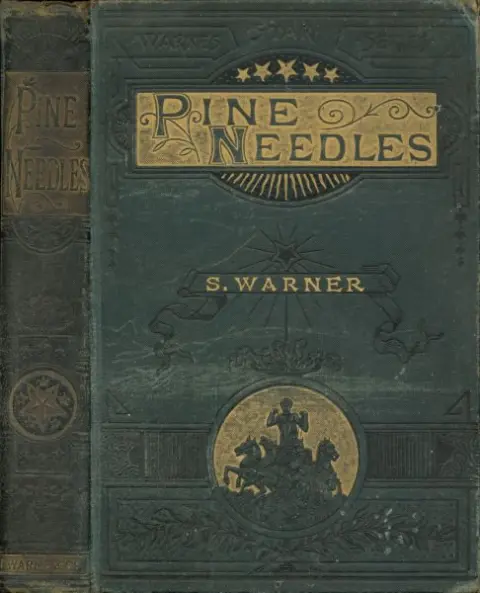
THE CLASSIC COLLECTION · 1877
"Pine Needles" by Susan Warner and Louis Harms is a fictional work written in the late 19th century. The narrative unfolds primarily around the experiences of the Franklin and Candlish families at Mosswood, as they navigate the joys of friendship and the beauty of nature, intertwined with deeper themes of faith and heroism. The book appears to explore both ordinary familial interactions and significant moral questions reflecting on Christian values, suggesting a thoughtful examination of personal growth and the impact of relationships. The opening of the story sets the stage for the reuniting of the Franklin and Candlish families at Mosswood, introducing characters like Maggie, Meredith, Flora, and Esther. As they prepare for a day in the woods, the excitement among the children builds, particularly around their plans for a picnic and their desire to invite their Uncle Eden, highlighting themes of joy and youthful adventure. During their outing, Meredith engages with a missionary story from a German pastor, hinting at deeper discussions about morality, faith, and cultural history. This premise creates a rich tapestry of both light-hearted moments and thoughtful reflections, especially regarding the characters' appreciation of their environment and relationships.
Introduction adapted from the source catalogue; source summaries may be automatically generated.
Free to read · English · 81,976 words · No account needed
MAKE TIME FOR A GOOD BOOK
On by default. Untick to stop anonymous reading totals. Each page counts after 10 seconds in view. How this works.
Anonymous counting is on unless you have switched it off.
"'O day most calm, most bright,
The fruit of this, the next world's bud--
Th' indorsement of supreme delight,
Writ by a friend, and with his blood;
The couch of time; cares balm and bay;
The week were dark but for thy light;
Thy torch doth show the way.'"
"That's better than anything I have got, sir," said Meredith.
"No. But it is good. And just here and to-day the Sabbath seems dressed in royal robes. I could not but think of those lines."
"I confess, Mr. Murray, Sunday is nothing like that to me," said Flora.
"You are honest, Miss Flora. That gives me some hope of you. No,
naturally the Sabbath does not seem like that to you yet.--Well,
Meredith?"
"Is there more of it, sir?" Meredith's sister asked.
"More than you would care for, Miss Flora.--
"'Sundays the pillars are
On which heav'n's palace arched lies;
The other days fill up the spare
And hollow room with vanities.--'"
"And yet that need not be true, either. Go on, Meredith. What will you
give us?"
"Two stories, sir, on the words, 'Hold that fast which thou hast, that
no man take thy crown.'"
"'On the twenty-fifth of June 1530, therefore three hundred and forty years ago, as is well known, our Lutheran Confession of Faith was delivered before the diet at Augsburg. There was the powerful emperor Charles V., and his brother, King Ferdinand, besides a number of electoral princes, dukes and bishops. Before this crowd of some three or four hundred nobles, stood a little company of seven princes and two represented cities; that is, the Elector John the Constant and his son John Frederick of Saxony, Margrave George of Brandenburg, Duke Ernst the Confessor and his brother Francis of Lueneburg, Landgrave Philip of Hesse, Prince Wolfgang of Anhalt, and the two burgermasters of Nuernberg and Reutlingen. These nine stood forth with the spirit of heroes, and confessed, under signature of their names, that in this faith they would live and die, and that no power of earth or hell should make them turn from it. For the Lutherans were wickedly slandered, as men who no longer believed in anything, and who therefore deserved no other than to be rooted out from the earth. That was why the Lutheran princes had requested that it might be granted them to declare their faith publicly before the Diet; to the end that everybody might know how their belief rested upon the Scriptures and stood in harmony with the universal ancient Christian Church; and indeed had flung away only the false human teachings which had found their way into the Church. For this purpose the twenty-fifth of June was fixed. The electoral chancellor Beyer stepped into the middle of the hall with the written Confession of Faith in his hand. The evangelical princes rose and stood listening while it was read, and testified that this was the faith they held, to which by God's help they would stand unmoved. Then did all that were present hear what the faith of the Lutherans was; there stood the doctrine of the triune God, of original sin, of the eternal Godhead of Jesus Christ; of justification before God through grace alone by faith in Jesus Christ, &c., though I hope I do not need to tell you any more about it; I think you all know the Augsburg Confession and have read it, for surely you are all of you Lutheran Christians, and all Lutheran Christians know the Augsburg Confession. But if there be one among you who does not yet know this act of confession, let him be ashamed of himself, and get a copy with all speed, and read it, and read it again. When it was read aloud at Augsburg, the impression it made was very great; people saw that the Lutherans had been shamefully slandered. Duke William of Bavaria reproached De Eck with having represented the Lutheran doctrine to him in entirely false colours. The doctor answered, he would undertake to refute this writing from the Christian fathers, but not from the Scripture. Then the duke returned, "So, if I hear aright, the Lutherans are in the Scriptures, and we near by!"
Your reading position is saved on this browser. Take it to another device with a library code. Reading pages adapt to text, rather than matching a printed edition.
Susan Warner
Susan Warner
Susan Warner
Susan Warner
BEHIND THE BOOK
This eBook is for the use of anyone anywhere in the United States and most other parts of the world at no cost and with almost no restrictions whatsoever. You may copy it, give it away or re-use it under the terms of the Project Gutenberg License included with this eBook or online at www.gutenberg.org. If you are not located in the United States, you will have to check the laws of the country where you are located before using this eBook. Read the source licence.
The original source file, including credits and licence, is retained by this library. Request an original-format copy at no charge. Please include the book title and Project Gutenberg identifier #38922.
KEEP YOUR CURIOSITY GOING
Cécile Tormay

Moritz Busch
Coulson Kernahan
John L. Ransom

Maurice Baring
Frances Wright