THE CLASSIC COLLECTION✦The Letter of CreditCLASSIC FREE BOOKS
The Letter of Credit
Susan Warner
THE CLASSIC COLLECTION · 1877
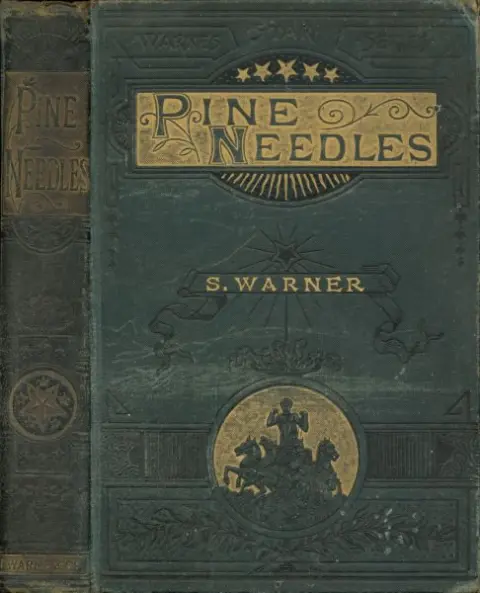
"Pine Needles" by Susan Warner and Louis Harms is a fictional work written in the late 19th century. The narrative unfolds primarily around the experiences of the Franklin and Candlish families at Mosswood, as they navigate the joys of friendship and the beauty of nature, intertwined with deeper themes of faith and heroism. The book appears to explore both ordinary familial interactions and significant moral questions reflecting on Christian values, suggesting a thoughtful examination of personal growth and the impact of relationships. The opening of the story sets the stage for the reuniting of the Franklin and Candlish families at Mosswood, introducing characters like Maggie, Meredith, Flora, and Esther. As they prepare for a day in the woods, the excitement among the children builds, particularly around their plans for a picnic and their desire to invite their Uncle Eden, highlighting themes of joy and youthful adventure. During their outing, Meredith engages with a missionary story from a German pastor, hinting at deeper discussions about morality, faith, and cultural history. This premise creates a rich tapestry of both light-hearted moments and thoughtful reflections, especially regarding the characters' appreciation of their environment and relationships.
Introduction adapted from the source catalogue; source summaries may be automatically generated.
Free to read · English · 81,976 words · No account needed
MAKE TIME FOR A GOOD BOOK
On by default. Untick to stop anonymous reading totals. Each page counts after 10 seconds in view. How this works.
Anonymous counting is on unless you have switched it off.
They were a very happy party at dinner. Fenton, it is true, came out singularly in the conversation, and gave a number of details respecting life at school and his views of life in the world. Mr. Murray's answers however were so humorous, and so wise and sweet at the same time, that it seemed Fenton only furnished a text for the most pleasant discourse. And after dinner Maggie got out stereoscopic views, and she and others delighted themselves with a new look at the Middle Ages.
"What a strange thing it must be," said Meredith, "to live where every farm and every church has a history; of course every village."
"Haven't farms and villages in our country a history?" Maggie inquired.
"No," said Esther; "of course not."
"A few," said Mr. Murray. "Such New England farms, for instance, as still bear the names 'Lonesome' and 'Scrabblehard.' But the histories are not very old, and refer to nothing more picturesque than the struggles of the early settlers."
"What struggles?" Maggie wanted to know.
"Struggles for life. With the hard soil, with the hard climate, and with the wild Indians. But such struggles, Maggie, left an inheritance of strength, patience, and daring to their children."
"Why haven't we stories like those of the Saxons?"
"Why!" exclaimed Fenton impatiently, "are you such a simple? There was nothing here but red Indians till a little while ago."
"We have not been a nation for more than a hundred years, Maggie," said
Meredith.
"And before that, were the Indians here at Mosswood?"
"No, no," said Fenton. "You had better study history."
"As you have," put in his uncle. "Won't you tell Maggie when the first settlements of the English were made in America?"
However, Fenton could not.
"In the beginning of the seventeenth century it was, Maggie, that the first colonies were established here. The Dutch came to New York, and the Puritans to New England, and a little earlier the English colonists to Virginia. We are a young country."
"Is it better to be a young country, or to be an old one?"
"The young country has its life before it," said Mr. Murray
smiling;--"like a young girl."
"How, Uncle Eden?"
"She has the chance still to make it noble and beautiful."
"We can't have these grand old castles, though," said Meredith, looking
at the view of Sonneck.
"Those are the picturesque scars remaining of a time which was not beautiful--except to the eye. I suppose it was that."
The conversation took a turn too historical to be reported here.
Your reading position is saved on this browser. Take it to another device with a library code. Reading pages adapt to text, rather than matching a printed edition.
Susan Warner
Susan Warner
Susan Warner
Susan Warner
BEHIND THE BOOK
This eBook is for the use of anyone anywhere in the United States and most other parts of the world at no cost and with almost no restrictions whatsoever. You may copy it, give it away or re-use it under the terms of the Project Gutenberg License included with this eBook or online at www.gutenberg.org. If you are not located in the United States, you will have to check the laws of the country where you are located before using this eBook. Read the source licence.
The original source file, including credits and licence, is retained by this library. Request an original-format copy at no charge. Please include the book title and Project Gutenberg identifier #38922.
KEEP YOUR CURIOSITY GOING
Cécile Tormay

Moritz Busch
Coulson Kernahan
John L. Ransom

Maurice Baring
Frances Wright