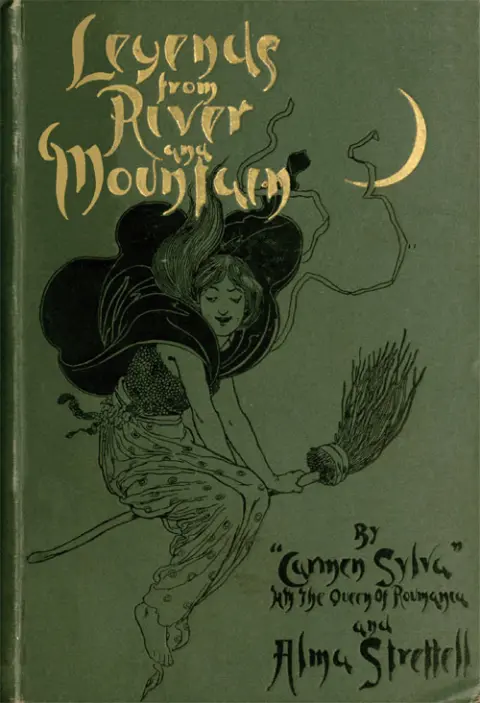
Legends from River & Mountain
Carmen Sylva & Alma Strettell
THE CLASSIC COLLECTION · 1884
"Pilgrim Sorrow: A Cycle of Tales" by Carmen Sylva is a collection of allegorical tales written in the late 19th century. The work explores profound themes of sorrow, love, and the human condition through enchanting and poignant narratives woven into a framework that blends fairy tale elements with deep emotional introspection. The opening chapters introduce characters like Sorrow, who personifies grief and hardship, and set the tone for stories that reflect the struggles and trials faced by individuals in their emotional journeys. The beginning of "Pilgrim Sorrow" intricately establishes the essence of the tales to follow. It begins with a rich introduction detailing the life of Queen Elisabeth of Roumania, who penned these stories under the pseudonym Carmen Sylva, emphasizing her experiences with sorrow and loss that deeply influenced her writing. The first tale, "The Child of the Sun," unfolds in a fantastical world where the personification of Life encounters Strife, leading to a struggle that brings sorrow into existence. This battle sets the tone for the overarching exploration of sorrow and its intertwining with beauty and joy, positioning the reader for a poignant exploration of the various forms grief may take throughout the cycle of tales.
Introduction adapted from the source catalogue; source summaries may be automatically generated.
Free to read · English · 31,138 words · No account needed
MAKE TIME FOR A GOOD BOOK
On by default. Untick to stop anonymous reading totals. Each page counts after 10 seconds in view. How this works.
Anonymous counting is on unless you have switched it off.
A merry sound of sledge bells sounded, and like a lovely dream two beautiful young girls flew past in a sledge, wrapped snugly in rich furs. Their cheeks and eyes sparkled with joy in the beautiful sunshine. It passed like lightning, this vision, but all in the little house were dazzled by it. The sick girl drew her thin hands through her black hair, the poor woman bit her teeth together, and the two children said--
"Mother, were those angels?"
"No," she uttered harshly; "they were human beings like ourselves, only rich and happy, who are not hungry, and have warm clothes."
Sorrow touched her arm--
"If you desire it, I will bring them here, into your home; but at one price--they will suffer pain and misery, and their joy will vanish. Do you want that?"
"Yes," said the woman, "I do. Why should not they watch and weep as we
do?"
Sorrow sighed.
"Shall I fetch them?" she asked once again.
"Go, go; do you not see that my children starve? What do other people's
children concern me?"
Sorrow neared the young girl's bed.
"Farewell for the present," she said; "be brave and reasonable, and
take care of yourself, that I may not have to come to you again to
punish."
She kissed the children. "I send you the angels and a good Christmas,
have patience."
Then she softly lifted the door latch and was gone. Envy slid after her; and in her place, on the first sunbeam that smote the rows of houses, Hope floated into the room and made it light. Mother and children looked out expectantly. The girl pushed back her hair from her brow, and the bad thoughts retreated.
Sorrow paced so lightly across the snow that she scarcely left a trace, as though she were borne by the sharp east wind, whose pungent tongue mocked the fine winter morning. She went through the most aristocratic streets, and vanished into one of the stateliest houses; entering so softly that no one noticed her, not even the servants, who were stretching themselves on red cushioned divans in the entrance hall; not even the parrot that always cried, "Canaille! Canaille!" and made a wise face. She went up the broad stairs, where everything was perfumed of fir-trees, straight towards a high door, whence the laughter of youthful voices resounded. Unnoticed she stood in the high large room through whose many windows the sun streamed, touching the white-covered, long tables, on which still lay all the presents given the night before. At one end of the room stood three tall fir-trees, their branches bent under a gay weight, and round about the room some thirty smaller ones. The six huge chandeliers were encircled with garlands of fir and chains of glass balls, and from one to the other hung rows of colored paper lamps. It must have looked quite fairy-like in the evening with all the candles alight. Amidst this glory two tall slim, supple figures, in dark, close-fitting, cloth dresses, were playing battledore and shuttlecock. Every movement was of rare grace, and the delicate profiles with the dark arched eyebrows, stood out well against the somber firs. The gold brown hair of the one hung in voluptuous waves over her shoulders, only held together by a ribbon; a weight of fair plaits hung down the neck of the other. Their heads thrown backwards revealed faultlessly set necks and laughing rows of pearly teeth. It was a sight for gods, and the young man who looked on thought so, as he sat in Olympian calm carelessly reading in an armchair, dressed in an elegant morning suit, a cigarette in his ring-covered hand. From time to time, in a powerful baritone, he hummed some rather frivolous songs that each time drew down on him a storm of laughing reproaches.
Your reading position is saved on this browser. Take it to another device with a library code. Reading pages adapt to text, rather than matching a printed edition.
Carmen Sylva & Alma Strettell
Carmen Sylva
BEHIND THE BOOK
This eBook is for the use of anyone anywhere in the United States and most other parts of the world at no cost and with almost no restrictions whatsoever. You may copy it, give it away or re-use it under the terms of the Project Gutenberg License included with this eBook or online at www.gutenberg.org. If you are not located in the United States, you will have to check the laws of the country where you are located before using this eBook. Read the source licence.
The original source file, including credits and licence, is retained by this library. Request an original-format copy at no charge. Please include the book title and Project Gutenberg identifier #46262.
KEEP YOUR CURIOSITY GOING
Coulson Kernahan

Maurice Baring
Frances Wright
Cécile Tormay
Francis Greenleaf Allinson & Anne C. E. (Anne Crosby Emery) Allinson

Frederic Jesup Stimson