THE CLASSIC COLLECTION✦Salve Venetia, gleanings from Venetian history; vol. IICLASSIC FREE BOOKS
Salve Venetia, gleanings from Venetian history; vol. II
F. Marion (Francis Marion) Crawford
THE CLASSIC COLLECTION · 1892
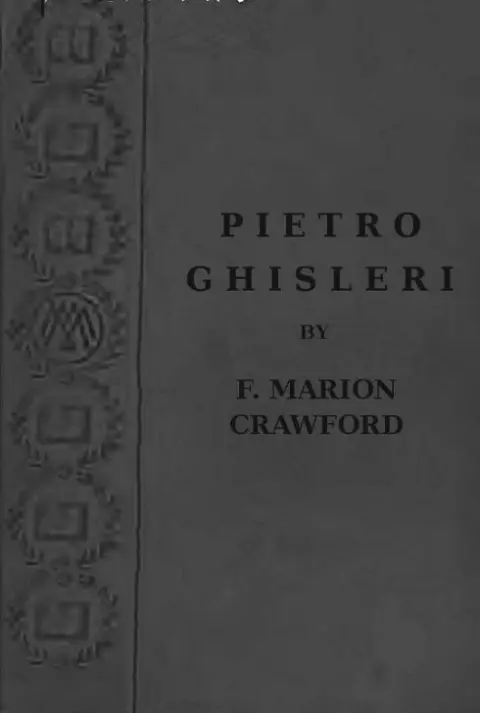
"Pietro Ghisleri" by F. Marion Crawford is a novel written in the late 19th century. The story revolves around complex relationships between two step-sisters, Laura Carlyon and Adele Braccio, in the context of a Roman high-society backdrop, exploring themes of love, jealousy, and social dynamics. The narrative delves into the intricacies of their family life, including the interests of their parents and the young men in their circle, particularly focusing on the attention that each step-sister garners in society. The opening of the novel introduces the family dynamics between the step-sisters and their parents, particularly the Honourable Mrs. Carlyon and Prince Gerano. Laura, who is described as beautiful yet without a dowry, and Adele, an heiress who is lively and somewhat vain, grow up with contrasting personalities and ambitions. As their stories unfold, romantic tensions arise, especially regarding Don Francesco Savelli, who is intended for Adele but finds himself attracted to Laura instead. This leads to jealousy and rivalry, setting the stage for deeper conflicts and emotional developments further along in the story. In this initial chapter, readers sense the societal pressures and personal struggles that will define the relationships at play.
Introduction adapted from the source catalogue; source summaries may be automatically generated.
Free to read · English · 153,334 words · No account needed
MAKE TIME FOR A GOOD BOOK
On by default. Untick to stop anonymous reading totals. Each page counts after 10 seconds in view. How this works.
Anonymous counting is on unless you have switched it off.
But as chance would have it, the Contessa found herself talking to San Giacinto one evening, when she was feeling very lonely and unhappy, and her half-formed resolution broke down as suddenly as it had presented itself. The giant looked at her keenly for a moment, bent his heavy black brows, and then told her the story of what had taken place at the club. He, who saw most things, and talked little of them, noted the gradual change in her face, and how the light came back to it while he was speaking. She understood that the man whom she had accused of betraying his friend had faced a roomful of men in his defence, and on the very ground now under discussion, and she repented of what she had done. Then she swore vengeance on Adele Savelli.
The world saw that a reconciliation had taken place, and concluded that Maddalena dell' Armi had abandoned her foolish plan of trying to attract Ghisleri by being cold to him. Ghisleri, indeed! As though he cared!
"But I have no particular wish to be revenged on Donna Adele," objected Ghisleri, when the Contessa spoke to him on the subject. "That sort of thing is a disease of the brain. There are people who cannot see things as they are. She is one of them."
"How indifferent you are!" sighed Maddalena. "I wonder whether you were
always so."
"Not always," answered Pietro, thoughtfully.
In due time the short Easter season was over, the foreigners departed, and many of the Romans followed their example, especially those whose country places were within easy reach of the city, by carriage or by rail. The Contessa went to pay her regular annual visit at her father's, near Florence,--her mother had long been dead,--and Ghisleri remained in Rome, unable to make up his mind what to do. Something seemed to bind him to the town this year, and though he went away for a day or two from time to time, he always came back very soon. Even his damaged old castle did not attract him as it usually did, though he had begun to restore it a little during the last few years, a little at a time, as his modest fortune allowed. There was an odd sort of foresight in his character. He laughed at the idea of being married, and yet he had a presentiment that he would some day change his mind and take a wife. In case that should ever happen, Torre de' Ghisleri would be at once a beautiful and an economical retreat for the summer months. Though he had a reputation for extravagance and for living always a little beyond his income, he was in reality increasing his property. He was constantly buying small bits of land in the neighbourhood of his castle, with a vague idea that he might ultimately get the old estate together again. He generally bought on mortgage, binding himself to pay at a certain date, and as he was a very honourable man in all financial transactions, he invariably paid, though sometimes at considerable sacrifice. He said to himself that unless he were bound he would inevitably throw away the little money he had to spare. It was a curiously practical trait in such an unruly and almost lawless character, but he did such things when he could, and then thought no more about them until a fresh opportunity presented itself. He was a man whose life and whole power of interest in life were almost constantly absorbed by the two or three persons to whom he was sincerely attached, a fact never realised by those who knew him--a passionate man at heart, and one who despised himself for many reasons--a man who would have wished to be a Launcelot in fidelity, a Galahad in cleanness of heart, an Arthur for justice and frankness, but who was indeed terribly far from resembling any of the three. A man liable to most human weaknesses, but having just enough of something better to make him hate weakness in himself and understand it in others without condemning it too harshly in them. He had the wish to overcome it in his own character and life, but when the victory looked too easy it did not tempt him, for his vanity was of the kind which is only satisfied with winning hard fights, and rarely roused except by the prospect of them, while quite indifferent to small success of any kind--either for good or evil.
Your reading position is saved on this browser. Take it to another device with a library code. Reading pages adapt to text, rather than matching a printed edition.
F. Marion (Francis Marion) Crawford
F. Marion (Francis Marion) Crawford

F. Marion (Francis Marion) Crawford

F. Marion (Francis Marion) Crawford
BEHIND THE BOOK
This eBook is for the use of anyone anywhere in the United States and most other parts of the world at no cost and with almost no restrictions whatsoever. You may copy it, give it away or re-use it under the terms of the Project Gutenberg License included with this eBook or online at www.gutenberg.org. If you are not located in the United States, you will have to check the laws of the country where you are located before using this eBook. Read the source licence.
The original source file, including credits and licence, is retained by this library. Request an original-format copy at no charge. Please include the book title and Project Gutenberg identifier #40922.
KEEP YOUR CURIOSITY GOING
Coulson Kernahan

Maurice Baring
Frances Wright
Cécile Tormay

Frederic Jesup Stimson

W. H. P. (William Henry Pope) Jarvis