THE CLASSIC COLLECTION✦Salve Venetia, gleanings from Venetian history; vol. IICLASSIC FREE BOOKS
Salve Venetia, gleanings from Venetian history; vol. II
F. Marion (Francis Marion) Crawford
THE CLASSIC COLLECTION · 1892
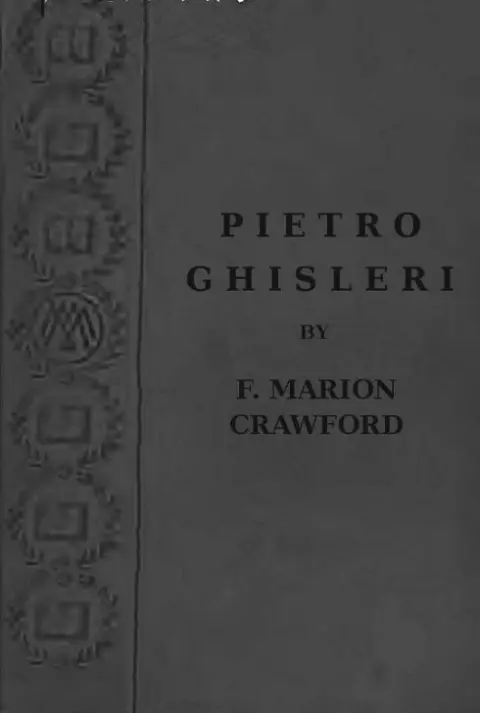
"Pietro Ghisleri" by F. Marion Crawford is a novel written in the late 19th century. The story revolves around complex relationships between two step-sisters, Laura Carlyon and Adele Braccio, in the context of a Roman high-society backdrop, exploring themes of love, jealousy, and social dynamics. The narrative delves into the intricacies of their family life, including the interests of their parents and the young men in their circle, particularly focusing on the attention that each step-sister garners in society. The opening of the novel introduces the family dynamics between the step-sisters and their parents, particularly the Honourable Mrs. Carlyon and Prince Gerano. Laura, who is described as beautiful yet without a dowry, and Adele, an heiress who is lively and somewhat vain, grow up with contrasting personalities and ambitions. As their stories unfold, romantic tensions arise, especially regarding Don Francesco Savelli, who is intended for Adele but finds himself attracted to Laura instead. This leads to jealousy and rivalry, setting the stage for deeper conflicts and emotional developments further along in the story. In this initial chapter, readers sense the societal pressures and personal struggles that will define the relationships at play.
Introduction adapted from the source catalogue; source summaries may be automatically generated.
Free to read · English · 153,334 words · No account needed
MAKE TIME FOR A GOOD BOOK
On by default. Untick to stop anonymous reading totals. Each page counts after 10 seconds in view. How this works.
Anonymous counting is on unless you have switched it off.
In the first place, she intended to admit that she had been jealous of Laura for years, and to own frankly that she had often said cruel and spiteful things of her, and of Arden, just as everybody she knew said spiteful things of somebody. She would even admit that she had first set afloat the rumour that Lord Herbert was intemperate, and that Laura had the evil eye. She could then point out that her conduct had suddenly changed in deference to her father's wishes, that there had been an open reconciliation, not very heartfelt on her part at first, but made sincere by the remorse she felt after Arden's death. For she meant to go even so far as to confess that Arden might have caught the scarlet fever in her house, seeing that her maid was only just recovering from it at the time. The woman's illness had been kept strictly secret, and she had been, from the first, taken to a distant part of the palace, so that Adele had not believed there could be any danger. Even her husband had not known what the maid's illness was, and poor Lucia had pleaded so hard not to be sent to the hospital that Adele had yielded. But to prove, she would say, how little fear of contagion she had, her own children had not been sent into the country. The Palazzo Savelli was big enough to have had a whole infirmary in one part of it, completely isolated from all the rest. Nevertheless, she had always felt that there was a possibility of Arden's last illness having been taken at that dinner-party, and her secret remorse had caused her the greatest suffering. Between that and a nervous disorder from which she had little hope of ever recovering, she had fallen very ill, and had gone to Gerano. While there, her conscience had so pricked her in the matter of her past unkindness to her step-sister and to Arden, that although she had been to confession at Easter, she wrote a long letter to her confessor in Rome, going again over the full details of the past winter. From that point she could tell the truth, without even sparing Lucia, until she came to the discovery that it was Ghisleri himself who had picked up the letter, or confession, under the shaft of the oubliette. And here she would lay great stress on Ghisleri's attachment to Laura, and consequent dislike of herself. The well-known fact that Pietro had fought a desperate duel merely because Campodonico said that Lady Herbert Arden might have the evil eye, sufficiently showed to what lengths he would go in her defence. Nothing more would really be needed. But there was plenty more. All Rome knew that he had broken with Maddalena dell' Armi for Laura's sake, and that he had exhibited the most untiring devotion ever afterwards. Never, since the death of the Princess Corleone, Adele would boldly assert, had he been faithful to any one woman for such a length of time. That was a strong point. The Princess of Gerano herself could testify to her own anxiety about Laura since Ghisleri had been so much with her. Laura herself had behaved in the most admirable manner ever since the reconciliation, but Ghisleri, in constituting himself her champion, had become, so to say, more royalist than the king, and more catholic than the pope. His dislike, if not his positive hatred, for Adele was apparent at every step in the story. He did not, it is true, speak of it to any one, but his reticence was a well-known peculiarity of his character. It was when he was alone in conversation with Adele that he showed what he felt. But his manner was always courteous and rather formal. It was by sarcastic hints that he conveyed his meaning. Nevertheless, Adele had maintained the outward forms of friendly acquaintance, and once, some six months after Arden's death, when matters had not been so bad as they now were, she had asked him to stay a few days at Gerano. Lucia could testify that he was there at the time when the confession disappeared, and Lucia, who had attempted to extort money for it, and would have succeeded if the document had been forthcoming, had naturally been as interested as any one to find it. Not until some time later had Adele suspected that it had been picked up by Ghisleri. The thing, of course, had not any very great value, but what woman, Adele would ask, could bear to think that the most private outpourings of her soul to her spiritual director were in the hands of a man who hated her, and who could, if he pleased, circulate them and make them the talk of the town? When Ghisleri, in the following winter, had begun to torment her systematically by quoting little phrases and expressions which she remembered to have written in the letter, she had at last boldly taxed him with having it in his possession, and he, with the unparalleled cynicism for which he was famous, had laughed at her and owned the truth. Every one would allow that this was very like him. She had threatened to complain to her husband, and he had expressed the utmost indifference. He was a known duelist and a dangerous adversary, and for her husband's sake she had held her tongue, while Ghisleri continued to make her life miserable with his witticisms. Then she had once asked him what he would consider an equivalent for the letter. He had laughed again, and had said that he would take a large sum of money in exchange for it, which, he added, he would devote to building a small hospital in the village of Torre de' Ghisleri, saying that it would be for the good of her soul to found a charity of that kind. She would not undertake to say whether he would have employed the money for that purpose or not, if she had given it to him. Possibly he would. But she had not been able to dispose of any such sum as he had then named. Under her marriage contract she controlled only her pin-money, and her father allowed her nothing out of the great fortune which would some day be hers. She and Ghisleri had corresponded about the matter in town, by notes sent backwards and forwards. She, on her part, had at that time thought she was doing wisely in burning his, but he had been less careful. He had, in fact, been so grossly negligent as to leave five of them at one time in the pocket of one of his coats. It was through his tailor to whom the coat had been sent for some alteration or repair that two of these notes had come back to Adele. A woman, apparently a seamstress, had come to her with them one day, and had offered them to her for sale, together with a card of Lady Herbert Arden's enclosed in an envelope addressed to "Maria B." at the general post-office. On the card were written the words: "For Maria B., with best thanks." The woman confessed that she was in great distress, that she had found the letters in a coat upon which she was working, had easily ascertained who Ghisleri was, and what his relations towards Lady Herbert were, and had appealed to the latter for help, offering the letters in exchange for any charity, and actually sending three of them when she had only received five francs. Lady Herbert had then sent her fifty francs more with the card in question, but the poor woman thought that very little. She bitterly repented not having brought them all at once to Donna Adele. Of course they belonged to her, and Donna Adele had a right to them all, without payment. But the woman was very poor. Adele had unhesitatingly given her a hundred francs and had kept the two notes and the card, which proved at least that even at that time she had been corresponding with Ghisleri and protesting her inability to pay the sum he demanded, and that Laura Arden was aware of the correspondence, and had been willing for Ghisleri's sake to pay money to obtain it. For a long time after this Adele had made no further attempt, but had avoided finding herself alone in conversation with Pietro, as many people had indeed noticed, because she could not bear to be perpetually annoyed by his reference to his power over her. Yet, out of fear lest some harm should befall her husband, she had still held her peace. Early in the preceding summer, shortly before leaving for her annual visit to Gerano, Ghisleri had managed to be alone with her, and had not lost the opportunity of inflicting another wound, which had revived all her old desire to obtain possession of the lost letter. He had, indeed, almost admitted that unless she would reconsider the matter he would send it to one of her friends to read. The Montevarchi library was then about to be sold, and many persons were talking of the famous confession of Isabella Montevarchi. By way of safety, Adele, in agreeing to think the whole thing over once more, had told him that when writing she should speak of her own letter as though it were this well-known manuscript. She had already some experience of his carelessness in regard to notes. Against his own statement, and against her own secret positive conviction, yet to give him one chance, as it were, she had made one desperate effort to have the oubliette opened and searched. Her father would remember how angry she had been, and, indeed, she had lost her temper, being always ill and nervous. He had positively refused. Then, in despair, she had reopened negotiations with Ghisleri, whose demands, though not so high as formerly, were still quite beyond her means. As a matter of fact, the dealer had asked an exorbitant price for the manuscript, being well aware of its historical importance, which was little less than that attaching to the famous manuscript account of the Cenci trial. Adele was in despair. She had no means of raising such a sum as Ghisleri required, except by selling her jewels, which she could not possibly do without exciting her husband's suspicions. She was powerless. Had any woman ever been placed in such a situation? Ghisleri's last letter distinctly stated that he could do nothing more for her if she refused to buy the confession of Isabella Montevarchi at the price he had last named. Those were his very words. They meant that unless she paid, he would make use of the letter he had. He even added, that in that case the manuscript would probably before long be disposed of elsewhere, as though to make his meaning clearer.
Your reading position is saved on this browser. Take it to another device with a library code. Reading pages adapt to text, rather than matching a printed edition.
F. Marion (Francis Marion) Crawford
F. Marion (Francis Marion) Crawford

F. Marion (Francis Marion) Crawford

F. Marion (Francis Marion) Crawford
BEHIND THE BOOK
This eBook is for the use of anyone anywhere in the United States and most other parts of the world at no cost and with almost no restrictions whatsoever. You may copy it, give it away or re-use it under the terms of the Project Gutenberg License included with this eBook or online at www.gutenberg.org. If you are not located in the United States, you will have to check the laws of the country where you are located before using this eBook. Read the source licence.
The original source file, including credits and licence, is retained by this library. Request an original-format copy at no charge. Please include the book title and Project Gutenberg identifier #40922.
KEEP YOUR CURIOSITY GOING
Coulson Kernahan

Maurice Baring
Frances Wright
Cécile Tormay

Frederic Jesup Stimson

W. H. P. (William Henry Pope) Jarvis