THE CLASSIC COLLECTION✦Salve Venetia, gleanings from Venetian history; vol. IICLASSIC FREE BOOKS
Salve Venetia, gleanings from Venetian history; vol. II
F. Marion (Francis Marion) Crawford
THE CLASSIC COLLECTION · 1892
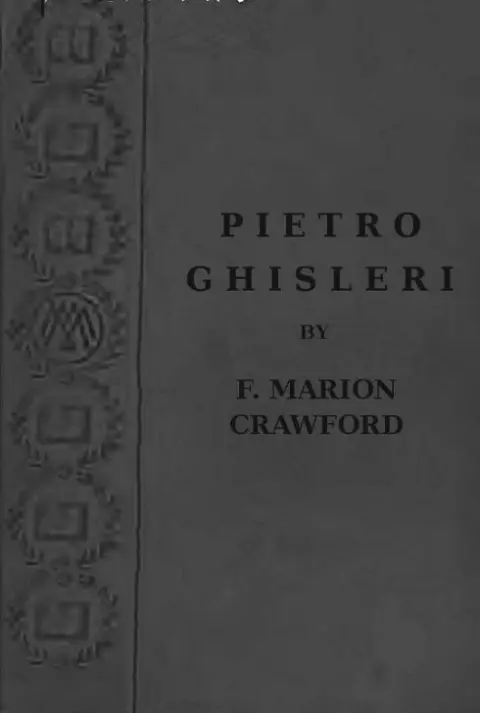
"Pietro Ghisleri" by F. Marion Crawford is a novel written in the late 19th century. The story revolves around complex relationships between two step-sisters, Laura Carlyon and Adele Braccio, in the context of a Roman high-society backdrop, exploring themes of love, jealousy, and social dynamics. The narrative delves into the intricacies of their family life, including the interests of their parents and the young men in their circle, particularly focusing on the attention that each step-sister garners in society. The opening of the novel introduces the family dynamics between the step-sisters and their parents, particularly the Honourable Mrs. Carlyon and Prince Gerano. Laura, who is described as beautiful yet without a dowry, and Adele, an heiress who is lively and somewhat vain, grow up with contrasting personalities and ambitions. As their stories unfold, romantic tensions arise, especially regarding Don Francesco Savelli, who is intended for Adele but finds himself attracted to Laura instead. This leads to jealousy and rivalry, setting the stage for deeper conflicts and emotional developments further along in the story. In this initial chapter, readers sense the societal pressures and personal struggles that will define the relationships at play.
Introduction adapted from the source catalogue; source summaries may be automatically generated.
Free to read · English · 153,334 words · No account needed
MAKE TIME FOR A GOOD BOOK
On by default. Untick to stop anonymous reading totals. Each page counts after 10 seconds in view. How this works.
Anonymous counting is on unless you have switched it off.
"Oh, no! But it will be gone very soon. I am quieter when I know I have taken the morphia. Of course," she said, with a forced laugh, "you must not suppose that I take it often, not even every day. I believe it is very bad in large quantities."
"Of course." Ghisleri could hardly help smiling at the poor attempt to disclaim any slavery to the fatal drug, contradicting, as it did, what she had said but a moment before.
For the third time since Arden's death the conviction came upon him that Adele had been the responsible cause of it, and this time it was destined to be permanent. The theory of coincidence was exhausted, and he abandoned it. The stories he had told her about Professor Wüsterschinder, the great German authority, were quite true, and Ghisleri's eyes had been opened on the previous evening to the possibilities of evil disclosed by modern science. He was not yet sure of what Adele had done, but he was convinced that the general nature of the process she had employed to communicate the fever to Arden was similar to those which the professor had described, and that she must, in all probability, have got the necessary information from a scientific book or article on the subject, which she had either procured expressly, or which had perhaps fallen under her eyes by chance.
She, on her part, had been desperately frightened, as she had good cause to be, for it was almost inconceivable to her that he could have accidentally gone so near the mark as he was going when her cry had stopped him. She felt that if he had pronounced the next half a dozen words, she must have gone mad there and then in the drawing-room where she sat, and she had instinctively prevented him proceeding any further. Then in the convulsion of terror she felt, she had resorted to her sole comforter, the morphia, and it had not played her false. In a short time its influence was at work and indeed the mere act of taking it was in itself soothing in the extreme. She felt herself growing calm again and more able to face the new difficulties and terrors that had arisen in her path. And they were many. She had no doubt now that Ghisleri had either read the lost confession or had spoken with some one who had. It was appalling to think that in that very room there might be a score of persons who knew what that letter contained as well as he. The morphia helped her wonderfully. But it was clear that Ghisleri had her in his power. An idea flashed across her mind. It was so simple that she wondered how she had not thought of it before. The letter had really fallen to the bottom of the shaft. Ghisleri, interested perhaps in the story of Paolo Braccio, had strolled down to the dungeon again by himself and had seen the paper lying there. In that case he alone knew of its existence or of its contents, besides herself and Lucia. The thought was so agreeable, compared with the alternative of supposing that all society knew the details of her evil deeds, that she clung to it. Then she looked at the man who, as she supposed, had power to dispose of her existence at his pleasure, and she wondered whether he had a price. All men had, she had heard. But as it seemed to her now, this particular man would not be like the generality, or else the price he would set on her letter would be of the kind which she could not possibly pay, because she would never be able to obtain for him what he might want. The feeling she had known in the first months of her torment returned upon her now, and very strongly--the awful feeling of degradation compared even with the worst of the people she knew. In her eyes, Ghisleri, with all his misdeeds, seemed a being of superior purity and goodness. He had never done what she had done, nor anything approaching to it in the most distant way. He had faced men in fair fight, and hurt them, and been almost mortally hurt himself, but he had never stabbed an enemy in the back nor dealt a blow in the dark. He had loved more than one woman, and had been loved in return, but no one had ever hinted that a woman's confidence had passed his lips, nor that he had ever spoken lightly of any woman's good name. If he had done evil, he had done it fairly, defiantly, above board, and in the light of day. Adele envied him with all her heart as he sat there beside her, confident in his own honourable reputation--as honour is reckoned in the world--and free to go and to come and to do what seemed good in his own eyes without a second thought of the consequences or the least fear of betraying himself. There was not at that moment one person in the room with whom she would not have been only too glad to exchange places, station, fortune, name, reputation--everything. And she fancied Ghisleri knew it, as indeed he almost did, and she feared to meet his eyes.
Your reading position is saved on this browser. Take it to another device with a library code. Reading pages adapt to text, rather than matching a printed edition.
F. Marion (Francis Marion) Crawford
F. Marion (Francis Marion) Crawford

F. Marion (Francis Marion) Crawford

F. Marion (Francis Marion) Crawford
BEHIND THE BOOK
This eBook is for the use of anyone anywhere in the United States and most other parts of the world at no cost and with almost no restrictions whatsoever. You may copy it, give it away or re-use it under the terms of the Project Gutenberg License included with this eBook or online at www.gutenberg.org. If you are not located in the United States, you will have to check the laws of the country where you are located before using this eBook. Read the source licence.
The original source file, including credits and licence, is retained by this library. Request an original-format copy at no charge. Please include the book title and Project Gutenberg identifier #40922.
KEEP YOUR CURIOSITY GOING
Coulson Kernahan

Maurice Baring
Frances Wright
Cécile Tormay

Frederic Jesup Stimson

W. H. P. (William Henry Pope) Jarvis